

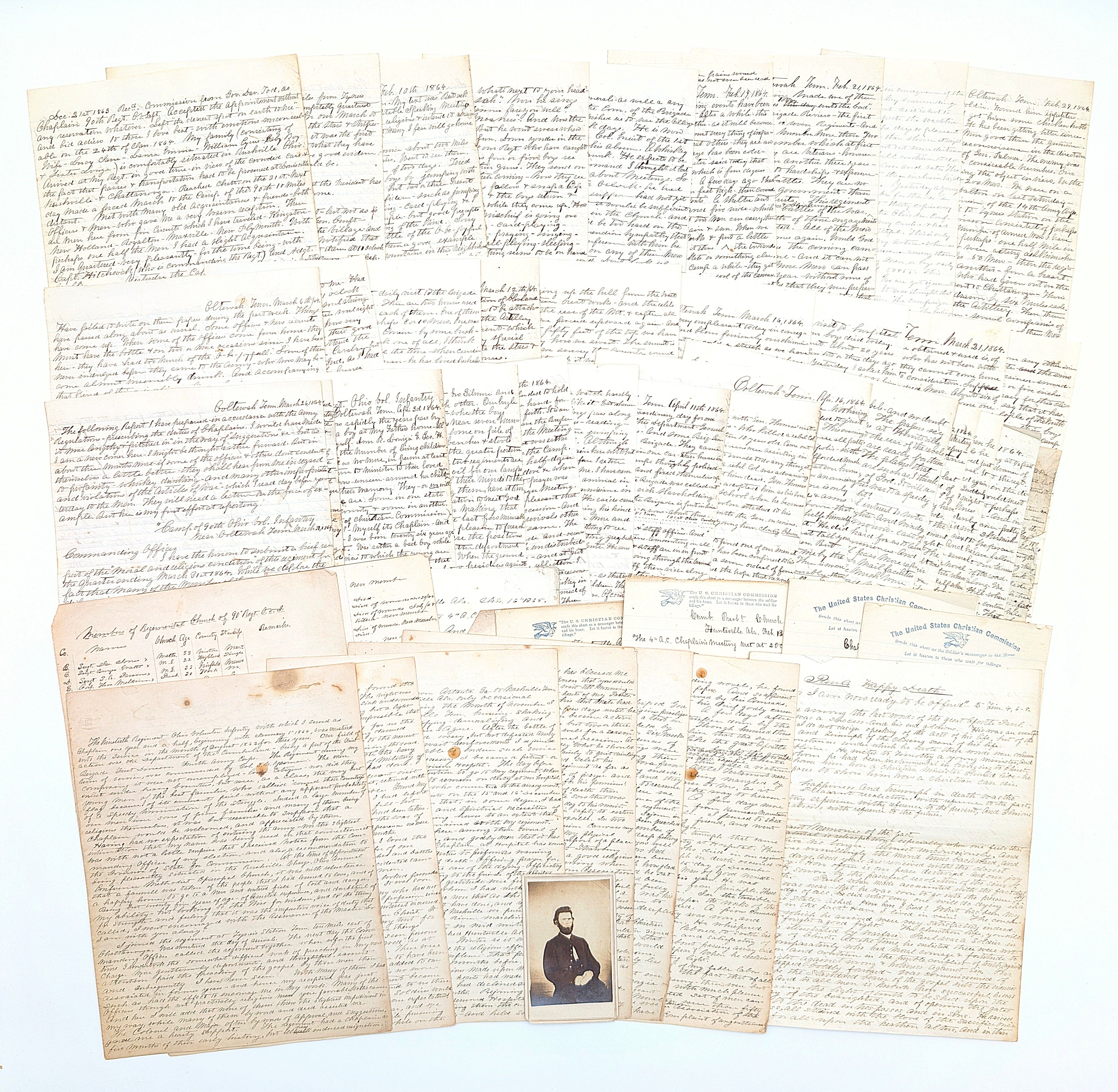

Military chaplain's diary and archive of Civil War service in Tennessee, Georgia, and Alabama, 1863-65
Holliday, William Christopher
- Date: 1864
- Seller SKU: 335
Archive of the Civil War service of Methodist Episcopal minister William Christopher Holliday, serving as chaplain for the 90th Ohio Infantry Regiment from the time of his enlistment in December 1863 shortly after the conclusion of the Chattanooga campaign and through the rest of the duration of the war. In its entirety, the archive consists of:
-64 page epistolary diary, February 3 - May 10, 1864, with the first two pages beginning retrospectively from the time of his enlistment in December 1863.
-2 page list of members of the regimental church, with their individual denominations, and a column of remarks which notes new church members and "reclaimed".
-10 page recollection of his service, likely written in the decades following the war, approximately 4000 words.
-6 sheets, some multipage, of notes taken during a series of Union chaplain's meetings in Huntsville, Alabama, January 16-February 27, 1865, four on U. S. Christian Commission printed letterhead.
-4 page manuscript sermon "Paul's Happy Death", likely written during his war service.
-3 sheets of undated sermons and theological notes.
-CDV photographic portrait of Holliday with later identifying note to reverse.
William C. Holliday (1838-1921) was born and raised in Ohio as the son of a Methodist preacher; he experienced conversion at a young age, joining the Ohio Conference at 17, ordained a deacon at 19, and an elder at 21, serving as a circuit rider in the few years prior to his enlistment as chaplain to the 90th Ohio. The archive is highlighted by Holliday's highly detailed epistolary diary recording the first four months of his service with the regiment, largely in and around Ooltewah, Tennessee, and concluding with his firsthand account of the skirmishing at Tunnel Hill, Georgia, coming to approximately 30,000 words and presenting an exceptional account of his work as a war chaplain, describing his efforts to increase morale as well as morals among the troops, and recording the shocking scenes of desolation left by the war. In his first entry, he writes in part:
War is not only a necessity - but a terrible calamity. The destruction of property is great. One in civil life in the North cannot form a correct idea of this. All along the roads are broken down wagons - smashed up Rail Road cars - Ashes of burned houses - scarsely any fence rails - Many acres of valuable timber cut down - beautiful plains + valleys all dug up for the purpose of entrenchment + fortifications - And then the dead mules + horse! It is almost incredible. Between Bridgeport + Chatt. (about 30 miles) there are thousands of them. Some have estimated the number at 10,000. The living mules + horse are nearly starved - the mean of transportation are insufficient: they have nothing but grain to eat. But what is this to the loss of human life. In and around Chatt. are thousands of men made graves. They give some idea of the horrors of war. At Murfresburogh are buried two thousand heroes. At Chickamauga perhaps as many more - and they are scattered along on every road - and near every camp. All honour to the heroic dead. Peace to their ashes. Let them be embalmed in the memory of the good. They - like our Divine Redeemer have died that we might live.
Shortly after this, on February 7th, he provides an account of some of the first services he holds for the soldiers as well as locals:
Yesterday evening sent for by Gen. Cruft - Reported. He said there was a church in the village and wished me to occupy it. We had the citizens notified that they would be welcome also. I preached to them 10 oclock. Hold probably 400 or 500 people. This afternoon the Chap. of the 81st Ind. V. Inft. (Methodist) preached magnificent sermon from "They that wait upon the Lord: &c. Pointed - plain -powerful - just such as one would think ought to do the soldiers good. The house was full to overflowing. Our soldiers behave as splendidly in church as on the Battle field. Not a whisper to be heard - God bless our soldiers. Many of them were faithful church goers at home. Some of the soldiers are very rough. Here is a little instance - As I was coming from church this afternoon - some soldiers were behind - talking about the sermon. One remarked that the sermon this afternoon was good - "Yes" said another "but the sermon this forenoon beat it all to (hell)." In the congregation today was an old citizen who gives good evidence of loyalty. The rebels took his cattle - horses - corn &c said the great mass of the people are truly loyal. "But" said I "What did you do when the rebels were here?" "Oh, we just crawfished a little." He said they had conscripted one of his sons + great many others.
He writes of how his youth and zeal for the church aid him in attempting to sway the soldiers from drinking, gambling, and swearing, by substituting vigorous activity, of which he joins in:
Many of the boys are religious + intend to remain so. They desire to go home better men. But many I fear will go home morally wrecked.
Three of our companions are on detached service - about two miles distant guarding a gap in the mountains. Went to see them. Seemed glad to see me after an absence of two days. Tried to get into the favour of some of the boys by jumping with them - and by the way beat all of them but two or three. I resort to various measures to gain their confidence - such as jump + Ball playing. But whiskey drinking - card-playing &c I not only give the boys a good example - but good precepts also. Positively disapprove of any thing of the kind. Sorry to hear that my predecessor took a little of the O-be-joyful with the men instead of giving them a good example.
In his efforts to provide a strong moral example, he also records - with a mixture of fascination and disgust - the sex lives of the soldiers, writing of known instances of bigamy as well as the common practice of hiring of sex workers in the larger towns and cities:
Among the many evils in the army - the marrying of soldiers with the natives - is not by any menas the least - and yet it is not an uncommon occurence. One Chaplain in this Brigade has married two couples - and was called upon to marry another the other day - but declined. The last marriage was about as follows. The man is a soldier on detached duty - teamster - he has had two wives - one of whom is still living. She (the bride) has a husband - who is said to be a prisoner at Camp Chase. She claims that he is ead. Of course they had no license from the courts as the land is not in the hands of the civil authorities. And they had no military license - as the commanding officer refused to grant it. So the minister takes the responsibility upon himself - a fearful responsibility in my opinion. What is it but giving license to Licentiousness - Authorizing [...] - and illegal - marriages. Whoever comes to me will hear from me on the subject. This - as before stated - is not an unfrequent occurence. They marry for a few weeks and while the Army remains - and then leave them to their sorrow or - joy. It is said that at Louisville + Nashville it is very common for men - especially officers - to make arrangements with the women of the town - to live or board at Hotels a few weeks - then "break ranks" - and return to their regiments.Write home that they cant get leave of absence - and thus deceive their wives + families. It is said that two of our men were married some time since.
He is especially incensed by the behavior of officers in this regard:
It is said that there are five thousand lewd women in Nashville. Nashville is perhaps as large a City as Columbus. About one year ago - Gen. Rosencrans issued an order - to send all such out of Nashville - they were put on Steamboats + sent up to Cincinnati when the Authorities there very wisely refused to let the boats land - and they were finally sent back to Nashville. It is an awful - shameful - fact that many men who are thought to be respectable at home often visit Nashville + other points for the purpose of attending these houses of ill fame. About three days since there were a couple of strumpets put off of the cars at the depot here. They are called Mexican women - part Indian - but they look to me like mulatoes. No sooner were they put off of the cars, that some soldiers inquired their destination &c, and engaged them a room in a house in the village - passed them off on an old simple-headed-fool, as his wife + sister-in-law. The other day I was visiting the hospitals there - when some degraded soldiers were there - there came the Col. of the 2d Ky. Regt. + two more Officers and they must go + see the Ladies. Then the little dogs had to stand off, when big dogs come around. They will not certainly be allowed to remain there - as they were driven out of Cleveland a few days since. You may form some idea of the moral + physical wrecks in the Army. Such looseness can be found all through this country. Some men boast of their licentiousness. A Lieutenant in this Brigade told me that he had been through all the bad houses from here to Louisville - three hundred miles. He seems to glory in his shame. That same miserable scamp is a member of the Methodist Church in Indiana - and when he goes home passes himself off as a religious man... I knew nothing of fallen humanity until I came into the army. What I have written on this page of course is not for the public eye or ear.
By contrast, he provides accounts of his efforts to hold camp meeting-style revivals among the troops:
Concluded to hold a Prayer-Meeting. Dont announce our Meetings before hand - for we know not what a day - or even an hour will bring forth. It is an easy matter to get an appointment out - just have the Bugler make the Church Call - + in three minutes after the Meeting is published we are at it. This evening the prospect was rather discouraging - there was a tremendous big dance in the Camp. Some of the brethren feared we would fail - but a half-dozen of us began to sing - "Come Holy Spirit heavenly dove" &c when the boys began to gather around + before the first prayer was ended the fiddle stopped + nearly all came to prayer meeting. I told them that when the weather became more pleasant that we would have Meetings several nights in succession - and exhorted them to pray for a revival - that there were revivals other places in the Army - and that we would seek the same. The Col. suggested the propriety of having seats made and - occupy - a grove near our Camp - where we would be undisturbed. No doubt he made the suggestion in kindness - and at first thought - I concluded to do so - but after some reflection - I have come to the conclusion that I wont do it for two reasons - 1st The men swear - dance - play cards + drink whiskey in Camp - and it would look as though we were ashamed of our religion - + had to take it out side. And, 2dly there will be a better attendance in the Camp. It would be giving the devil a fine opportunity to fiddle + dance - here while we would go + pray yonder. And more - the Officers would not go outside of the Camp to Meeting - whereas they have to hear or see in Camp - even if they do not attend... Our Meetings are better attended than when I came which I look upon as a very favorable indication. I do not either in my conversation or preaching talk harshly - but in pity - + with Christian sympathy try to do them good.
After spending months in camp at Ooltewah, he records the first days of the Atlanta campaign as the regiment moves into Georgia, and provides a vivid account of the multiple days of skirmishing at Tunnel Hill, prior to the Battle of Resaca:
Yesterday evening we recd. orders to move in the morning at 1/2 past four. The Officers were told that this was to be a general advance of the Army. Thinking it very appropriate I preached to the regt. Nearly all attended. At day light we started in the direction of Tunnel Hill. It was expected that we would meet with considerable resistance. We had not gone but perhaps one mile when we met Gens. Howard - Stanley - and indeed all of this Corps. Our Brigade has the advance - pretty soon we hear guns discharging - Bang - bang - bang. Skirmishers firing upon each other. The rebels fall back rapidly - we proceed onward - as rapidly as the roads will allow. They have fallen trees all along the road to prevent our advance - but our Pioneers with axes + other implements are cutting the trees out of the road or making new ones - so that the Artillery can get along. We proceed on until we get within two miles of Tunnel Hill - where the Column is formed in line of battle. The Skirmishers continue their firing upon each other. But here comes the Artillery. That will bring them to their senses. And here comes General Howard + Staff. They ride rapidly to the front. The Artillery is put in position - and they let the rebels have it on tunnel hill. They reply - but their shells do not reach us - we make them skedaddle. About noon the word passed around that the enemy has fallen back from the Hill. We move forward - and think that probably we will be the first on the Hill - but when we get within sight we see the Hill almost covered with troops. This is called T. Hill - because of a deep + long tunnel under the hill - on the railroad from Chattanooga to Dalton. We are seven miles from Dalton + the same from where we came today. The loss so far as I heard in our Corps, was one man shot in leg while Skirmishing - not dangerously. There is a village at the foot of the hill - of probably a dozen or fifteen houses - nearly all vacated. The Country here is very Mountainous, and rocky. On one of the highest hills is a rebel signal station. They see all of our proceedings - and are signaling with Flags, to the rebels probably at Dalton. Our Signal Officer understands their signs - and all over the hill they are looking through their Field glasses + noting down the result. As soon as the Artillery got on the hill it was put in position and the rebels about two miles off seen - Boom - boom - went the old cannon - Whiz whiz went the Shells through the air and bursts in their midst. Mercy how they run. While I have been writing this some Cavalry came within sight - when the Cannon just above me gave them several salutes. They could be seen carrying off one man from the field. We are lying here on a side hill so steep that we will have to straddle a stump to keep from going down the hill. Gens. Sherman - Thomas - Palmer + others arrived here a short time ago. This gives encouragement to the men. They have confidence in their Commanders. You may be anxious to know how I felt to-day - I answer Just I expected. I had anticipated the feeling I would have. I felt as cool as a cucumber. Somehow the firing of these guns especially the artillery sounds kind of Musical. God be thanked for the achievements of this day!
While I write skirmishing is actively going on and the Ambulances are going to + fro carrying back the wounded. Quite a number have been killed. One was wounded in our regiment this morning. It now appears that we do not want to take this Mountain just now - but are making these demonstrations to attract the attention of the enemy - while Gens. Mc Ferson + Hooker come upon the right flank + Scofield on the left. We hear Cannonading on the right + left - and it is possible that we may bag a good many of them. From where we are to the hill is less than one half mile. Their Sharp Shooters are shooting at us all the time. The bullets occasionally fall around us. The railroad is finished up to this point. It advances as fast as the army. While I write - besides the music of Hostile guns Brass bands are playing. Music never had a sweeter charm - nor ever produced more devotional feelings - + gratitude than this morning when before day light two brass bands struck up, "Hail Columbia" &c. I felt grateful to God that I was an American Citizen + Chap. in Army. This is a hard country to fight over - great gaps in the Mountain which have to be flanked. For one to look on this valley now but few troops could be discovered as they are lying down behind the trees + thickets. But they are as thick as hops. The rebels must have fallen back from Tunnel hill in a great hurry as they did not destroy the track - nor disturb the Tunnel. A few hours may develop the strategy of this Campaign. We are confident of success.
In addition to his contemporary account of camp life and his first experiences of battle, the archive also includes a series of handwritten minutes of meetings of military chaplains held in Huntsville, Alabama, in early 1865; a list of church members of the regiment and their denominational affiliation; a full sermon, likely of war date, as well some other theological notes; and a ten page, approximately 4,000 word retrospective account of his war service.
While Civil War archives are fairly common, those belonging to military chaplains from the period are far scarcer. Holliday's journal of his first few months in service are of particular interest, providing a lengthy, detailed, and energetic account of a young Methodist Reverend joining the Union cause, full of patriotism and religious zeal, but also keen-eyed, observant, and humble in the difficulty of his task. Among his entries in the journal are a series of rules he establishes for success as a military chaplain, writing:
The qualifications for a successful chaplain are the following. 1st. A good religious - Christian man - one who is not ashamed of his religion any where. 2d. A good degree of common sense -(the very kind that the world needs) 3d. Good social qualities. His place is in the Hospitals, and among the boys - as much as possible. If the boys wont bera religious talk - talk about something else. Speak them every time you meet them. Make them feel that you are one of them. Never attempt to show off. They think there is a disposition on the part of Officers to act as though they were made of better clay than the private. A chaplain need not expect to benefit officers muchs, for they "rank" him. And there is a great stress placed on rank in the Army. Some of the Officers have common courtesy to hear you with respect, while others would'nt know how if they were to try. 4th Indomitable perseverance. He must not wait for an opportunity to turn up - but turn up an opportunity. He is expected to lead off in all religious meetings - and in every other good enterprise. If he does not do it no one else will. Difficulties of various kinds will present themselves in the way, and it requires energy + perseverance to overcome them. Other things are necessary beside those referred to. It remains to be seen whether I am equal to the task.
Offered by Open Boat Booksellers


