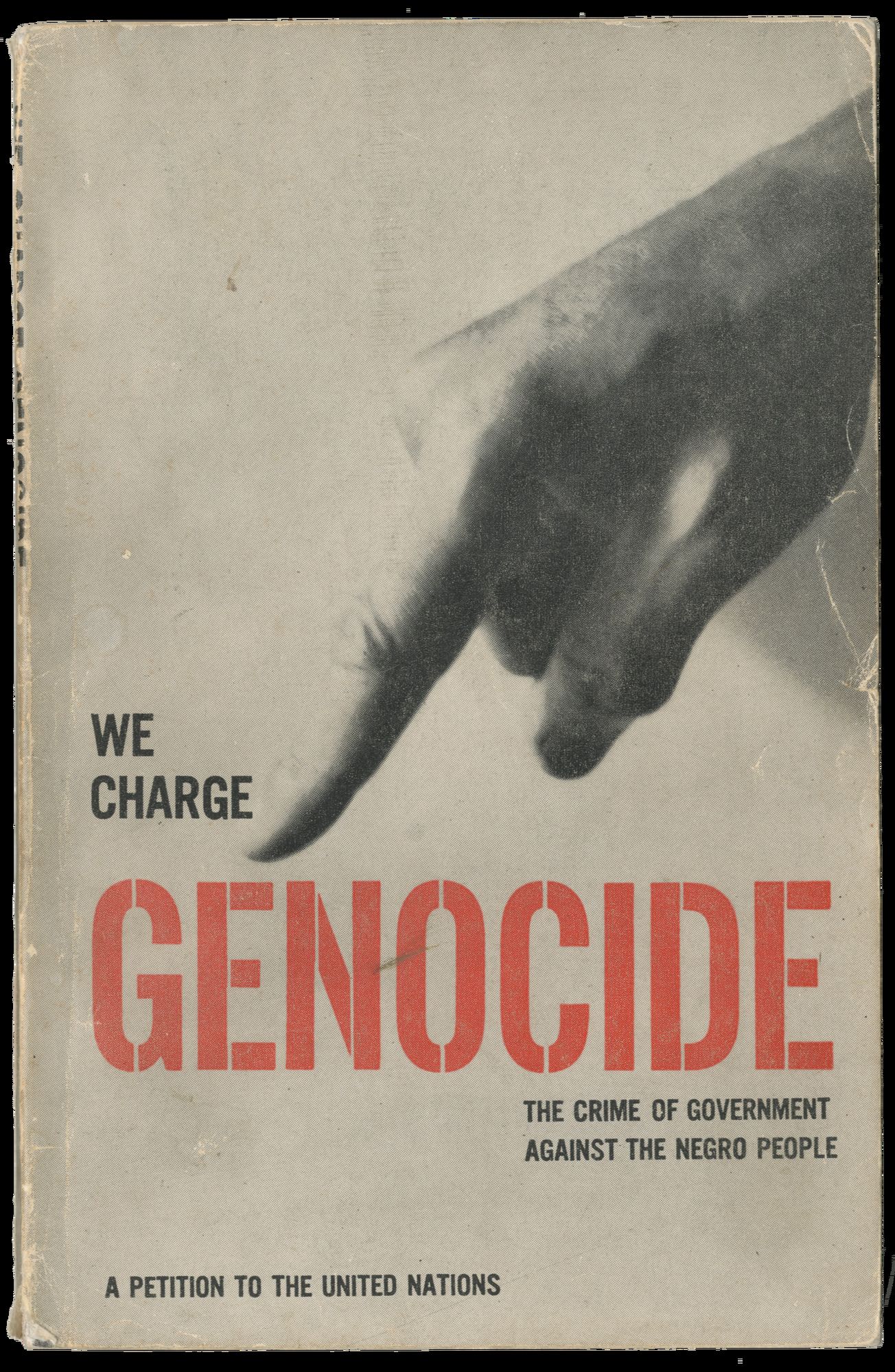
New York: Civil Rights Congress, 1952. 6 ¼ x 9 ¼ in. Third edition. Offset. Perfect bound in pictorial wraps. xiii, 240 pp. Very good, with bumping and minor loss to corners and edges of wraps. The groundbreaking petition delivered to the United Nations on December 17, 1951 and subsequently suppressed by the United States government. The petition was signed by nearly 100 activists and intellectuals, including W.E.B DuBois, civil rights attorney and later Congressmember George Crockett Jr., and Communist New York City Councilmember Ben Davis.
The authors carefully lay out the evidence that the United States government had perpetrated genocide on its Black citizens, citing the definition in the 1948 United Nations Convention on Genocide: "the intent to destroy in whole or in part a national, ethnical, racial or religious group." The book documents hundreds of cases of lynchings and "legal lynchings" by state police forces; voter suppression through poll taxes, literacy tests, and terrorism; and the violent exploitation of Black people by the leaders of capital.
We Charge Genocide was delivered to the UN on the same day in two separate delegations, one led by musician, actor, and activist Paul Robseon in New York, and the other in Paris, led by William L. Patterson, executive director of the Civil Rights Congress. Paul Robeson was accompanied by several signers of the petition including Amy Mallard, the widow of George Mallard who was lynched in 1948 for voting, and Josephine Gray, widow of one of the Martinsville Seven - a group of young Black men who received the death penalty for charges of sexual assault. W.E.B. DuBois had been scheduled to accompany William Patterson to Paris, but his travel had been denied by the State Department.
A large shipment of copies of the petition went missing in transit to Paris, supposedly seized by the United States government. Patterson was also forced to forfeit his passport and return to the United States in direct retaliation for the petition. Robeson's passport had already been denied because of his unwillingness to recant his activism during the McCarthy-led Red Scare. The United Nations General Assembly refused to take up the petition, following behind-the-scenes pressure from the United States on member nations. The state's persecution of the petition's most vocal proponents, along with the silence of the mainstream media, gave credence to accusations of censorship. However, contemporary reports indicate that the petition was widely read outside of the United States. It is worth noting that the United States would not ratify the UN genocide convention until 1987.
Concerned about distribution, the Civil Rights Congress printed only a small run of each edition; his third edition was printed only two months after the first edition.
A rare document of organized Black struggle against legal and extra-legal violence, oppression, and systemic exploitation.