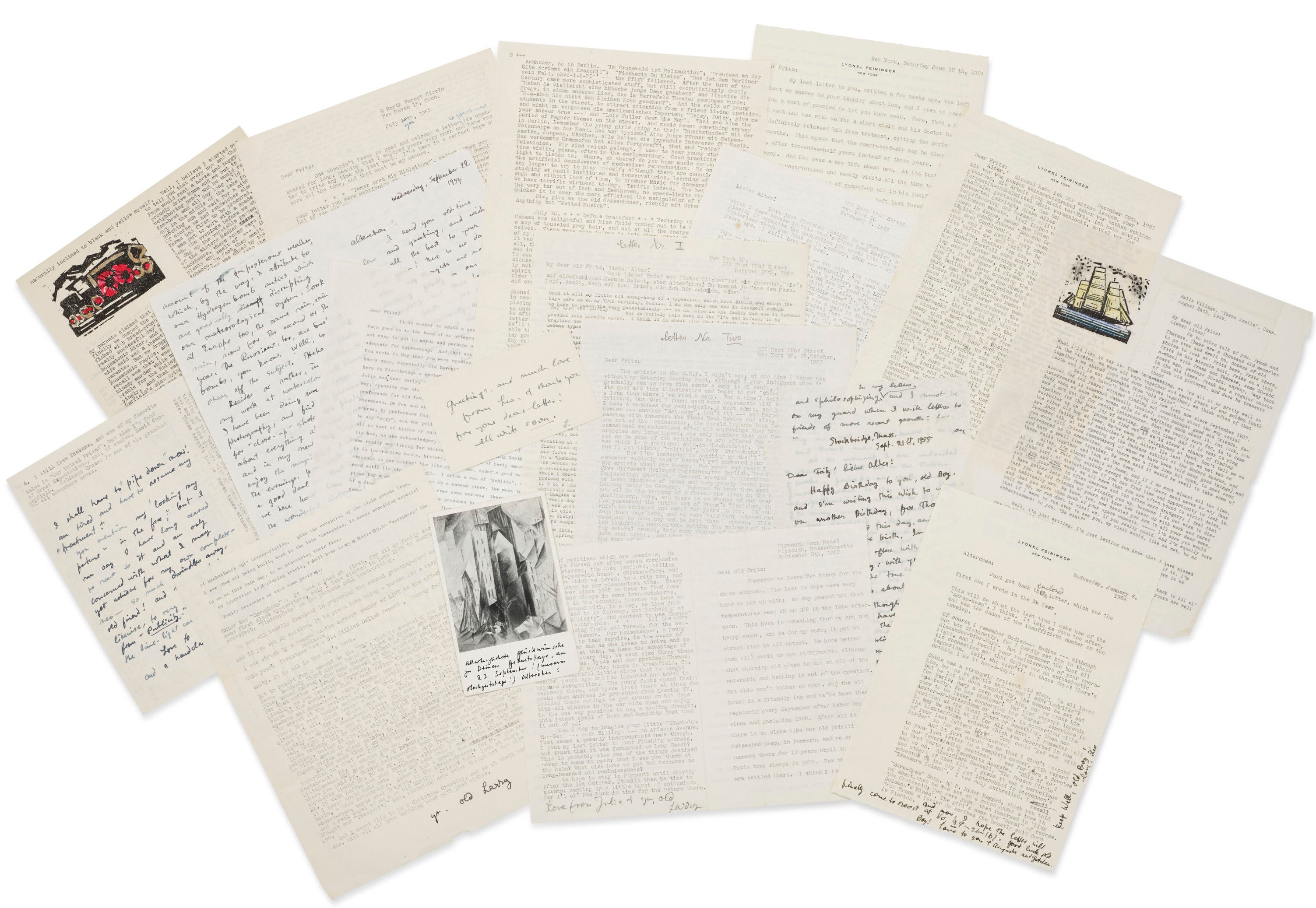
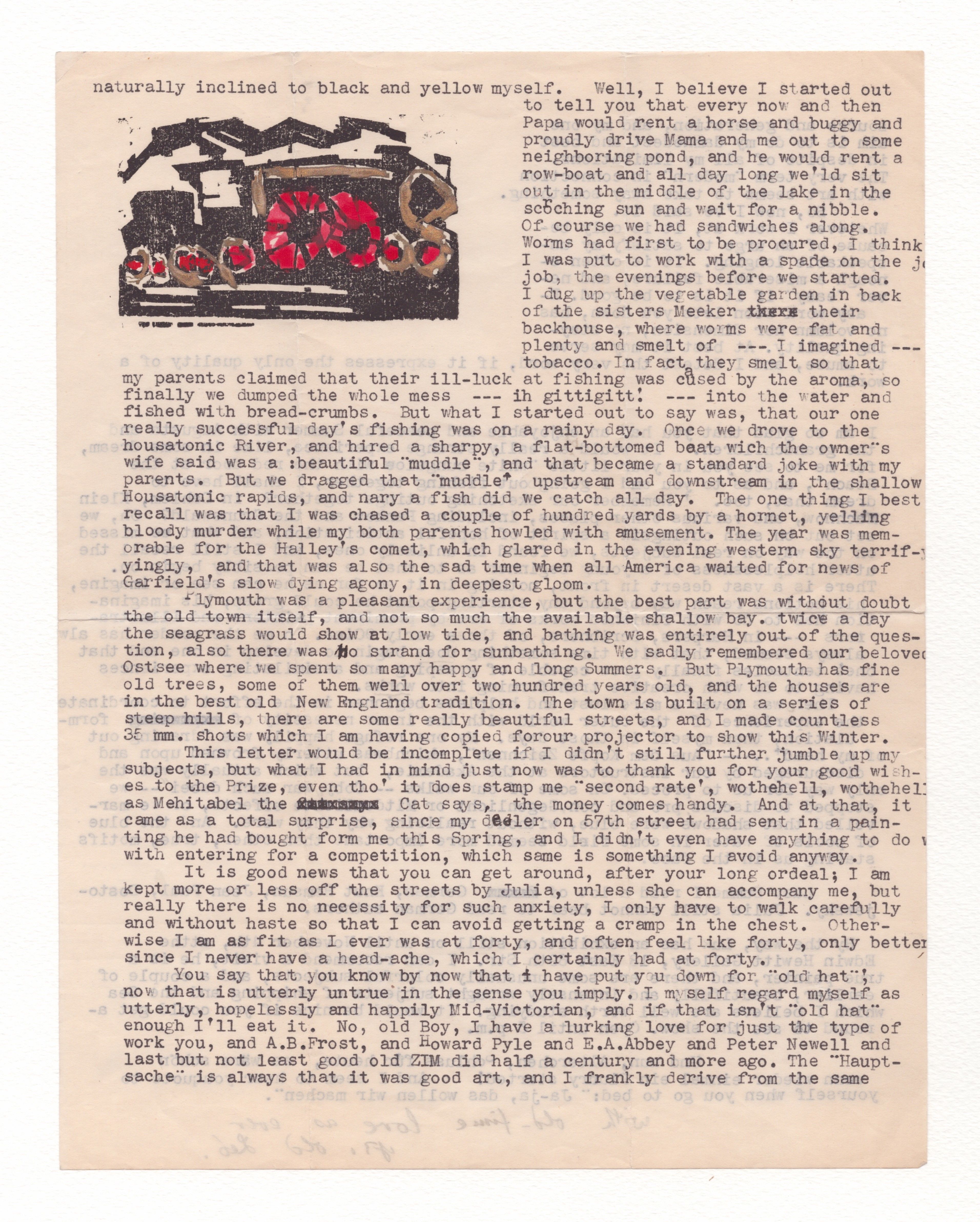
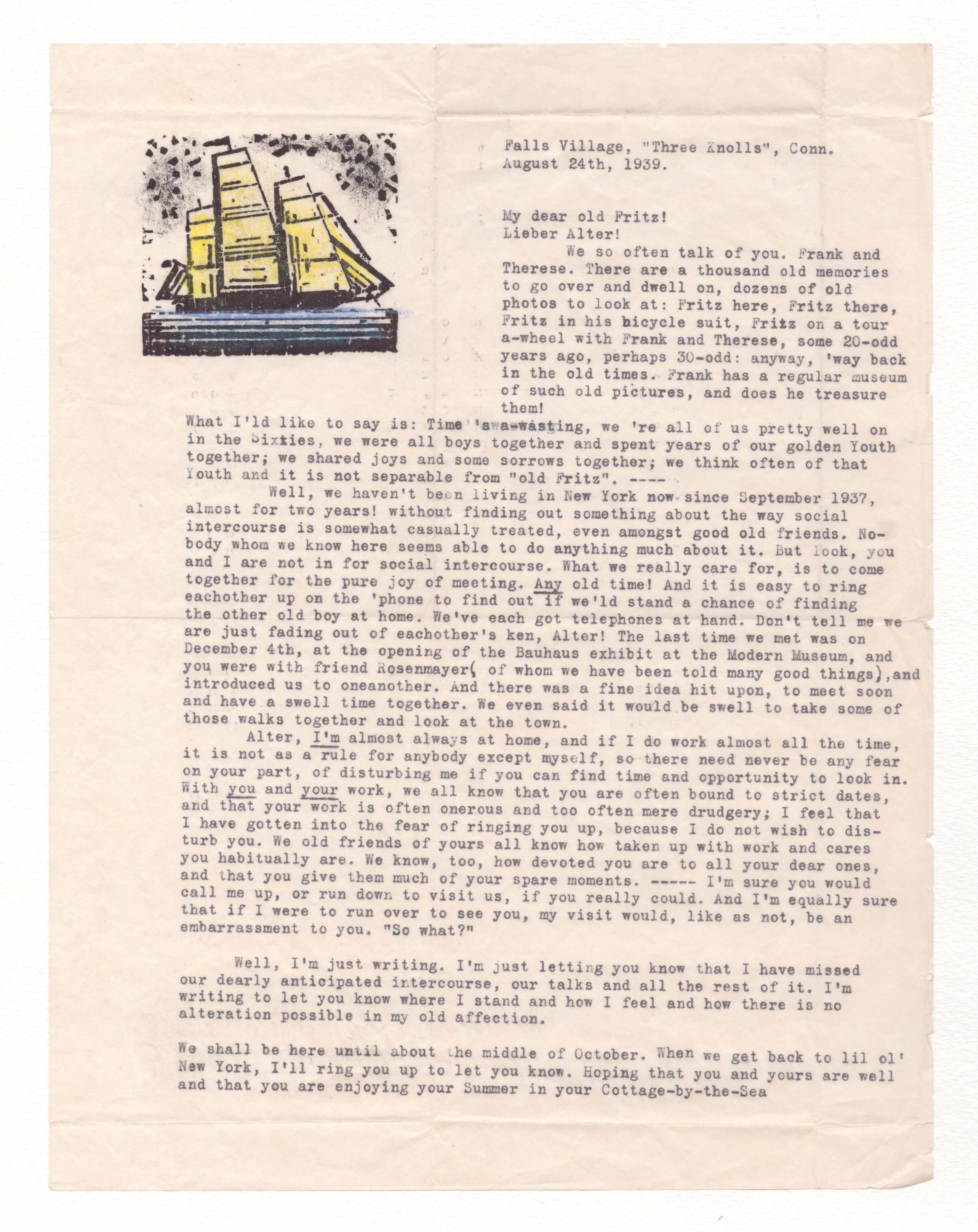
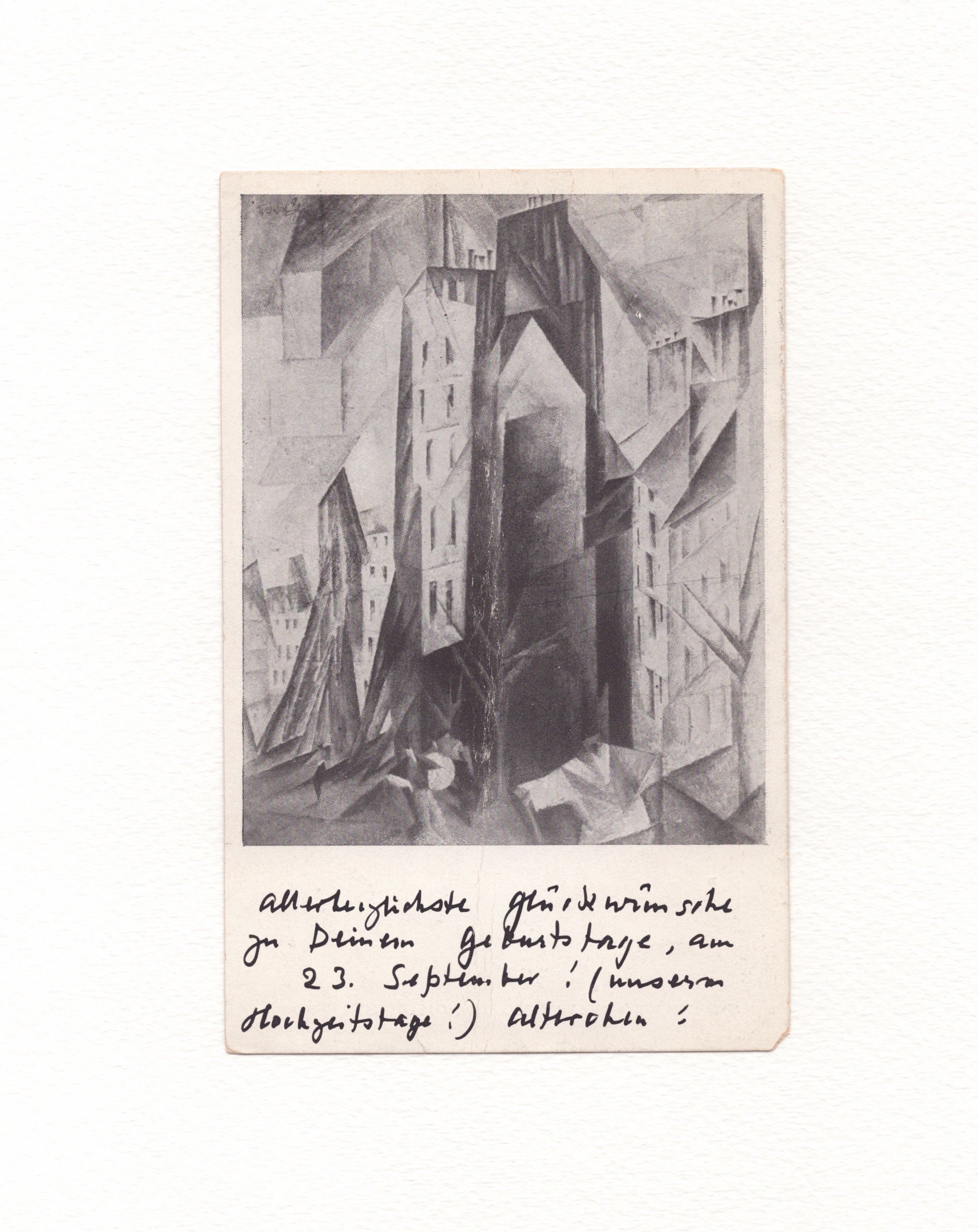
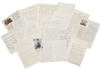
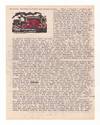
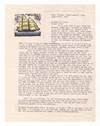
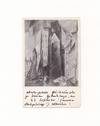
Thirteen complete letters, 1953-1955, mostly typewritten, totalling 36 pages; along with two partial letters with Feininger's color woodcuts to the top right corner, the first a single page of the beginning of a letter from August 24, 1939, with ship woodcut, and a double-sided undated sheet with a vibrantly hand-decorated woodcut of a locomotive; also included is a brief signed note, and a black-and-white postcard of Feininger's painting Hohe Häuser II (Gemälde) with Feininger's handwritten note below the image.
Most of the letters are signed by Feininger with his nicknames "Leo" and "Larry" and addressed to "Fritz" - fellow Berlin-trained artist Frederick Strothmann - who Feininger befriended while studying at the Königliche Kunstschule, and became close with again following his exile to the United States in 1936. Taken together, the letters provide a fascinating window into Feininger's thoughts and preoccupations primarily during the last two years of his life.
While often focused on the past - his boyhood in Connecticut and New York, and his student days in Berlin, in particular - these memories are much more than sentimental reminiscences, with the details provided being sharp and aesthetically charged and grounded in Feininger's philosophical engagement with art and Nature, form and content, color and spirit, demonstrating that he continued grappling with these same themes through the final weeks of his life. At the end of one of the letter fragments, presumably written in 1942, the year of his receiving a purchase prize from the Metropolitan Museum of Art, he describes his education in Berlin:
Remember our sketching outings together? in Dahlem, Klein Machnow, and various other places, including Pankow and the Grunewald? Oh, we set out on such outings in a spirit of hopeful anticipation, and what we missed on the way on real subjects, we found in unlikely ones, and I still recall the utter helplessness of a young beginner as to what he can possibly begin on. There is a vast desert in front, nothing in it so far as he can see or imagine, his notions reach way beyond any starting-point he could grasp; his imagination has to do with finished works of art by prominent painters and illustrators --- in Harpers, Scribners, of those early 90ies. To me the wonder has always seemed, that with time something does begin to develop in one and that one's tentacles finally grow capable of grasping and assimilating experiences having to do with creative transforming into works.
There was never a more lost and helpless beginner in the effort to coordinate the experience of the outer world with the inner necessity of formulation, than myself in those days. My one refuge happily was "drawing out of my head" --- "Aus dem Kopfe Zeichnen", which was utterly frowned upon and discouraged by our instructors at the Akademie, but which actually was the only way for us to proced. On some of our walks -- Coby "war auch dabei" -- we stopped to discuss, pro and con, Gegenlicht or Mitdemlichte effects, or we marvelled that shadows were blue, without realising why they were. And the blue of pools of water in some field seemed more important than other, true, motifs staring us in the face.
From one of his letters written in 1953, he writes of his experience with the fog of Berlin during his student days, the sensory and perceptual effects of which are clearly reflected in his own later paintings, particularly those from the Baltic shore of Ostsee:
Do you, perchance, remember those Winter mornings in old Berlin, when a yellowish fog lay over the scene, snow lay everywhere on the streets and roofs, from whence it gleamed through the dark air? God, Sir, how I used to love crossing the Gensd'armenmarkt, with its two big buildings of the Opernhaus and the Staatstheater in the murk, and those big cupolas high up in the Dunst, with snowflakes falling sparsely across the view in a promise of more soon to come? Oh blessed memory. There were etchings by a famous Berlin Radierer whose name I can't remember at this moment, ---- which reproduced the effect I've just tried to describe. In the mornings, twice a week, I accompanied Fred Werner --- this was in the Winter 1889-90 --- to the Klindworth-Scharwenka Musik-Akademie in the Markgraenstrasse. It was a Winter of much snow and cold, and fogs were sometimes so heavy that one could not see from einter Laterne bis zum Nächsten. The shadows cast by a Gaslaterne penetrated the fog in fan-shaped rays. I have such recollections of fogs in those years in the Nineties, up to to about 1896 or '7; after then, they became rarer. I remember one night, crossing the old Potsdamer-Brücke, I actually had to creep from one lantern to the next, which was at best only to be distinguished in a faint brownish glow twenty feet away. And I still recall the smell of those fogs. I'm sure you must have had the same impressions yourself. I incline occasionally to the luxury of closing me old peepers and fancying I'm back in the fog again, with the mysterious traffic --- not of cars, but of horse-drawn wagons, sounding muted in the heavy murk. And I remember the bob-tail horse-cars which plied to the hafenplatz about the Anhalter Bahnhof, the hoss struggling valiantly through snow one one of the inclines to the bridge over the Canal, until he got safely to the top and could slide down on the opposite declivity. I once made a drawing for the LUSTIGE BLAETTER of this scene, with the passengers leaving the bob-tail car and lending a helping hand, shoving through knee-deep snow and slush alonside and with outstretched arms pushing onwards.
He also frequently describes his photographic work, and just weeks before his death he details his decades-long photographic project recording the destruction of the New York elevated railway lines, culminating with the dismantling of the Third Avenue El in 1955:
Something fateful is happening, the Third Avenue "El" is disappearing, there only remain a row of truncated columns still standing in a diminishing perspective. And the most tormenting sight is the 23rd St. station, still perched up over the supports, and bared to the very ribs of the whilome "Swiss Chalet" housing. The girders of the express middle track still stands, truncated at both ends with a sheer drop of some thirty feet, on supports bereft of all diagonal strengthening, and haunting me with the idea that for some seventy years speedg train-loads of human beings were rush through what now is empty air. Can you get it? I made some camera shots of the remaining construction a few days ago. Suddenly the thought took possession of my Gemüth, that here was something of history being irrevocably enacted. and I now awaiting the results on the film with anxiety. Of the different "Els" I have made many snapshots in the '30ies and '4ies during their demolishing; but none will compare in drama with this last breaking up of the Aera of Manhattan's "El" transportation. With the exception of the Ninth Avenue line, I saw them all being built, back in the late 'Seventies. It means something especial to me at this late day, to be witnessing...
But to revert for a moment to the "EL", that is something you should have seen. Suddenly Third Avenue takes on light of Heaven and shows up as a fine, broad fairway; the same became evident of Second Avenue --- and Sixth for that matter -- after the removal of the overhead constructions. Originally, as you doubtless remember, the "El" were built on the sidewalks, close to the curbs, and didn't much darken the outlook. The two systems -- up-town and down-town, were attached and joined by light girders crossing the street at the position of the supporting columns. On the Bowery, where the road became suddenly very broad indeed, there were no transposed girders at all, which looked alarming to my young eyes. The Bowery was a fine part of town for me, there were the horsecar track of -- if I recollect rightly -- several down-town lines. The cars were a jolly sight: chinese red, bright yellow, and a hot plaid design on one line's carsides. I believe nothing did so much as these bright colors, to develop my love of painting, unless it was the sight, in the old Metropolitan Museum somewhere on Fifthe Avenu in the '70ies, of old X4-XV Century gothic old masters, figure pieces of clear colors, in ancient dresses and men's gay attire.
The above is only a partial sampling from these highly textured letters, where this mixture of past reflection and continual creation gives the present collection of letters both biographical and documentary value, providing details of Feininger's youth spent in New England and New York – complete with vivid descriptions of farmhouses, railroads, and ships – as well as insight into his artistic practice and the philosophical synthesis of German-American Romanticism and European modernism which he brought to his work.