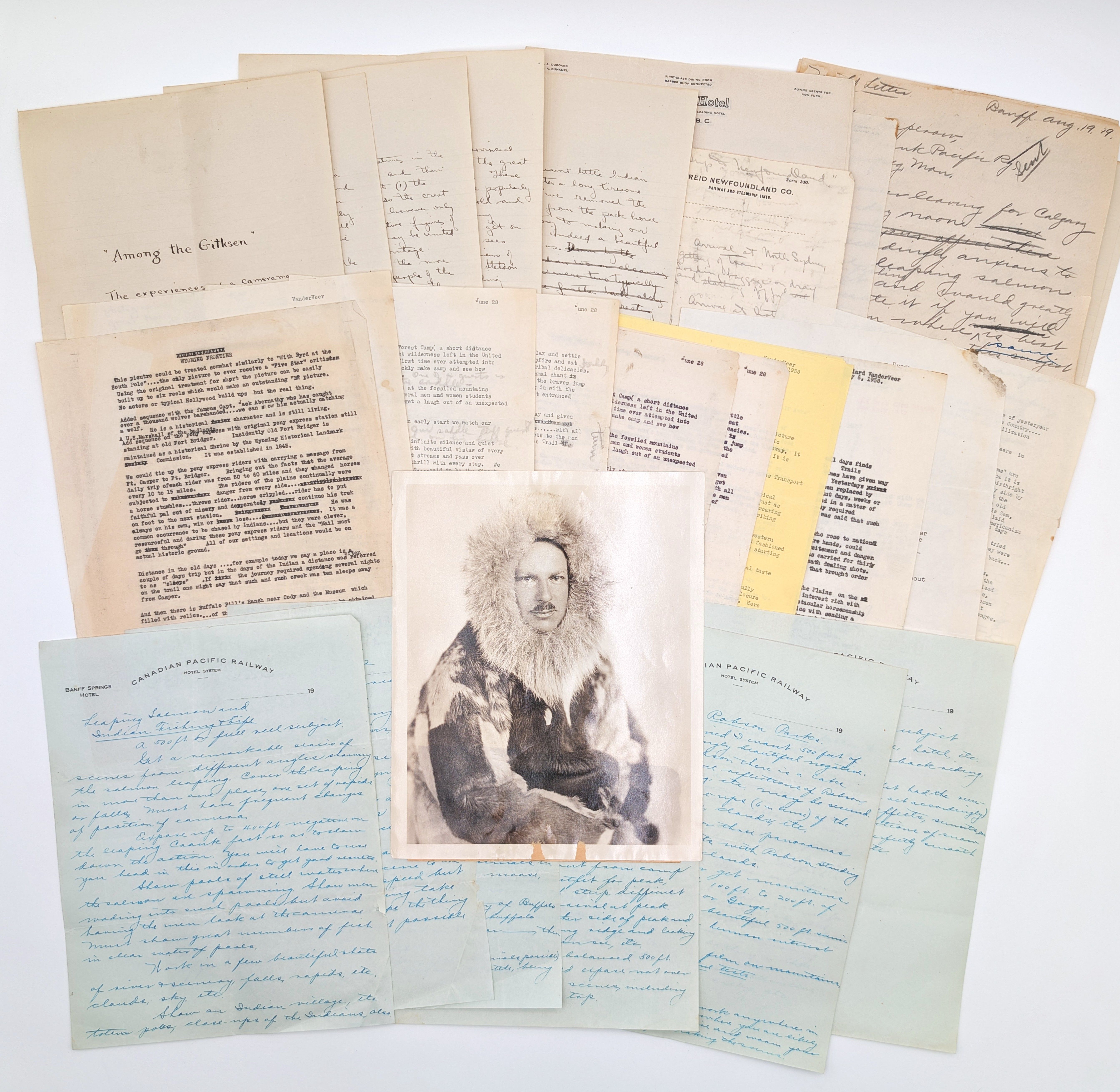
Archive of Willard Van der Veer, spanning two decades of his career, with a strong focus on his work with Native American and First Nations peoples, chronicling multiple projects, produced and unproduced, including for films that are now likely lost. Approximately 100 manuscript pages, both handwritten and in type, 1919-1938.
Willard Van der Veer (1894-1963) was a photographer with the Byrd Antarctic Expedition of 1928-1930. He started his career as a documentary cameraman and won an Academy Award for Best Cinematography at the 1930 Academy Awards for the film "With Byrd at the South Pole." Van der Veer was featured in a 1940 issue of "International Photographer," lauding him as a "producer, writer, director and cinematographer... virtually a one-man studio" with credits on about 500 major company pictures, a Local 659 special achievement award and a fellowship in the Royal Photographic Society of Great Britain.
The highlight of the collection is a group of papers related to a documentary Van der Veer was working on in 1919 called "Among the Gitksen" which told the "experiences of a cameraman photographing the Indians of the great Northwest in British Columbia." These include a five-page handwritten manuscript, as well as seven pages on Canadian Pacific Railway Banff Springs Hotel letterhead with detailed filming notes for scenes to be shot of "Leaping Salmon and Indian Fishing and Life," "Buffalo Park," "Ascent of Mt. Rundle," "Jasper and Mt. Robson Parks," "Lake Mayer" and "Lake Louise." There are three pages of Reid Newfoundland Co. Railway and Steamship Lines stationery holding manuscript notes for 16 scenes entitled "Our Trip to Newfoundland" and nine pages on letterhead for "Central British Columbia's Leading Omineca Hotel, giving detailed notes on the Hagwilget and Gitksen tribes, Totem poles and Native languages. This section also contains some miscellaneous notes by Van der Veer on filming and on the First Nations village of Kispiox, and autograph letters to and about Van der Veer from C.L. Chester.
Another portion of the collection is related to a series Van der Veer was working on in 1934: "Paramount Pictures presents The Bomb Squad in cooperation with the N.Y. Police Department." These include ten pages of autograph notes on Paramount Pictures letterhead about bombs and defusing them, as well as storyboard notes for the series. One page notably covers the "Police Horse," "Brought from Western Range via train... Broken to paddle in true Western style - Bronco Busting." One handwritten sheet of notes and eight typed pages describe bomb-related topics that would be covered, including criminal motives and detailed information on subjects ranging from "explosives" and "suspicious packages" to "blackmail" and "anonymous writings."
More material pertains to three other proposed documentaries for Paramount Pictures. These include a one page typed synopsis of "We Americans," "a series of pictures which should show the romance of yesteryear in each of the United States or specific sections of the Country..." Van der Veer posits: "Americanism is being threatened on every side by Fascism, Communism, Nazism, Bolshevism and today we find that the original Americans, the Indians, are carrying on in the old traditions of centuries past..." Nine typed pages are ideas and synopses for "Wyoming Frontier": "this picture could be treated somewhat similarly to 'With Byrd at the South Pole'." Van der Veer provides scenes set in various places in Wyoming, with numerous handwritten corrections and additions. One page reveals a line, "Cowboys, Indians N Everything" above the title but it is crossed out in pencil. There is also a one-page typed manuscript titled "Added Sequences for Build Up of The Trail to Yesterday": "Historic heritage handed down from the trail days finds perfect accent in this story of Wyoming Frontier." The papers also contain a letter on Paramount Pictures letterhead from Leslie Roush regarding shooting the ideas in script form.
The remainder of the collection contains miscellaneous scripts, episodes and outlines, as well as a press photograph of Van der Veer in a parka as the movie operator on the Byrd Expedition, dated September 5, 1928.