This item is currently on reserve; please contact dealer for more details.
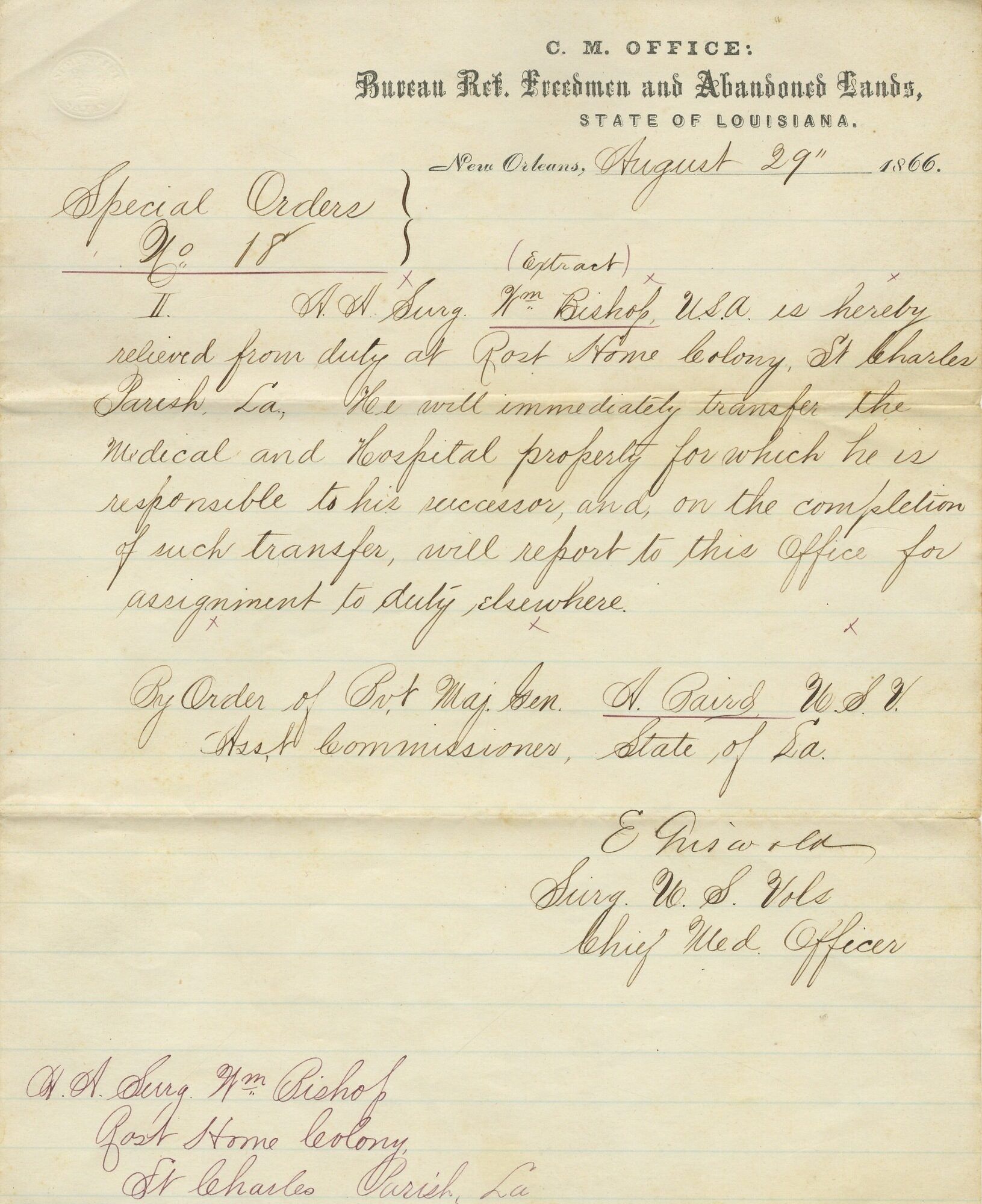
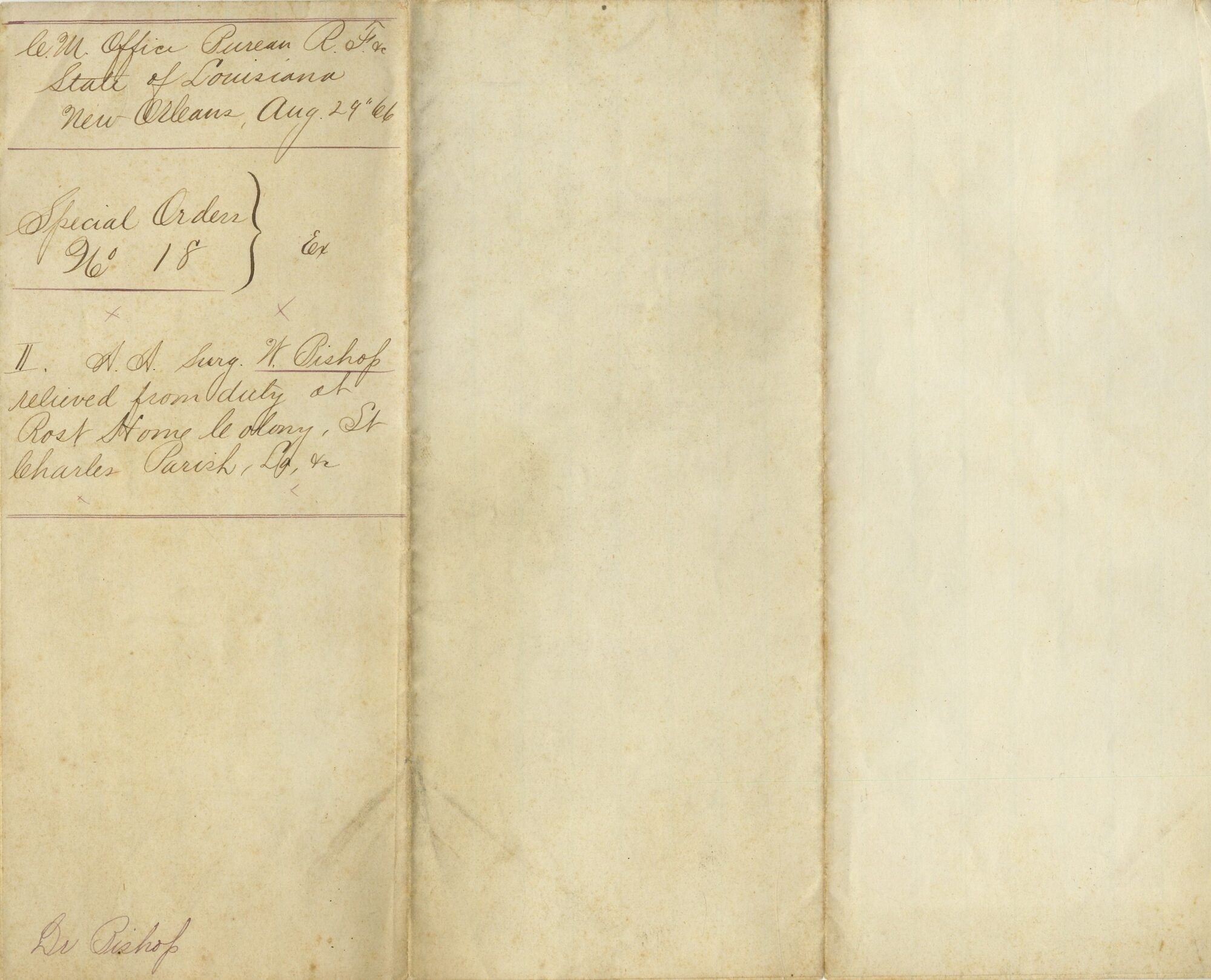
New Orleans, Louisiana, 1866. 4to, bifolium, with text to one page and docketed verso, 7 ¾ x 9 ¾ inches. A Reconstruction-era Freedmen's Bureau medical order issued in New Orleans on August 29, 1866, directly connected to the famed Rost Home Colony in St. Charles Parish, Louisiana, the largest and most significant Freedmen's Bureau refugee settlement in the state. Written on official Bureau of Refugees, Freedmen and Abandoned Lands letterhead and issued under the authority of Brevet Major General Absalom Baird, the document relieves Acting Assistant Surgeon William Bishop from duty at the Rost Colony and orders the transfer of the colony's medical infrastructure to his successor:
"A.A. Surg. Wm. Bishop, U.S.A. is hereby relieved from duty at Rost Home Colony, St. Charles Parish, La. [...] He will immediately transfer the medical and hospital property for which he is responsible".
The Rost Home Colony occupied the confiscated plantation of Pierre Rost, former Confederate diplomat and Louisiana Supreme Court justice. Established by the Freedmen's Bureau in 1865 along the Mississippi River plantation corridor west of New Orleans, the colony became one of the Bureau's most ambitious humanitarian experiments. Hundreds of formerly enslaved refugees, elderly freedpeople, widows, laborers, and the chronically ill were housed there under federal supervision. By 1866 the colony reportedly sheltered more than seven hundred residents, many unable to support themselves because of age, illness, disability, or wartime displacement.[1] Its hospital facilities became one of the principal Freedmen's Bureau medical operations in Louisiana, staffed by army surgeons and supported through a centralized military-style administrative system headquartered in New Orleans.
The present order belongs directly to that system. William Bishop appears as early as 1865 in surviving Bureau references, corresponding with Chief Medical Officer E. Griswold regarding conditions at the settlement.[2] Griswold-who signs the present order as "Chief Med. Officer"-served as the senior medical administrator for the Louisiana Freedmen's Bureau, overseeing hospitals, refugee care, medical supply transfers, and physicians assigned throughout the state during the first years of Reconstruction.
The document's language suggests a formal transfer or winding-down of medical operations at Rost Colony during the late summer of 1866. By this point President Andrew Johnson's restoration policies had begun returning confiscated plantations to former Confederate owners, and the Freedmen's Bureau faced mounting political pressure to dismantle the expensive home colony system. The order therefore appears to capture the closing administrative phase of one of Reconstruction Louisiana's most important federal freedmen's communities.
A highly ephemeral Freedmen's Bureau survival documenting the medical administration of the Rost Home Colony, one of the most important Reconstruction-era refugee settlements in the American South. We find no similar examples of internal orders from the settlements in the trade or auction records.
[1] Howard Ashley White, "The Rost Home Colony: Freedmen's Bureau Refugee Camp in Louisiana," Prologue Magazine 33, no. 3 (Fall 2001), National Archives, https://www.archives.gov/publications/prologue/2001/fall/rost-home-colony.html
[2] Howard Ashley White, The Freedmen's Bureau in Louisiana (LSU Press, 1970): 106, fn. 21.