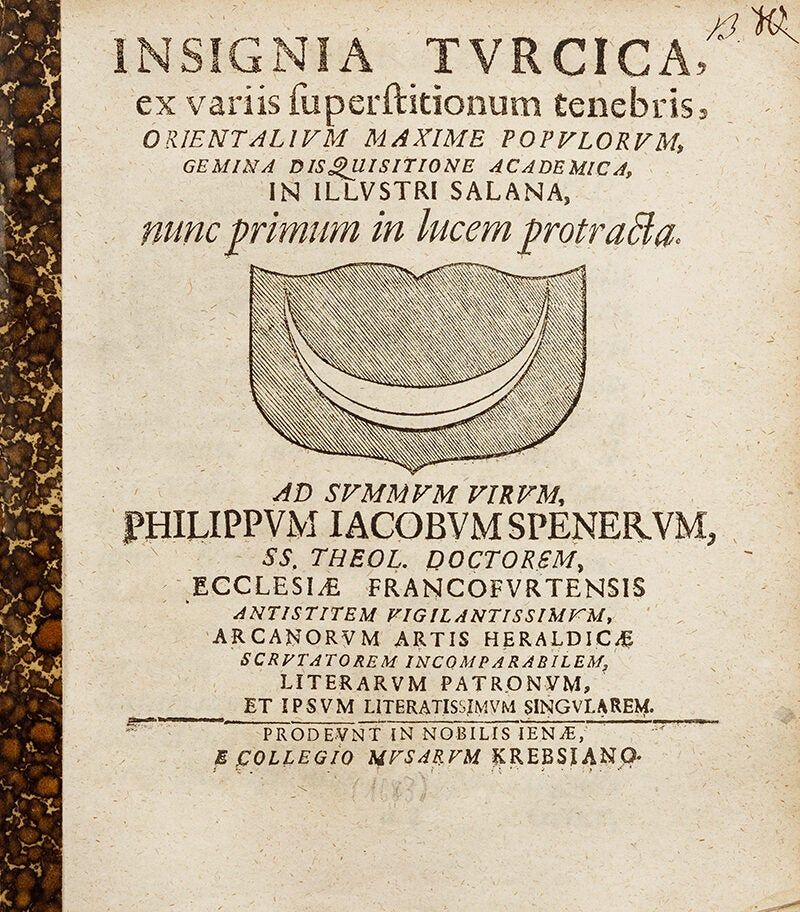
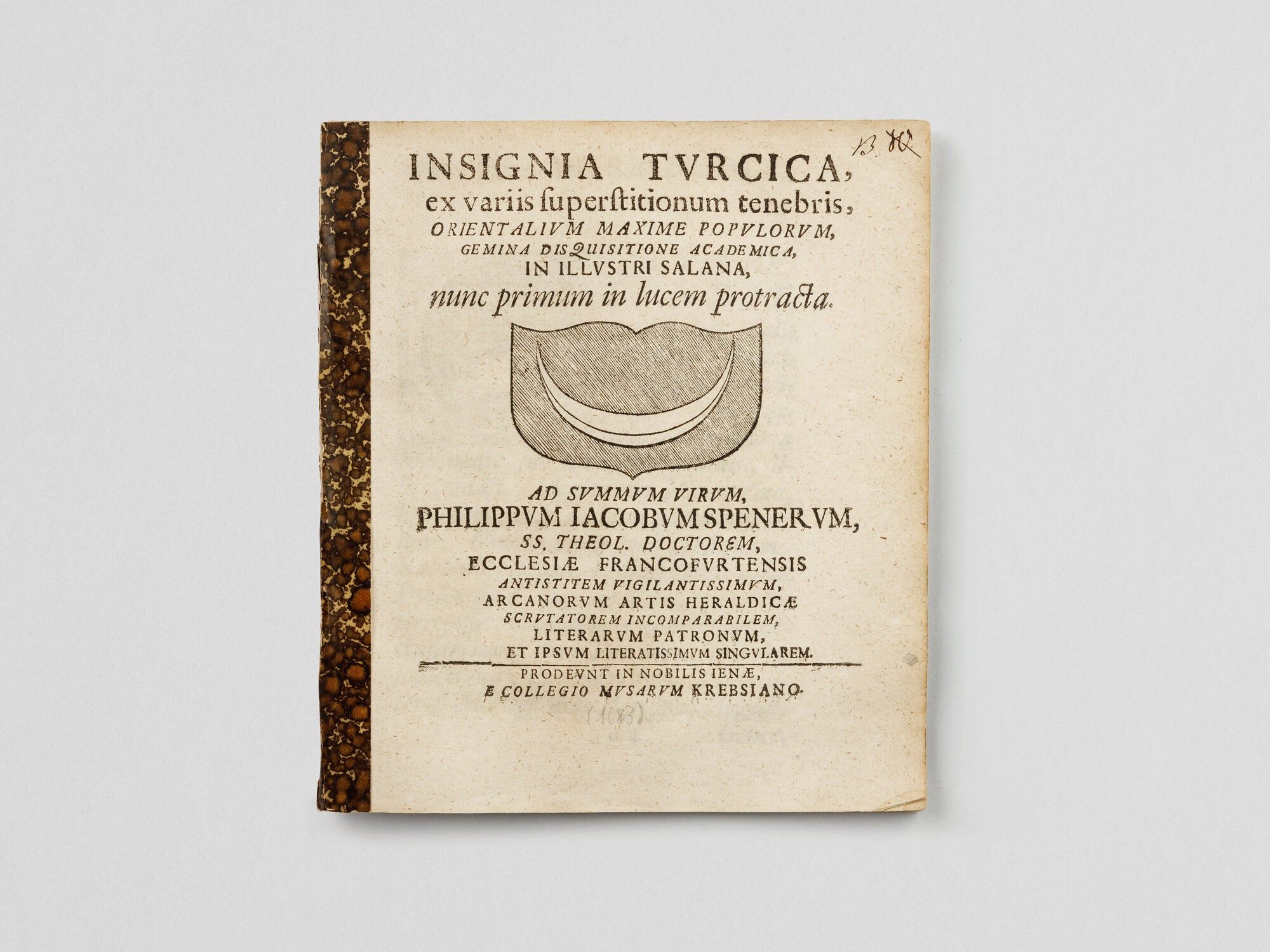
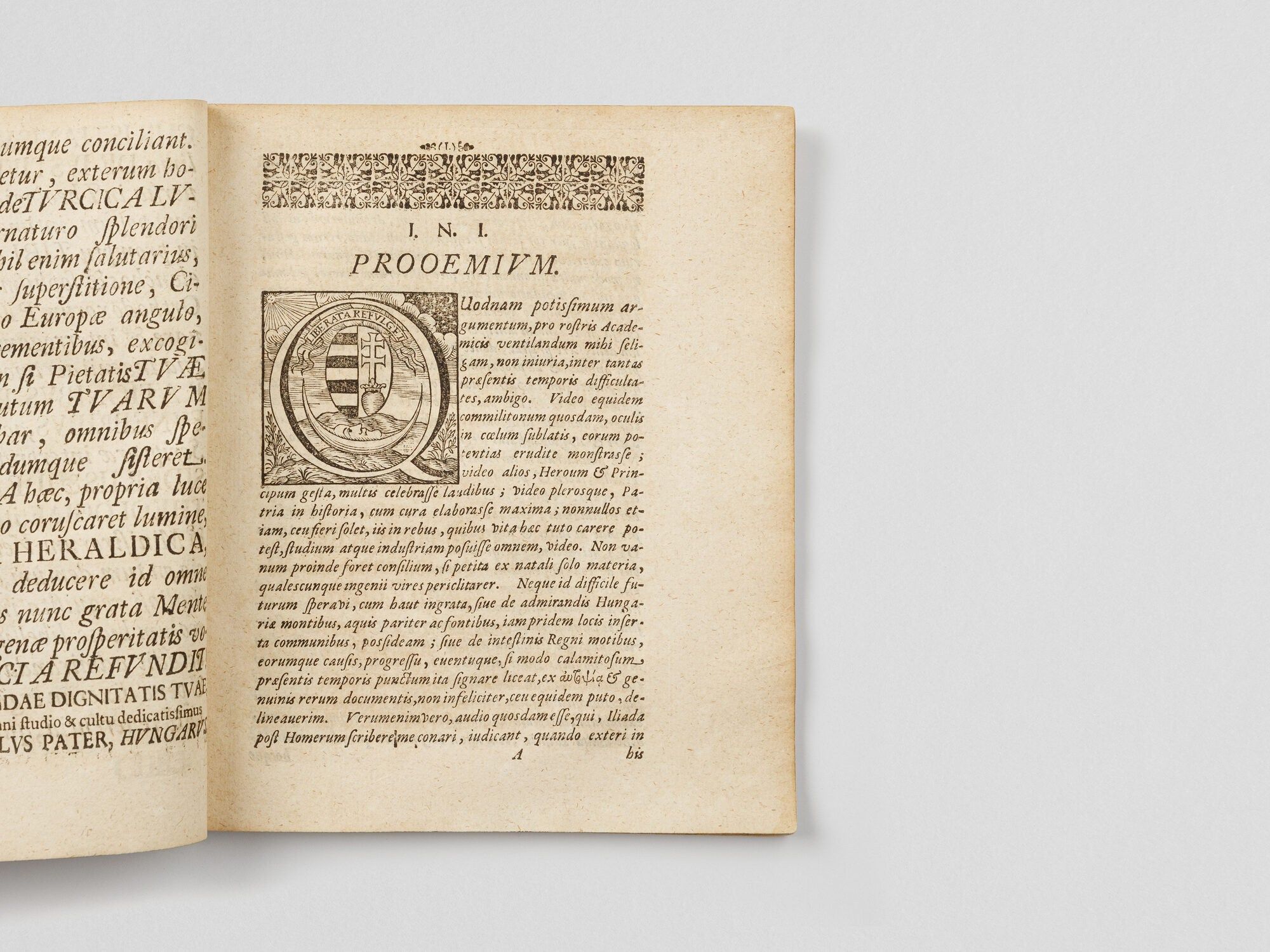
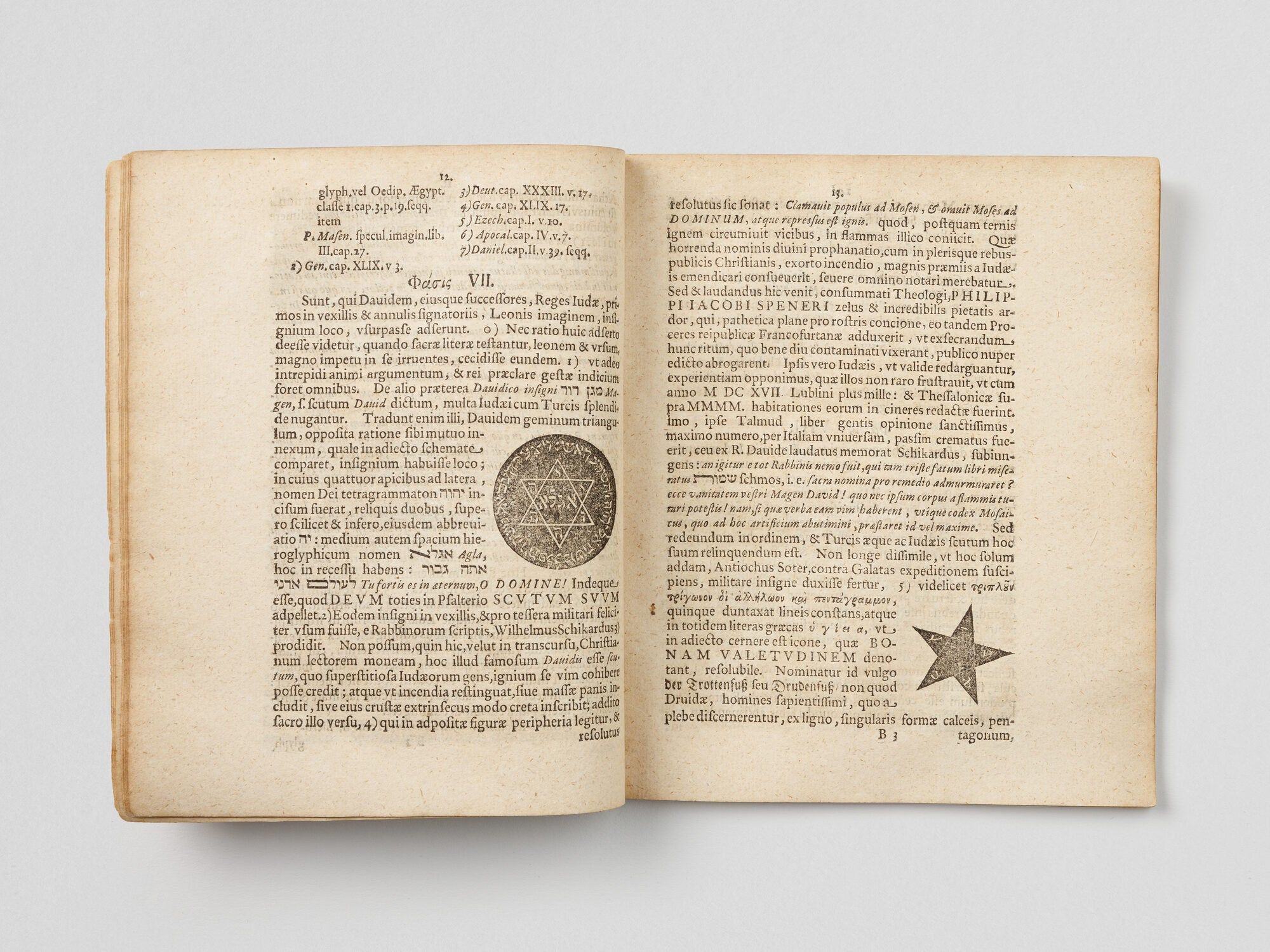
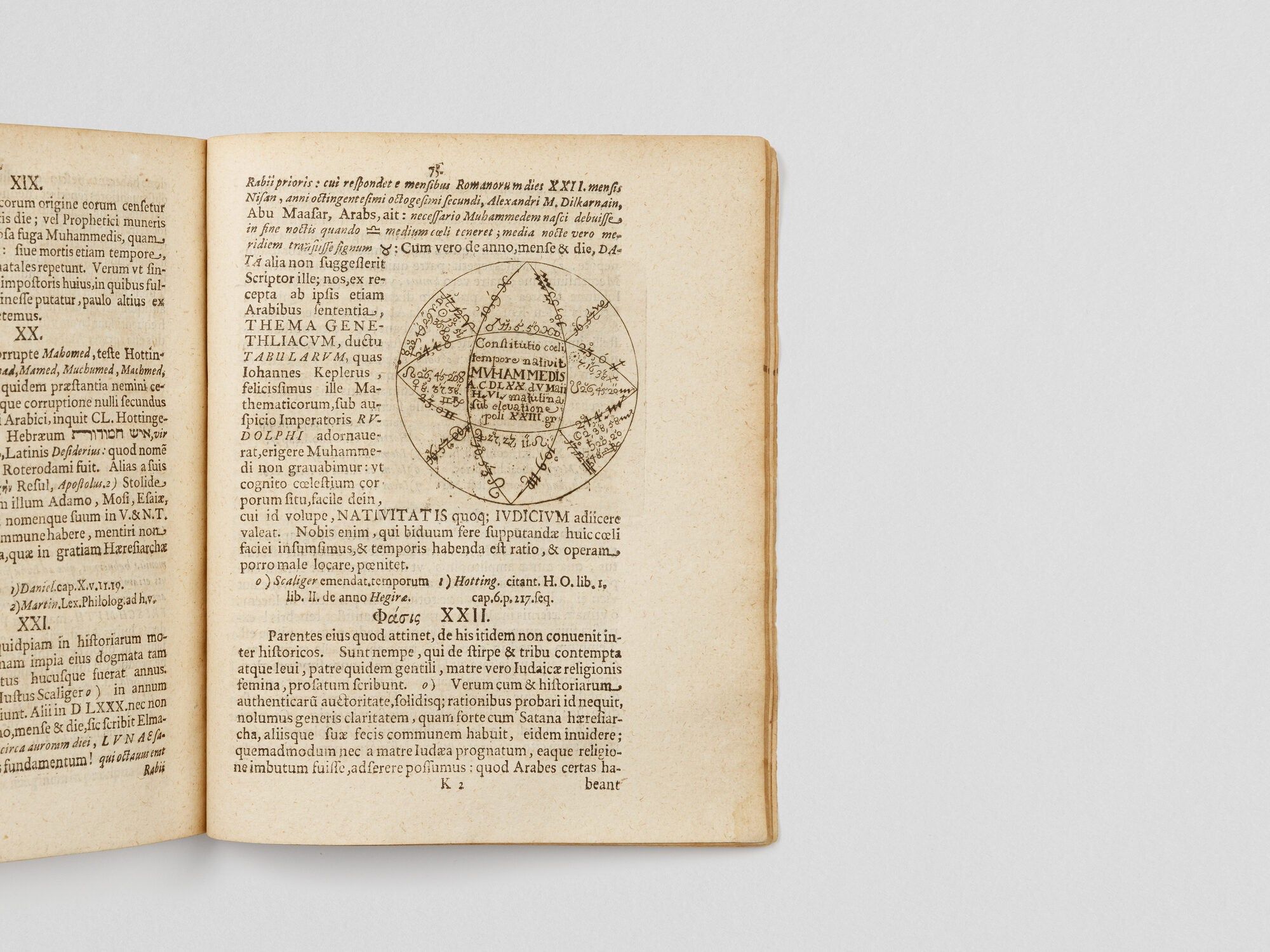
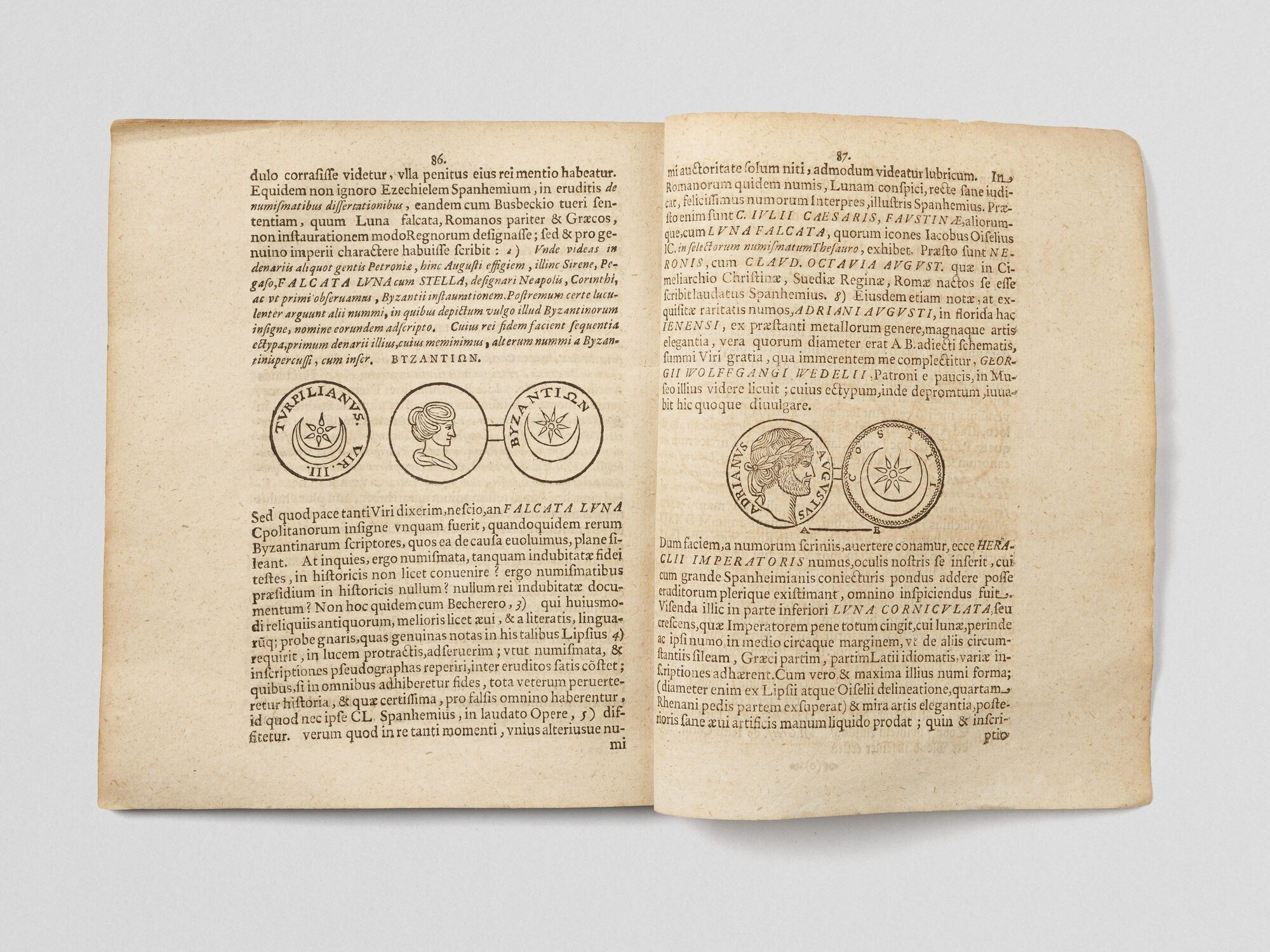
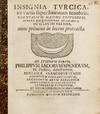
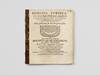
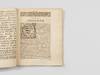
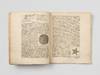
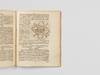
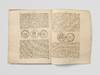
Jena: Collegium Musarum Krebsianum, [ca. 1685]. Small quarto (18.6 × 16.3 cm). Spine covered with later strip of decorative paper; [4], 88 pp. with woodcut title vignette, seven small woodcuts, one copper engraving, and two woodcut initials in the text. First and leaf with minor dust-soiling; else very good.
First edition of this treatise on the Turkish crescent by mathematician and man of letters Paul Pater, who for a period served as director of the Herzog August Library in Wolfenbüttel. At the very outset of his work, Pater makes explicit the biographical motivations underlying his interest in the symbolism of the crescent. Born the son of a Lutheran pastor in Hungary, Pater responds to the Great Turkish War with a comprehensive engagement with the emblem that the Ottoman army deployed for the symbolic occupation of his native land. By way of introduction, he elaborates: "they likewise lay claim to every place among our compatriots as soon as they behold it adorned with the image of the crescent. Thus it happened in the previous century at Austrian Vienna, at that famous tower consecrated to Saint Stephen; immediately they proclaim that such a place rightfully belongs to them. Hence it is that they habitually regard all those places above which this sign is affixed as their own property, and preserve them with particular care."
Paul Pater, who also taught Greek and Latin literature at Jena, opens his inquiry with an etymological investigation in order to trace the origins of the crescent in both sacred and profane writings. In critical demarcation from Athanasius Kircher, Pater ultimately endeavors to reconstruct the pre-Islamic use of the crescent as a heraldic symbol. Among the questions examined is whether King David - the builder of the First Temple, on whose site the Islamic Dome of the Rock stands today - might have been the inventor of the sign. This is followed by a treatment of the "vestiges" (vestigia) found among the ancient Egyptians, the Greeks and Trojans, and the Assyrians and Babylonians. By way of contrast, the introduction of the Christian cross into heraldry is also discussed, tracing a lineage from Emperor Constantine through King Stephen of Hungary to the Dukes of Saxony. The emergence of other heraldic symbols - among them the dragon of Alexander the Great - likewise receives attention. Pater further addresses speculations concerning the ethnic origins of the Turkish people within the Ottoman Empire, as well as additional Ottoman heraldic devices such as the fivefold crown, the tulip, and the leaf.
A second part of the work pursues, among other questions, the inquiry into why it is above all Oriental peoples who venerate the moon. Pater advances the thesis that "the entire theology of the pagans can be traced back to those two celestial bodies." To substantiate this claim, he once again examines a range of ancient cultures, discussing, for instance, the correspondences between the goddess Isis and the moon, drawing on Plutarch and returning to Athanasius Kircher. Pater identifies lunar veneration among the Germanic peoples as well as among the ancient Greeks and Romans. In the latter he also discovers "silver lunar standards of the military commanders," and emphasises: "This very moon was also venerated by the Arabs and Saracens and invoked under the names Alilat or Alitta, and furthermore Cabar and Venus." Pater ultimately draws a line of continuity between ancient Rome and the Ottoman Empire, in which the veneration of Venus persisted in a transformed guise. He further demonstrates that the coinage of the Byzantine emperors was likewise struck with the sign of the crescent - though this is by no means the only cultural connection between Orient and Occident that is pursued.
Pater reads the "Orient" literally through a Latin lens. His knowledge of Turkish and Arabic sources is derived from translations as well as second- or third-hand accounts. The term "Orientalist" was first used in English in 1779 and in French in 1799. There was continuous exchange between the Christian and Islamic worlds, driven by both trade and war. Latin-Arabic dictionaries, for example, are known from the twelfth century. The first Latin translation of the Qur'an also dates from this period (printed in 1543 in Basel). At the Council of Vienne in 1311, it was decided that two scholars should be appointed at each of five European universities (Rome, Bologna, Paris, Oxford, Salamanca) to teach the languages of the Near East, which included Syriac, Arabic, Greek, and Hebrew.
(For this and the following, see: MUSTA'RIBŪN, in: Encyclopaedia of Islam. 2nd ed. Leiden, 1993, pp. 735-753.)
The fall of Constantinople to the Ottoman Empire led to an intensified engagement with the languages and cultures of the Near East in Europe. The Spanish theologian Juan de Segovia proposed a conference between Christian clergy and Islamic jurists to open a dialogue, an idea previously pursued by Nicholas of Cusa in "De pace fidei". In his work "Cribratio Alchorani", he attempted to examine the Qur'an to determine what connected Islam to Christianity and what separated them. Pope Pius II eventually wrote a letter to the Ottoman Sultan Mehmed II to initiate exchange in the context of the conquest of Constantinople. Good relations were also significant for economic reasons. The first work printed with Arabic type was produced in Rome in 1514 for Christians in the Near East. An Arabic Qur'an was printed in Venice about 15 years later but was subsequently destroyed on the orders of the Pope. Rome became the most important center for Arabic printing presses, which primarily served missionary purposes.
A completely different relationship developed between France and the Ottoman Empire, linked by a military alliance against the Habsburgs. The alliance was forged by the scholar Guillaume Postel, who taught Greek, Hebrew, and Arabic in Paris. He used his diplomatic travels to acquire a series of Arabic manuscripts for France. His 1540 publication "De la republique des Turcs" painted an idealized picture of the ally. In the seventeenth century, Leiden became a center for the study of Near Eastern languages. The Netherlands had its own economic interests in cooperating with Morocco and the Ottoman Empire. Not only were standard works of Arabistics developed in Leiden, but collections of Arabic manuscripts and books were also established. A decisive turning point was the second siege of Vienna.
Pater belongs to a new wave of engagement with the Near East. Barthélemy d'Herbelot published the thousand-page "Bibliothèque Orientale" in 1697. The first French translation of "One Thousand and One Nights" appeared in twelve volumes between 1704 and 1717. Leibniz published "Mahomet no impostor, or a Defence of Mahomet" in 1720, followed by Henry de Boulainvilliers' "Vie de Mahomet". This new perspective was due, not least, to the fact that the Ottoman army was in retreat in Europe. Pater's "Insignia Turcica" was written and published precisely at this historical turning point.
VD 17 32:673868Z
As of June 2026, KVK, OCLC show three copies in North America.