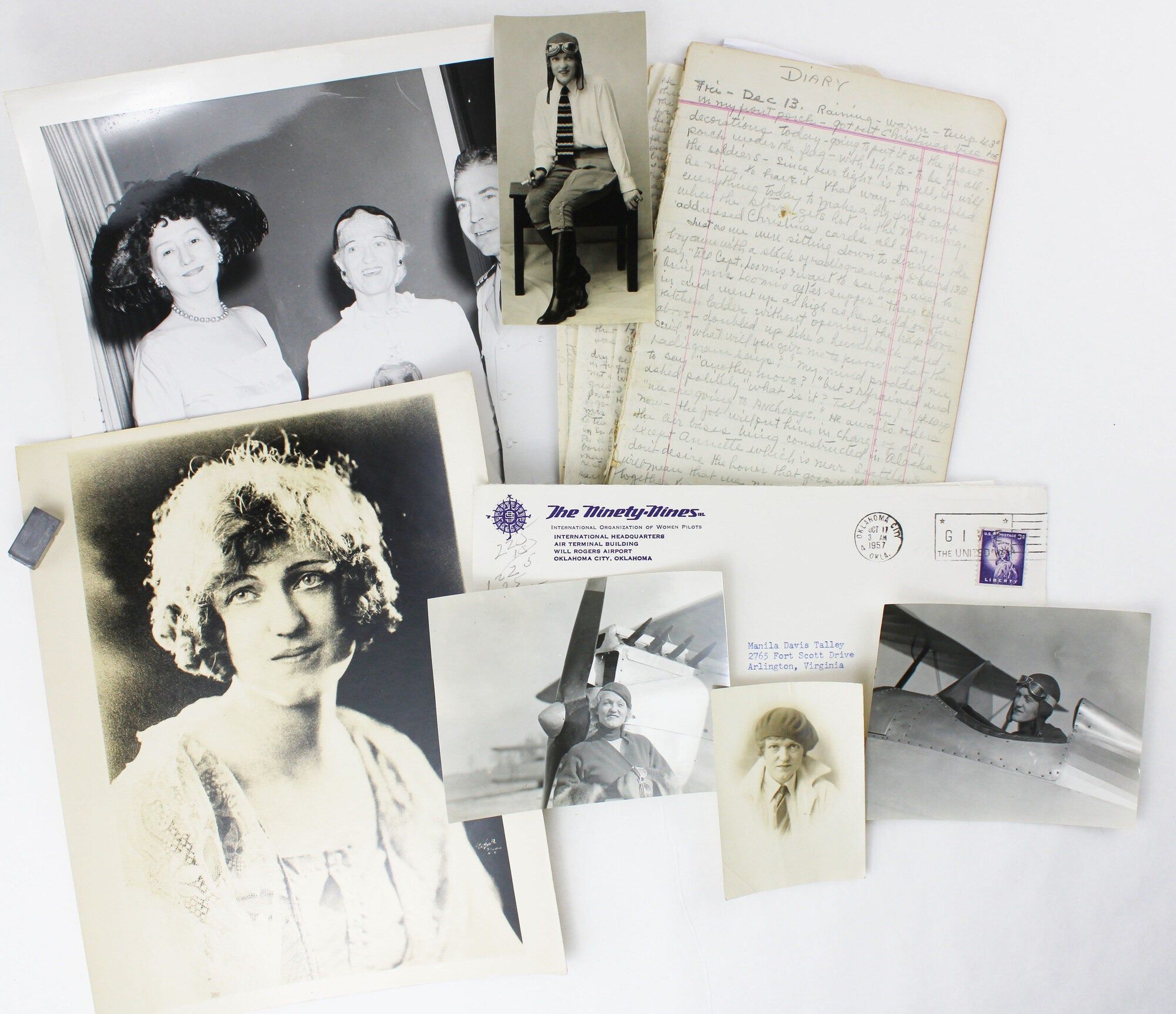
[Various places, including Yakutat, Ak.; Flatwoods, W.V.; New York City; Brasilia, 1963. Very good.. Approximately 225 items, comprising manuscript, printed, and photographic material and ephemera, including [30]pp. manuscript diary on stitched, lined paper and over fifty photographs of varying formats. Light wear and dust soiling, larger format photographs curling somewhat, but condition generally quite strong. A collection of well over 200 manuscript, printed, and photographic items relating to the life and career of early female commercial pilot Manila Davis Tilley, including her manuscript diary about her pre-World War II stint in Alaska. Manila Davis was born in Flatwoods, West Virginia. She attended West Virginia University before transferring to the New England Conservatory to study music and drama. While there she became interested in aviation, taking a Curtiss-Wright course in mechanics and attending the Guggenheim School of Aeronautics at M.I.T. From there she became a salesperson for the Curtiss-Wright Corporation, and learned to fly. She obtained her commercial pilot's license in the early 1930s; was a founding member of the Betsy Ross Corps, a female auxiliary/reserve for the Army Air Corps; an early member of the Ninety-Nines, an international association of female pilots; joined the Civil Air Patrol in 1941; and was the third woman to go through the Air Force War College in December 1966. Her first husband died in 1930, and she married Benjamin B. Talley in 1933.
The diary that discusses the end of her time in Yakutat, Alaska, begins on December 13, 1940, and relates that her husband Benjamin was being transferred to Anchorage, and that, "The job will put him in charge of all the air bases being constructed in Alaska except Annette which is near Seattle. I don't desire the honor that goes with it, for it will mean that we never have any time together to enjoy ourselves again as long as it lasts -- he will travel -- mostly by plane and I'll be alone…. Oh well, such is army life -- here today and gone tomorrow…." She also records his struggles to get the proper supplies and manpower to Yakutat while in charge of construction for Elmendorf Air Force Base. Instead of filling his order for three 20-ton tractors, they sent him three little farm, vanity tractors. Looking at them in disgust, she says he turned to one of his soldiers and said, "'If I catch you wearing one for a watch charm it will go hard with you.' To me he said, 'I'll tie a line and buoy to one in the morning start it down the field and take a picture as it sinks out of sight' – he was so mad he nearly died when he saw them." The skilled laborers they sent him were likewise threatening to strike before they ever saw the field. He told them if they refused to work they would have to find their own way back to the States. To solve his labor shortage, Talley asked permission to hire Natives who were all anxious to work for him. Knowing they were being transferred, Manila suggested she leave early to take a flying course but he did not believe a wife should be in one place while a husband was in another: "Seems ok for him to be away and leave me alone in Anchorage -- different for me to be gone a couple of months -- but I want to see Dad -- the army boat would take me down -- and I would of course have to pay my way back -- but I want to go so much. However, I might just as well have un-loaded 3 more little tractors as to have sprung that idea this morning."
In the meantime, she was asked by the native Alaskans to play the piano in their Christmas celebration at the Alaskan Native Brotherhood Hall -- the only white woman asked to participate. She describes the play the Native children put on, and also records the tragic deaths in the village since mid-September, two drowned, one murdered, one poisoned by home-made liquor, and two from tuberculosis. She records that several of the Native villagers brought her Christmas gifts of moccasins, nine pairs so far. She also mentions that wolf packs had been seen in the area near the village and that the soldiers should be told to be on alert, as they were in the habit of walking out alone at night unarmed. "Some night a hungry pack will make a tasty meal of a couple of them."
Manila boarded the freighter Kvichak alone to return to the States on January 4, 1941, with Benjamin having already left on a coast guard boat. Her ship stopped along the way to pick up other passengers and goods, including other women and children. They arrived at Tamgas on January 9, where a Colonel George J. Nold gave her a tour of the construction of the air base. The buildings were up but not the hospital, or even a road to the air field. She was surprised they were building two docks, which later became Annette Air Station. She continued her rough passage back to the States: "I keep thinking after all the flying I've done, to go down on an old tub out in the Straights of Georgia [was] rather an inglorious end for one Manila." She arrived safely in Seattle on January 14, 1941.
By the end of the year, the United States had entered the war. Manila and Benjamin spent time apart while he was assigned to various places in Alaska and Europe supervising engineering projects for the Army. Included in this group of letters from him is one from Pusan just after the conclusion of the war with Japan, dated September 18, 1945. In it he describes the Pusan harbor which could accommodate as many as fifteen Liberty ships, such a change to unload at an actual port after "so many beaches." He also witnesses the steady stream of refugees coming down from the north, "on their way from Japan and across the channel come the Koreans who have been in Japan, another migration of peoples uprooted by war... and I've seen so many."
There are about twenty-five more letters from her husband Benjamin B. Talley (1903-1998), an engineer, designer of numerous airfields in Alaska, and a Brigadier General during World War II who helped plan the D-Day beach assault in Normandy. After he retired from the Army, Talley worked for Raymond International and supervised construction of buildings in Brasilia, Brazil's new capital. Most of her correspondence back and forth with Talley in this collection relates to his time in Brazil in the late 1950s, where she sometimes joined him. She writes to her family at home from Rio about her attempts to get a license to fly down there: "There are no women flying in Rio. I hear we have one 99 in Sao Paulo but she may be a pilot from elsewhere. I'll find out. She is an old timer." Other letters are from Italy, New York City, Boston, Addis Ababa, and other destinations
There is also a small group of six letters from a Native American woman in Carnegie, Oklahoma, to Manila Talley, from 1938 and 1940, mentioning her schooling, her interest in selling some of her crafts, her knowledge of Kiowa songs, and more. Benjamin was born in Greer, Oklahoma and he and Manila traveled back there on occasion. Also included are fifty letters from family and friends; nearly seventy photographs (many candid shots; some studio portraits); approximately six printed items, including typescripts related to an organizational meeting of the Betsy Ross Corps, a reproduced typescript defining the mission of the women's aviation group the Ninety-Nines, an Activity Report for the New York Wing Civil Air Patrol, etc.; and some one dozen drafts of stories or plays Manila Talley was working on at various times, expanding her career as a pilot to include her experiments in writing autobiography and literature. A wonderful record of this pioneering woman, worthy of further study.