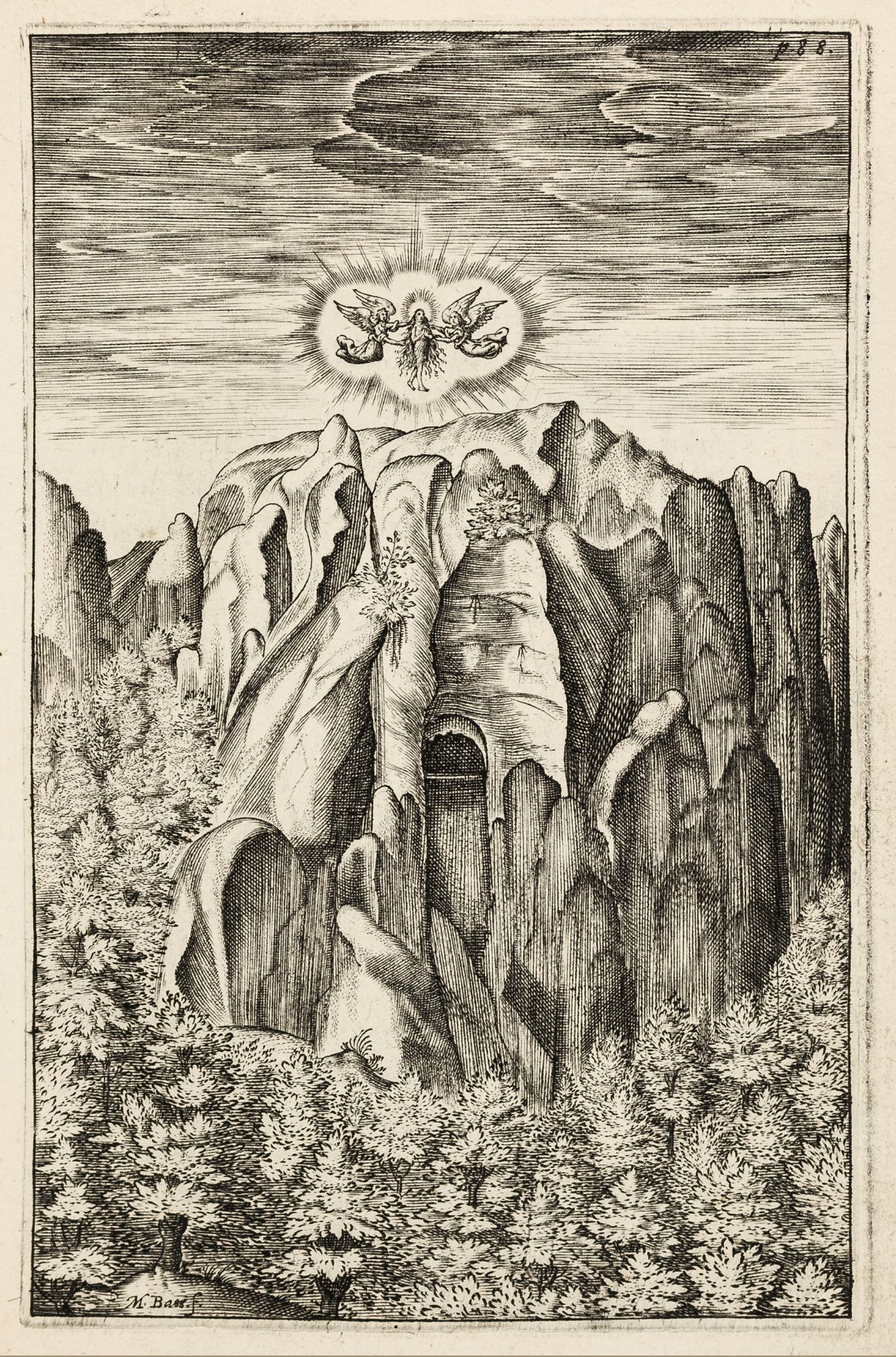
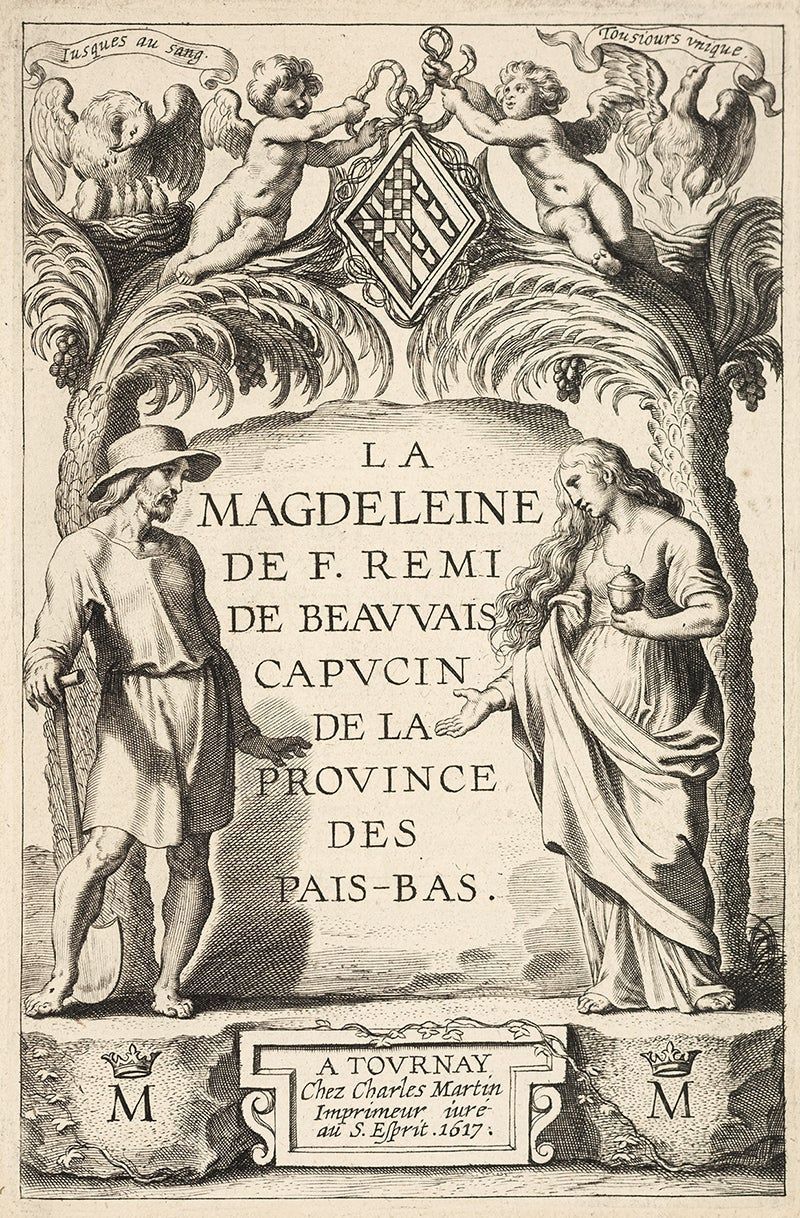
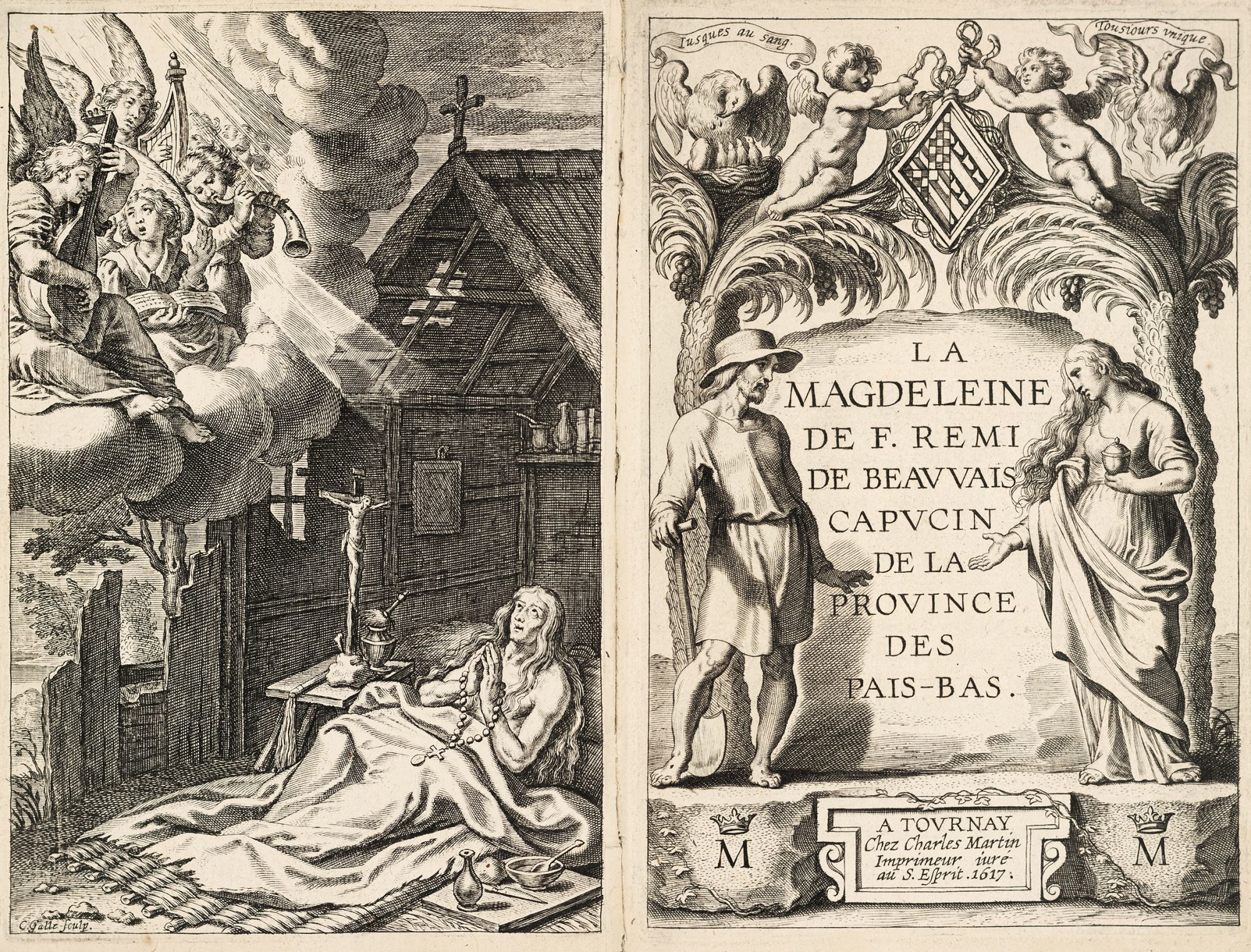
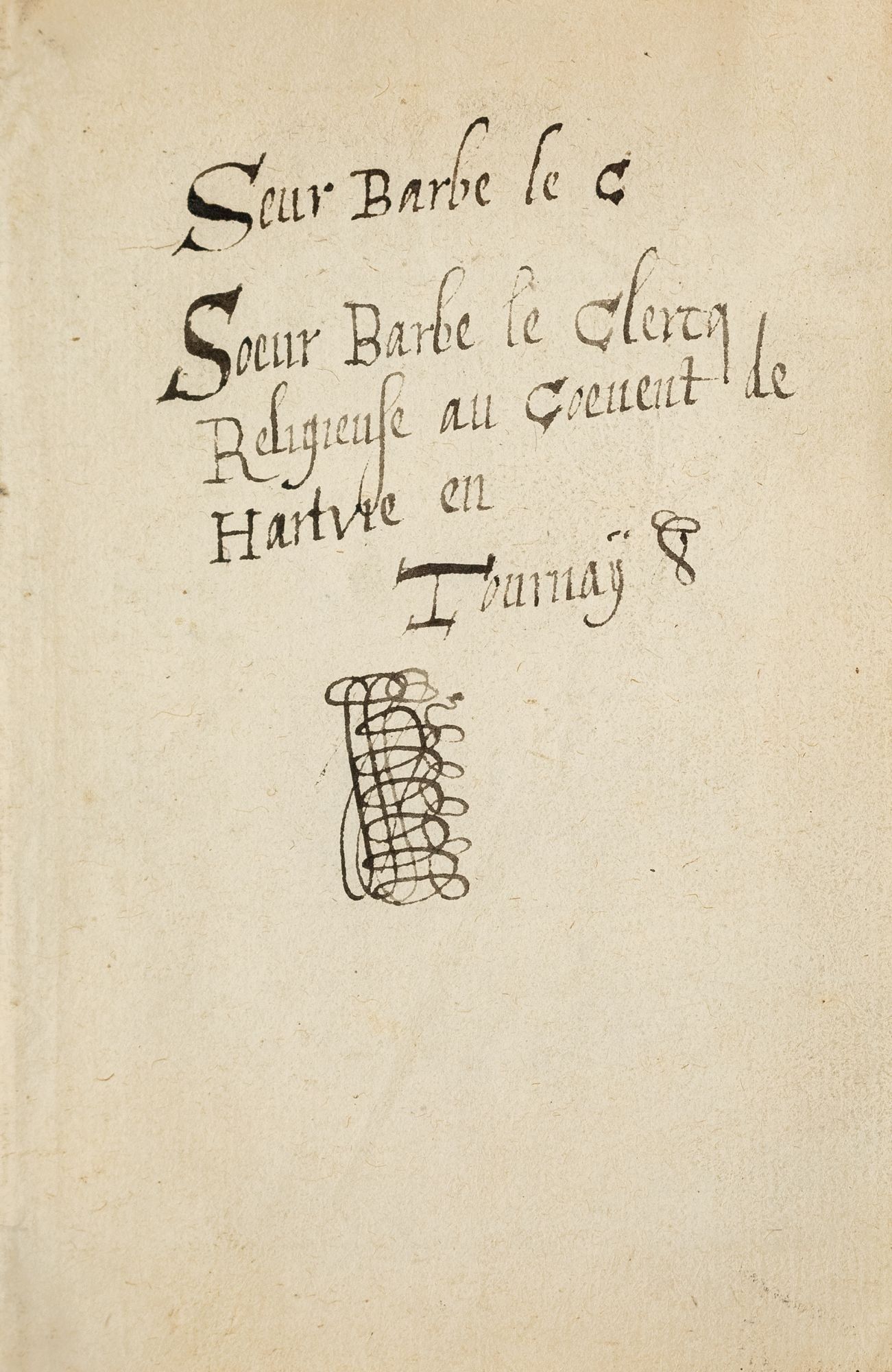
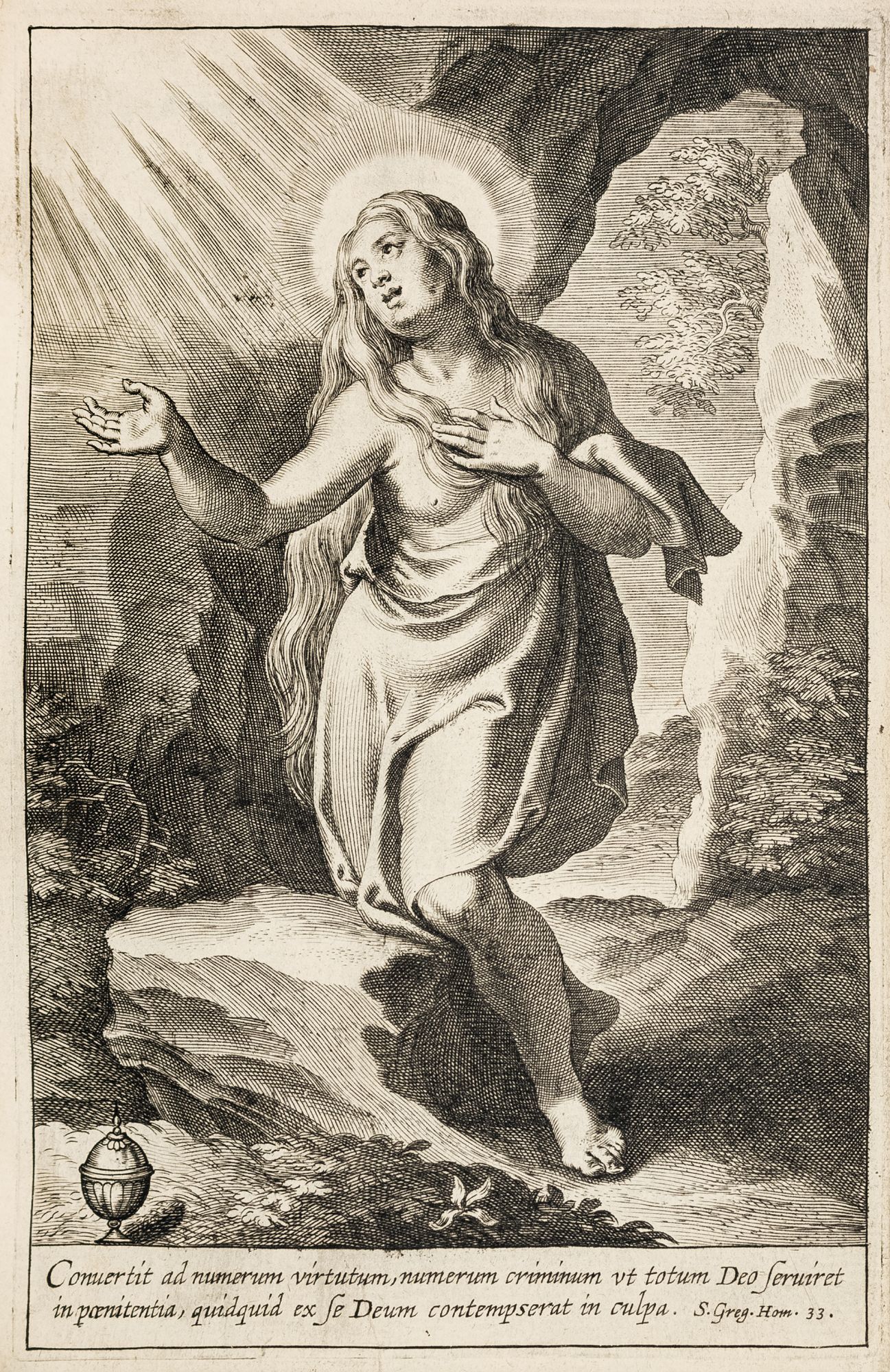
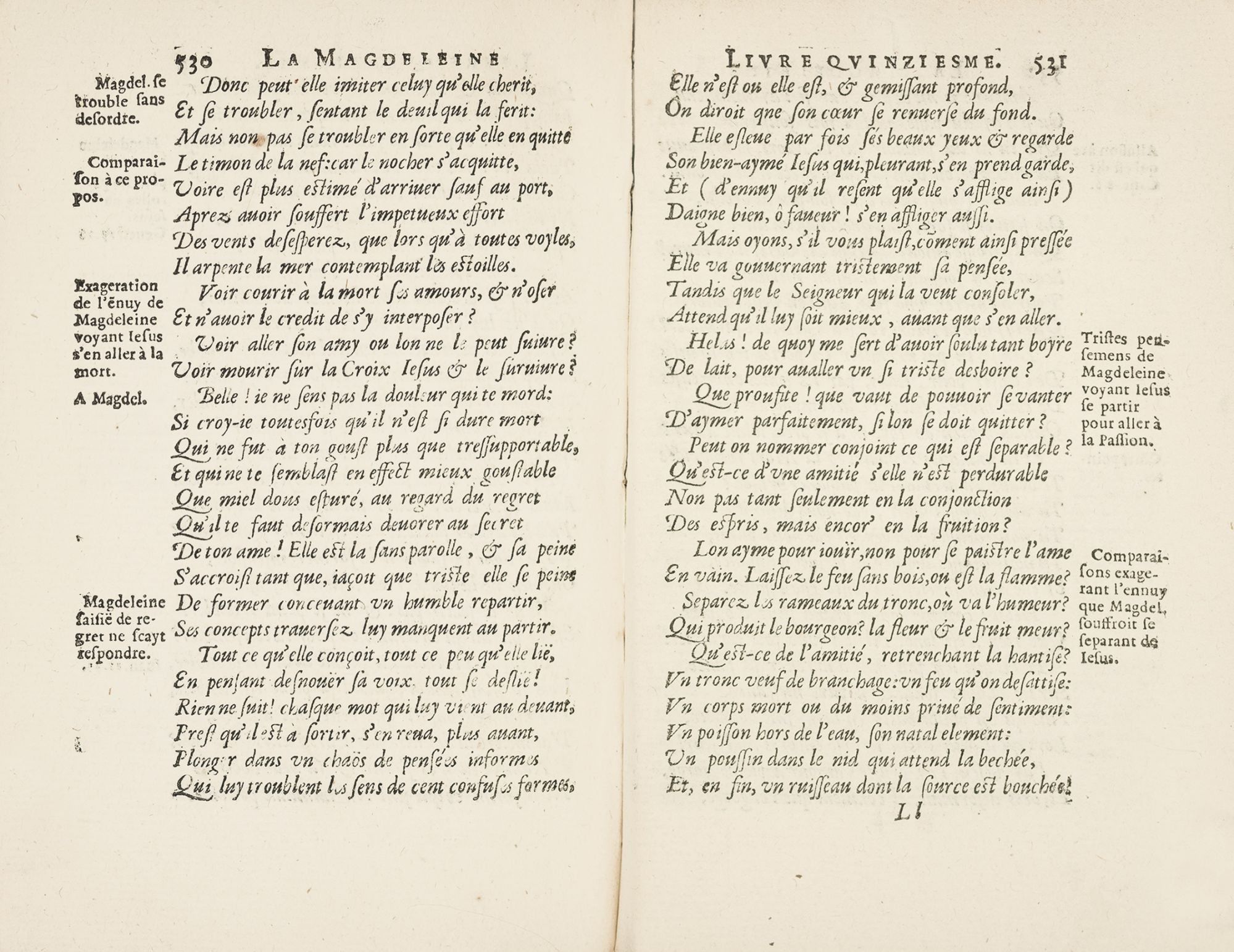
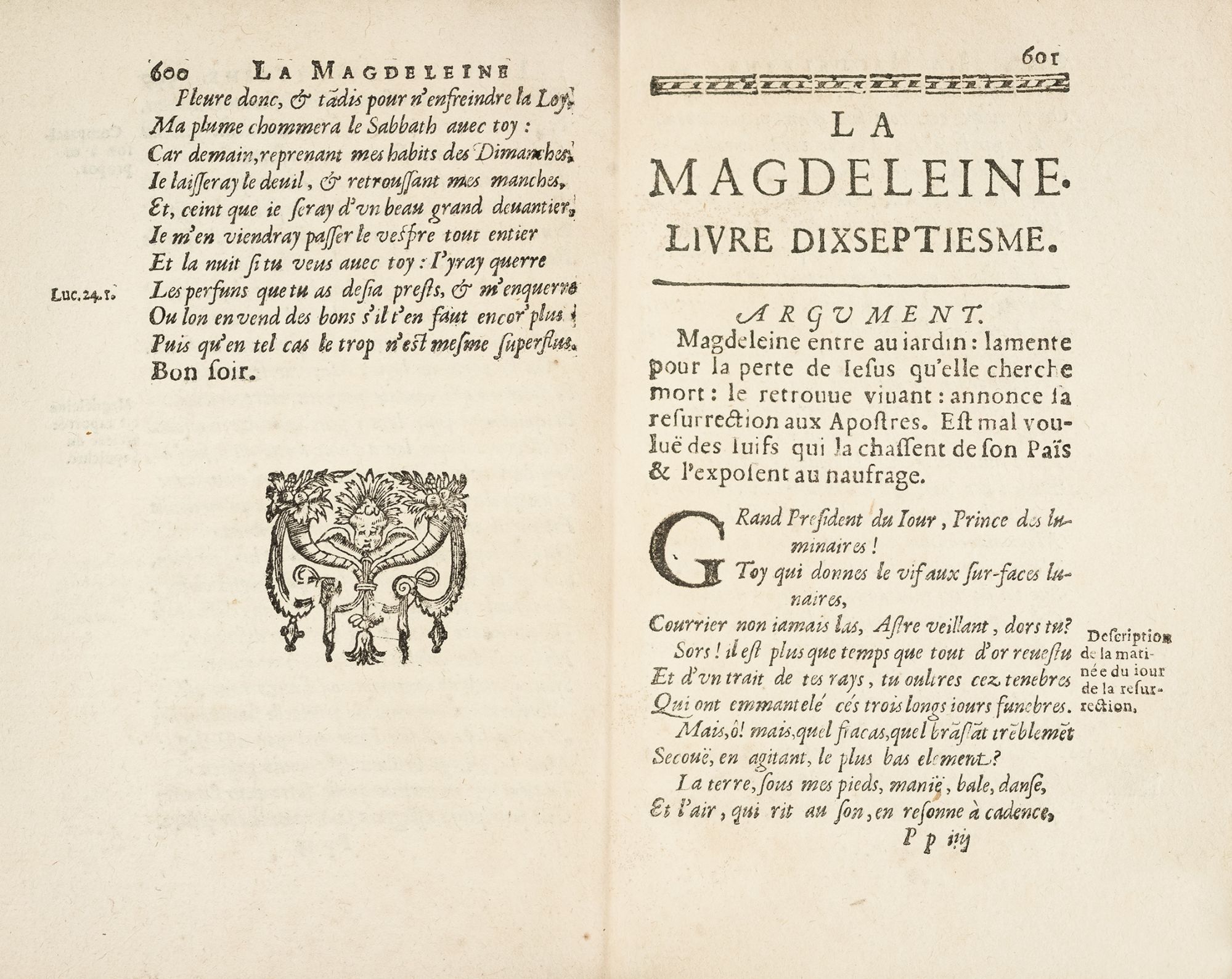
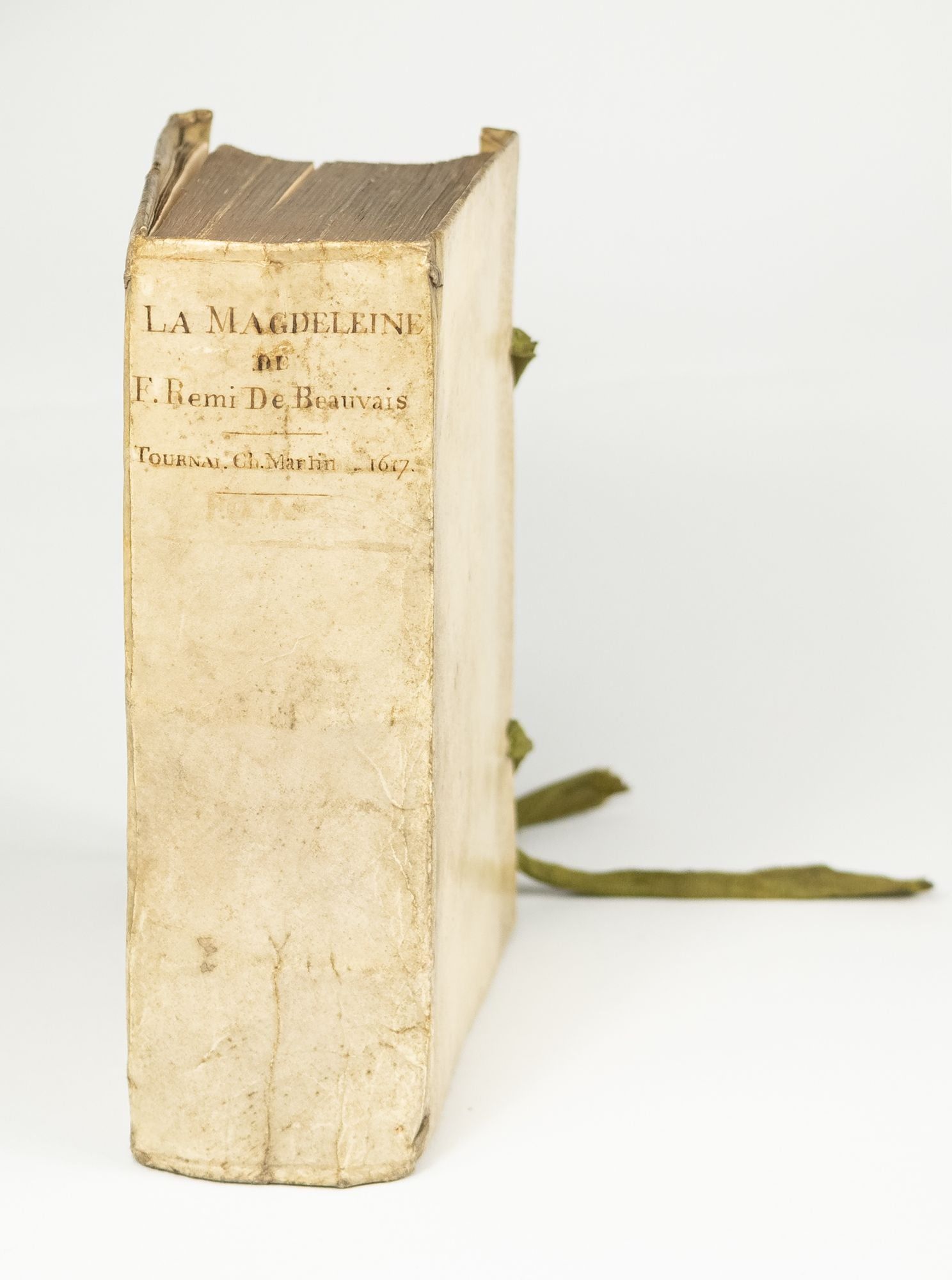
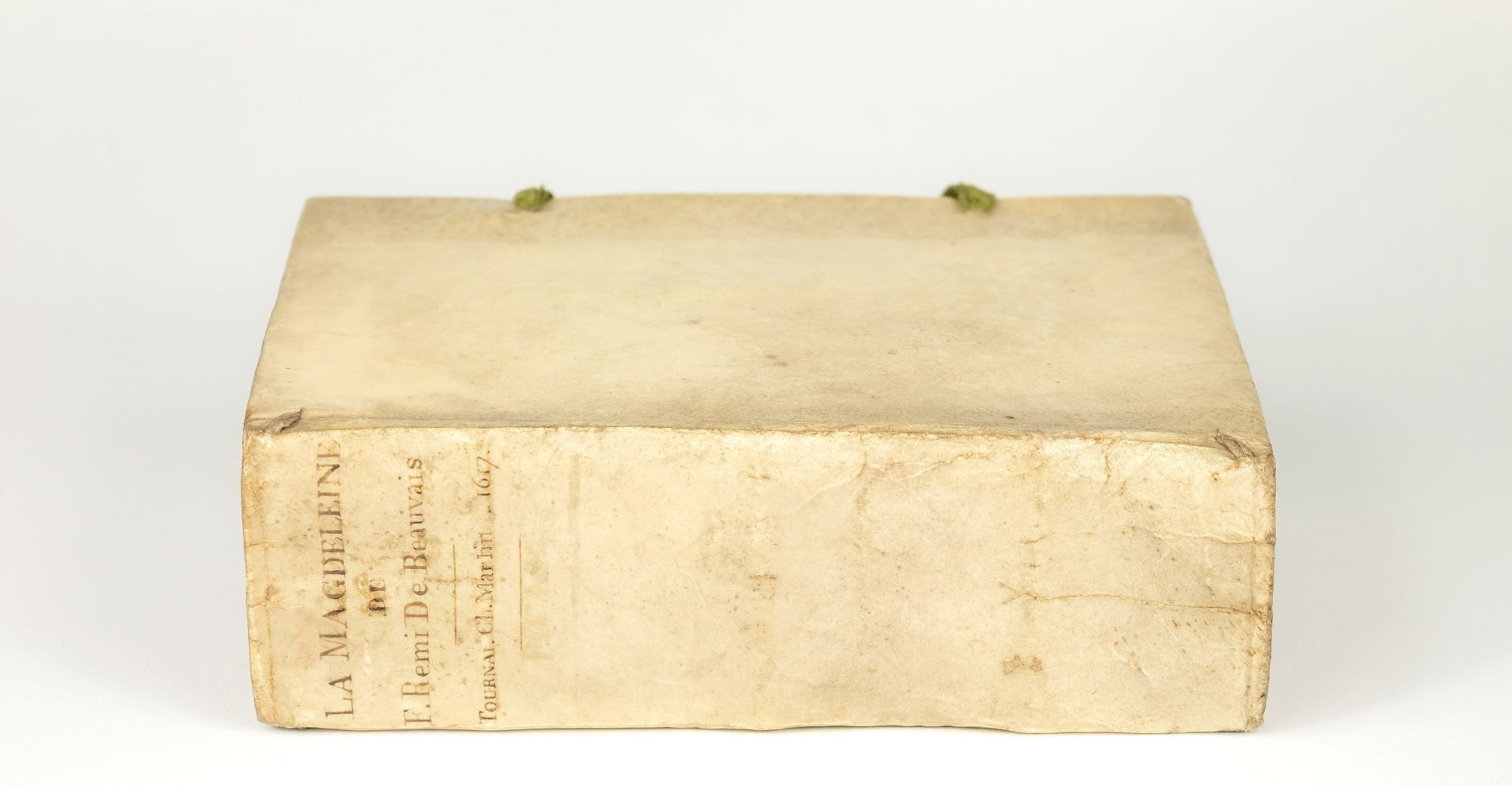
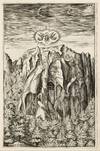
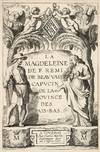
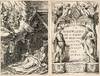
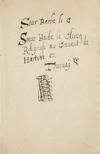
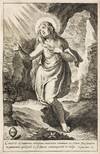
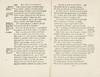
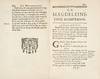
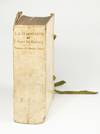
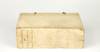
Tournay: Charles Martin, 1617. Octavo (16 × 11 cm). Contemporary vellum binding with contemporary neatly written title on the spine and green (later?) textile ties; 746 [recte 744, pagination jumps from 458 to 460], [5] pp., 1 errata leaf, with copperplate title (with Noli me tangere, blood-nourishing pelican and resurrected phoenix, as well as two palm trees and cherubs), engraved frontispiece (reclining Magdalene as a penitent with floating, music-playing angels), and two copperplates (kneeling Mary Magdalene as penitent, elevation of Mary Magdalene with angels). Front endpaper with contemporary ownership annotation of a "Soeur" from a convent in Tournay. Gathering "xx" incorrectly bound between gatherings "rr" and "ss" (with contemporary ink annotation); complete and very good.
First and only edition of the Baroque long poem, which historically marks the beginning of a succession of Magdalene-themed poetic texts and reflects the changing iconography of Mary Magdalene in the late sixteenth and early seventeenth century. The Capuchin monk's work was not originally intended for publication, but was written privately for a devout lady named Marie de Longueval. Other sources give her full name as Marie Madeleine, which explains her fondness for the holy penitent. According to Hildebrand d'Hooglede, she was not, as assumed elsewhere, the daughter of Maximilien de Longueval, the governor of Mons and Arras, but a daughter-in-law, Marie Madeleine de Biglia, who in 1600 married the famous general Charles Bonaventure de Longueval, who fought for the Habsburgs in the Thirty Years' War. Marie Madeleine was connected to the Capuchins and knew Remi before her marriage. He had given her several poems and songs that he had written himself. At her request, he wrote her a long poem about her patron saint, which he completed in about four years. The work comprised 20 "livrets". (See: Hildebrand d'Hooglede: Deux poètes peu connus: les capucins Remi de Beauvais 1568-1622 ... , in: Collectanea Franciscana 24, 1954, pp. 159-165.)
The apostle of the apostles, according to legend a "penitent courtesan" who was the first to see the risen Lord (noli me tangere) and proclaimed him, not only received great popularity among the Capuchins (ibid.), but also increasingly took on a life of her own outside church structures from the sixteenth century onwards. While efforts had been made since the Council of Trent to curb sacred art, the image type of the naked or semi-naked beautiful penitent, whose physical charms were emphasized rather than concealed by cloths and hair, became established in courtly and bourgeois private devotion (Lex. Christl. Ikonografie VII, column 520). In his long poem, the author embellishes the biblical passages in which Mary Magdalene appears and those later attributed to her, as well as the narrations from the "Legenda Aurea" and other medieval poems and prose works in Baroque detail. Later readers, especially Protestants, reproached him for this. The German philologist Paul Dittmer, for example, criticizes the monk's numerous scholarly digressions, whose archaeological remarks and ancient allusions supposedly distract from the subject. Rejecting the Baroque abundance of symbols, allegories, and emblems, Dittmar wrote: "We can literally see the poet before us, rummaging through a veritable mountain of scholarly books in search of some quotation or other, which he then inserts in a place that may or may not be appropriate." (p. 9) What Dittmer finds worthy of criticism actually refers to Mannerism and the early Baroque as a whole: "Christ is, in Romy's view, king, pulpit speaker, and miracle worker in one person, who quite clearly combines all the characteristics of the sixteenth century." (La Magdeleine: eine Magdalenenlegende aus dem Anfange des 17. Jahrhunderts, in: Siebzehnter Jahresbericht über die Städtische Realschule zu Magdeburg, Magdeburg 1907, p. 1-10.)
Remarkable is also the bibliophile arrangement of the book. Hildebrand d'Hooglede assumes that the engraved title page, on which the text is framed by a "Noli me tangere" scene in which Jesus appears to the grieving Magdalene wearing a shovel and a gardener's hat, was engraved by Jean Collaert based on an unknown original by Peter Paul Rubens (Hildebrand d'Hooglede, see above). The etching of the elevation of Mary Magdalene with angels is the only surviving landscape by Martin Baes, who was one of the most sought-after engravers and, above all, book illustrators in Flanders. (Alphons Hamer, More on printmaking in seventeenth-century Douai: The engraver Martin Baes ..., in: Delineavit et Sculpsit no. 54 2024, pp. 39-64.) Baes seems to have based his illustration of the penitent being lifted up by angels for the Liturgy of the Hours on two Dutch images in which the floating group above the La Sainte Baume cave in southern France is also a rather small detail. On the one hand, his illustration is very reminiscent of the painting by Joachim Patinir, which is now in the Kunsthaus Zürich, and on the other hand, of an etching based on a model by Pieter Breughel the Elder, published in a series of landscape illustrations in 1555. Of similar iconographic interest is the frontispiece, which shows an old recluse who has been doing penance in the hermitage for thirty years lying on a bast mat at the end of her life, while angels visit her, singing and making music with lute, harp, and tenor cornett. The plate signature "C Galle sculp" suggests that Cornelis Galle was the engraver. He worked in Antwerp for Rubens and the Officina Plantiniana and made graphic reproductions of paintings by important Flemish and Italian painters such as Quellinus, Anton van Dyck, Titian, and Guido Reni (cf. AKL XLVIII, 2006, 8).
Rare with all the etchings and errata leaf.
Brunet IV, 1211f.
As of November 2025, KVK, OCLC list five holdings in North America.