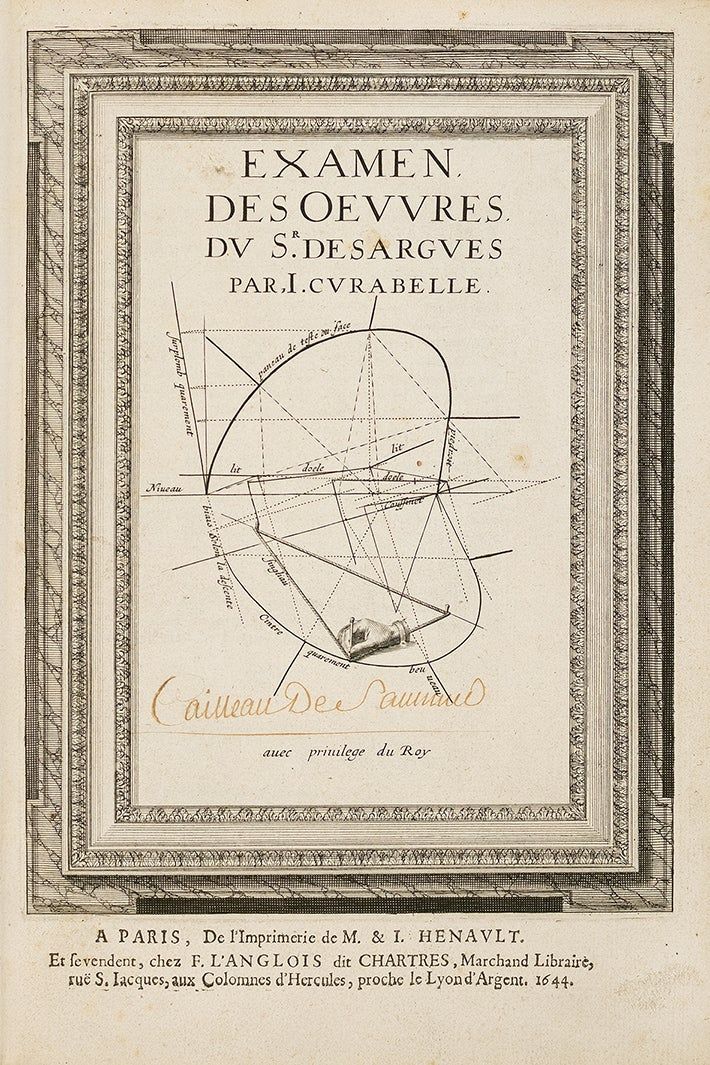
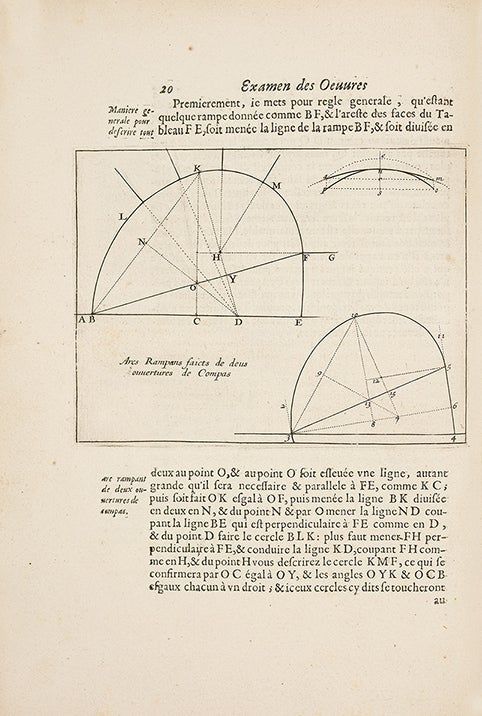
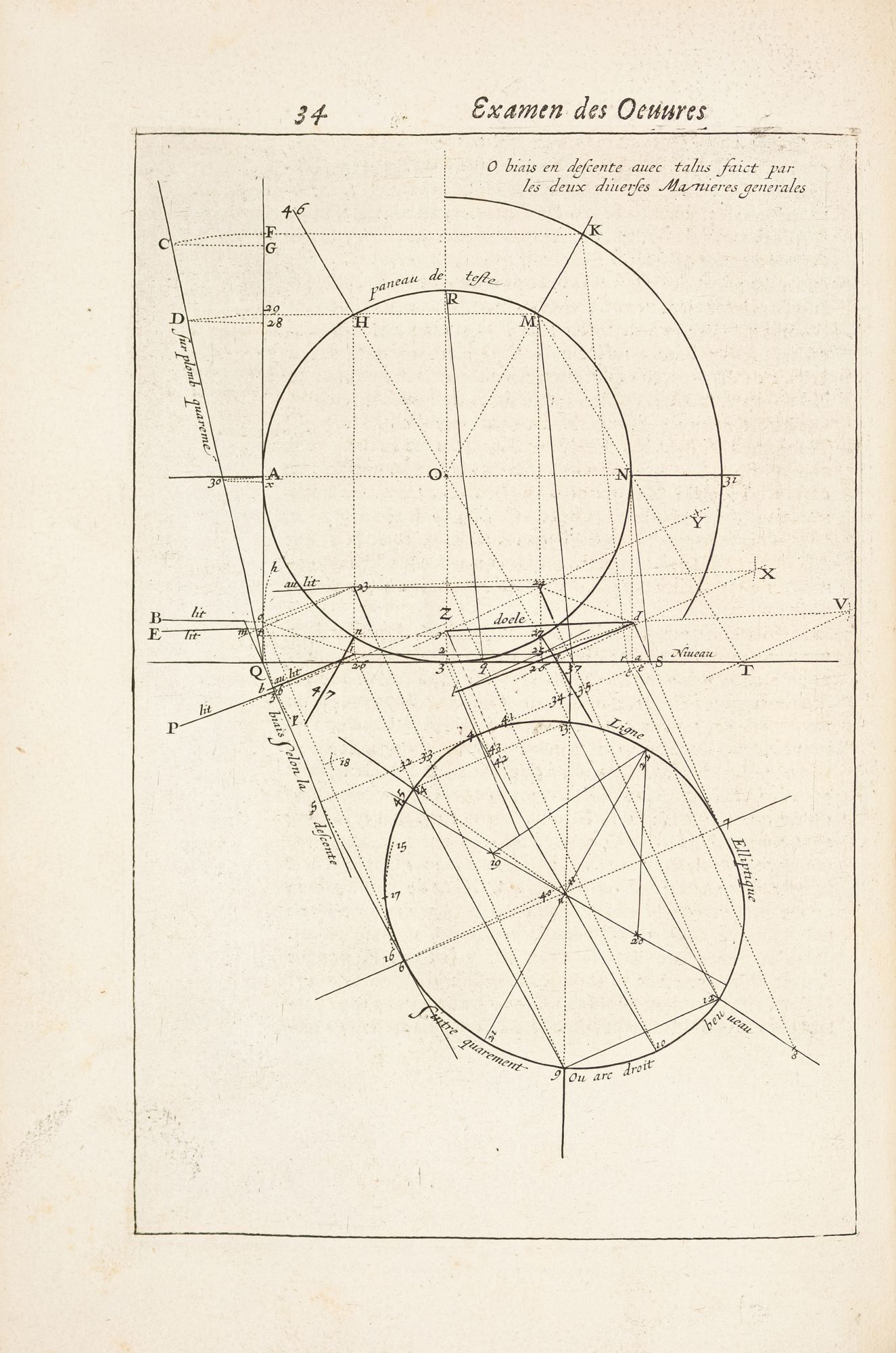
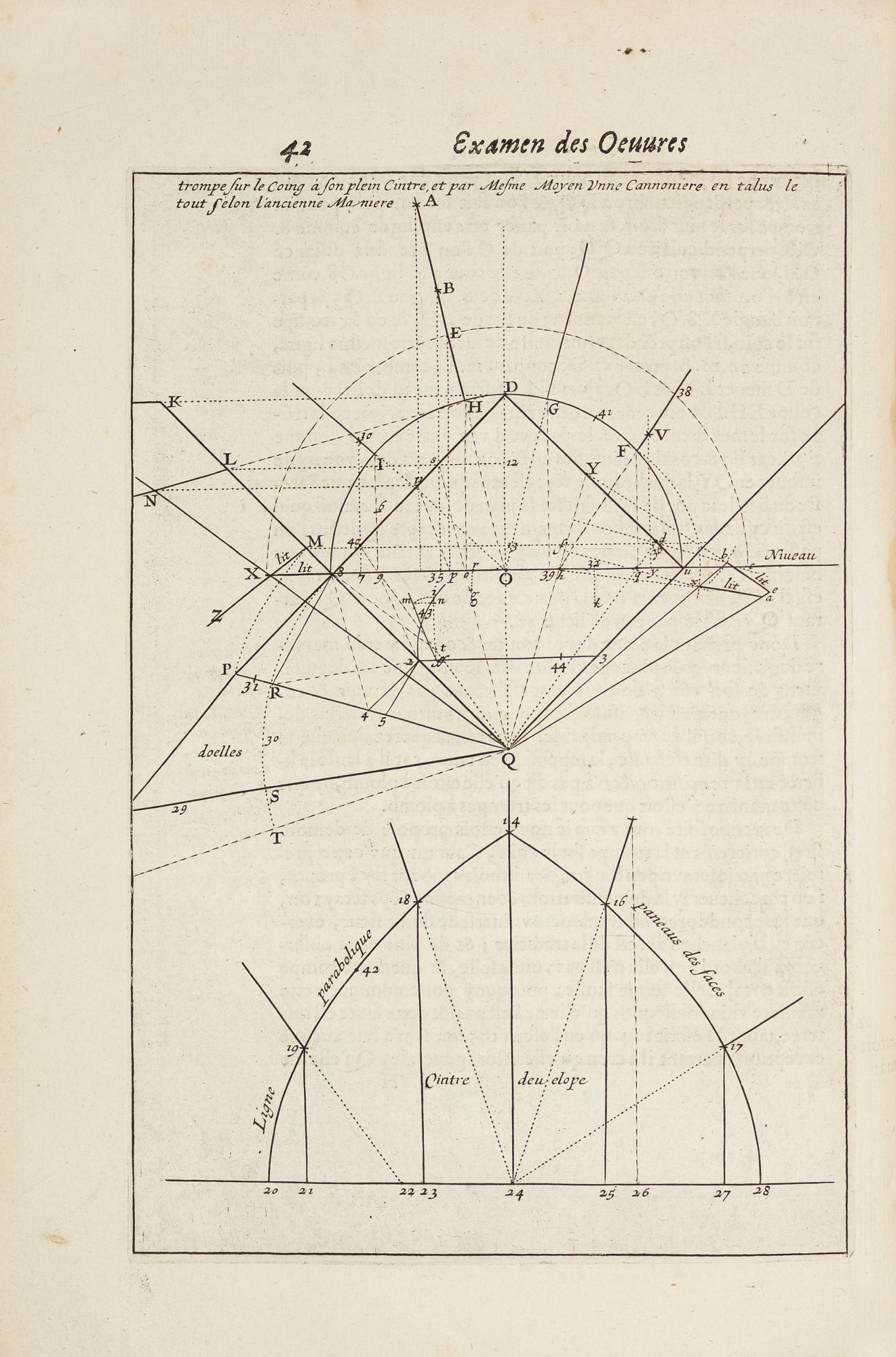
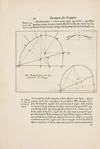
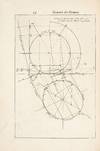
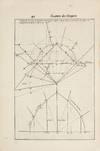
Paris: Henault for Langlois, 1644. Folio (29.5 × 21 cm). Red marocco binding in the style of the seventeenth century, with spine and edges richly gilt; 81, [1] pp. with 17 copper engravings in the pagination (including engraved title and 8 full-page engravings) - Appended text: Paris: n.p., 1644. 9, [1] pp. with one text copperplate engraving. Title page with ownership note by "Cailleau de Saumuie" (ink offsetting on the flyleaf); somewhat toned and slightly stained; else very good.
First edition of one of the first pamphlets in the Parisian "Perspective War", here bound with the rare treatise "Foiblesse pitoyable du Sr. Desargues", in which Curabelle reacts to Desargues' response to "Examen des oeuvres du Sr. Desargues". With this work, the Parisian architect and sculptor Curabelle intervened in a dispute between the mathematician and architect Gérard Desargues on the one hand, and the Jesuit Jean Dubreuil on the other. This dispute developed over many decades in Paris into a core conflict that went down in history as the "Perspective War". The art historian Martin Kemp also calls this "war" the "golden age of perspective tracts".
In contrast to Kirsti Andersen, Andrew Horn emphasized a few years ago that the "Perspective War" had a considerable influence, at least indirectly, on the practice and theory of illusionist ceiling painting, which would characterize the interaction between architecture and visual illusion in the late Baroque period, especially since Andrea Pozzo. Thus Horn emphasizes, for example, Desargues' and Dubreuil's interest in images on slanted surfaces. "This lesson, of course, is a necessary step before addressing more complex cases, from the rendering of images and entire illusionistic perspective systems on surfaces that are irregular or not perpendicular to the eye - the majority of situations in which Pozzo worked in his quadratura projects" (Andrew Horn, Ritual, Scenography and Illusion: Andrea Pozzo and the Religious Theatre of the Seventeenth, Edinburgh 2016, p. 76; cf. Kirsti Andersen, The Geometry of an Art: The History of the Mathematical Theory of Perspective from Alberti to Monge, New York 2007, p. 451).
The initial cause for the "Perspective War" was Dubreuil's positive reception of Desargues' methodology of perspective construction (whose actual significance as the beginning of projective geometry was only recognized in the nineteenth century by Jean-Victor Poncelet and Michel Chasles - who encountered the then-forgotten author via Blaise Pascal). Desargues saw his theory falsified and plagiarized in Dubreuil's extensive work "Perspective pratique" (for a long time the definitive compendium for painters, architects, stage designers, and other artisans) and responded with two shorter texts in which he accused Dubreuil of "incredible errors" and "enormous mistakes". In response, Dubreuil published a treatise in which he in turn accused Desargues of plagiarism. However, in the ensuing back and forth of accusations and insults, the fundamental question of how geometric theory and artistic practice related to each other was negotiated. (Cf. Martin Kemp. The Science of Art. Optical Themes in Western Art From Brunelleschi to Seurat. New Haven/London 1989, pp. 119-131.)
The Parisian architect and stonemason Jacques Curabelle took Dubreuil's side at the very outset of the controversy with the present treatise. Here he extended the criticism of the mathematician, whose theory, in Curabelle's view, does not do justice to artistic practice. (Cf. M. Poudra, Oeuvres de Desargues, Paris 1864, p. 887f.) The "Dictionary of scientific biography" states: "In 1644, however, new attacks were launched against Desargues's work. They originated with a stonecutter, J. Curabelle, who violently criticized his writings on stonecutting, perspective, and gnomonics, as well as the two treatises Bosse published in 1643, claiming to find nothing in them but mediocrity, errors, plagiarism, and information of no practical interest. A very harsh polemic began between the two men, and Desargues published the pamphlet "Récit au vray de ce qui a esté la cause de faire cet escrit", which contains a number of previously unpublished details on his life and work. He also attempted to sue Curabelle, but the latter seems to have succeeded in evading this action." (DSB IV, p.48). As a result, Curabelle published the pamphlet "Foiblesse pitoyable du Sr. Desargue", which is bound with our copy.
With the founding of the Paris Academy of Arts, this conflict raised the question of which party would prevail within the institution. One avowed partisan of Desargues was the graphic artist Abraham Bosse, who was appointed to the newly founded Paris Academy to teach perspective. He paid particular attention to the illusionistic projection of perspective onto ceilings and vaults. His opponent at the academy was Charles Le Brun, who, citing Leonardo's writings, questioned the prioritization of geometric theory over painterly perception and practice. The dispute came to such a head that Bosse was expelled from the Academy and forbidden to spread "slander" about the Academy on pain of imprisonment. This was followed by numerous other treatises by Bosse, in which he set out his teachings influenced by Desargues. (Cf. Martin Kemp. The Science of Art. Optical Themes in Western Art From Brunelleschi to Seurat. New Haven and London 1989, pp. 119-131).
Poudra 331-348. DSB IV, p. 48. Kemp, The Science of Art, 1990, 123 (mit Anm. 93) und 351. Andersen, The Geometry of an Art, p. 451.