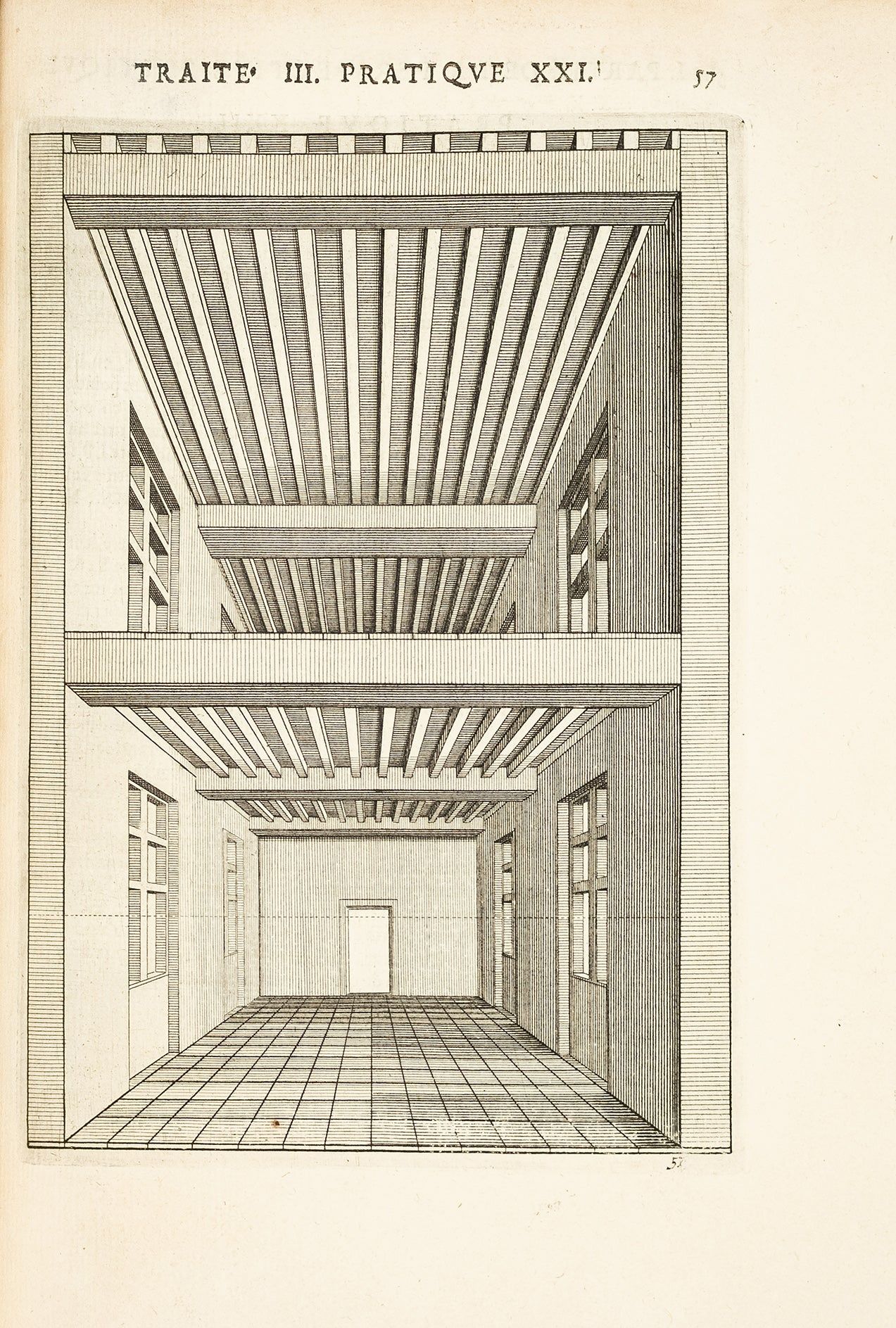
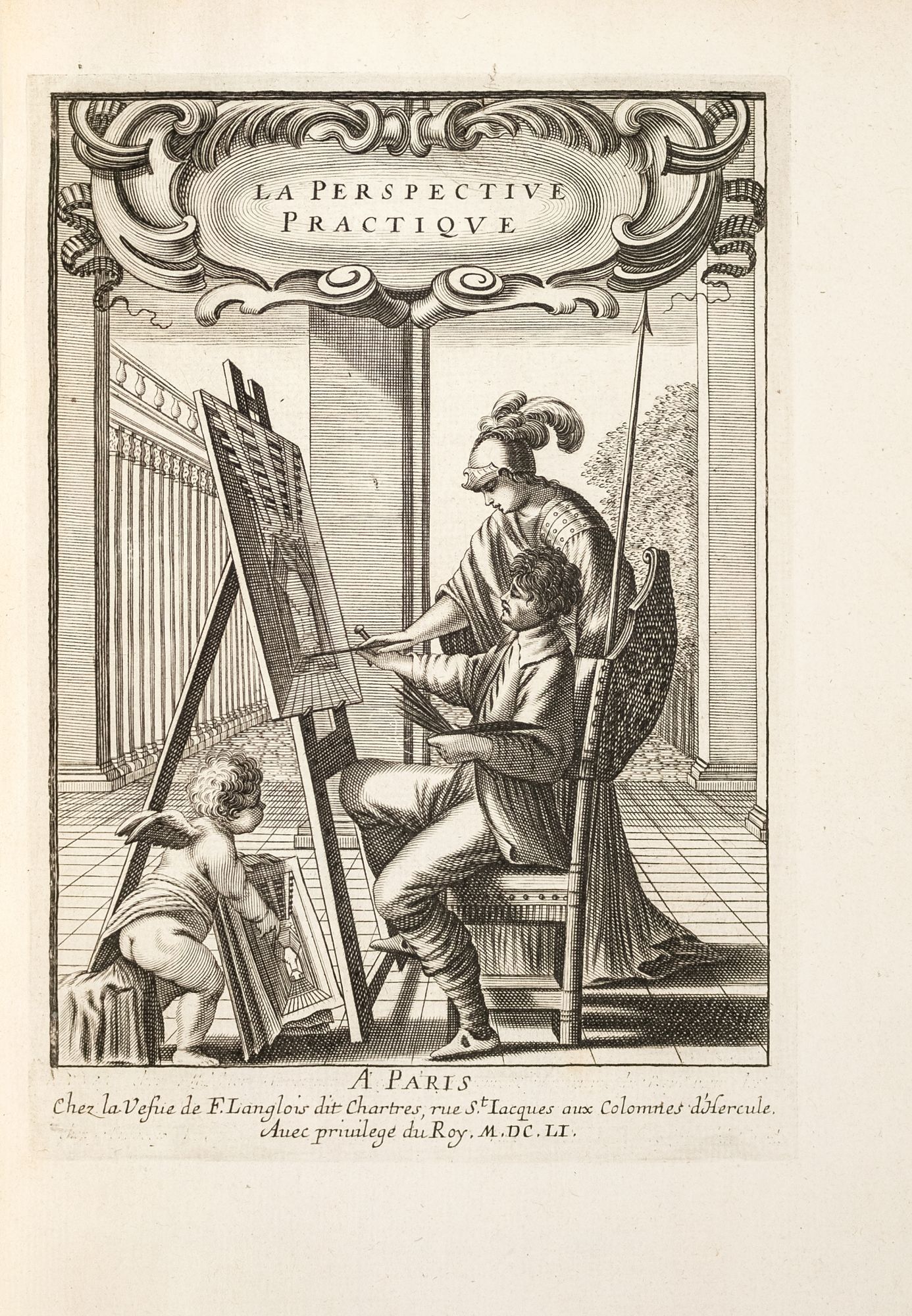
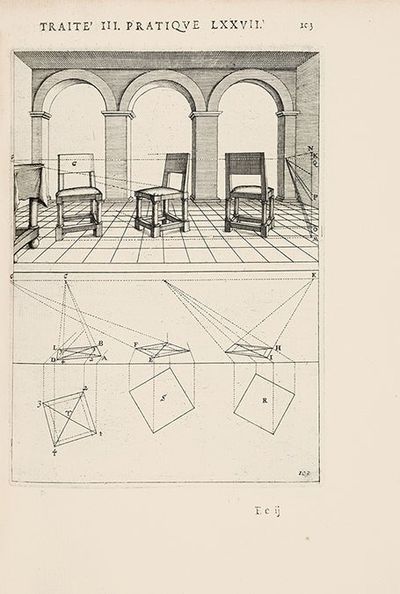
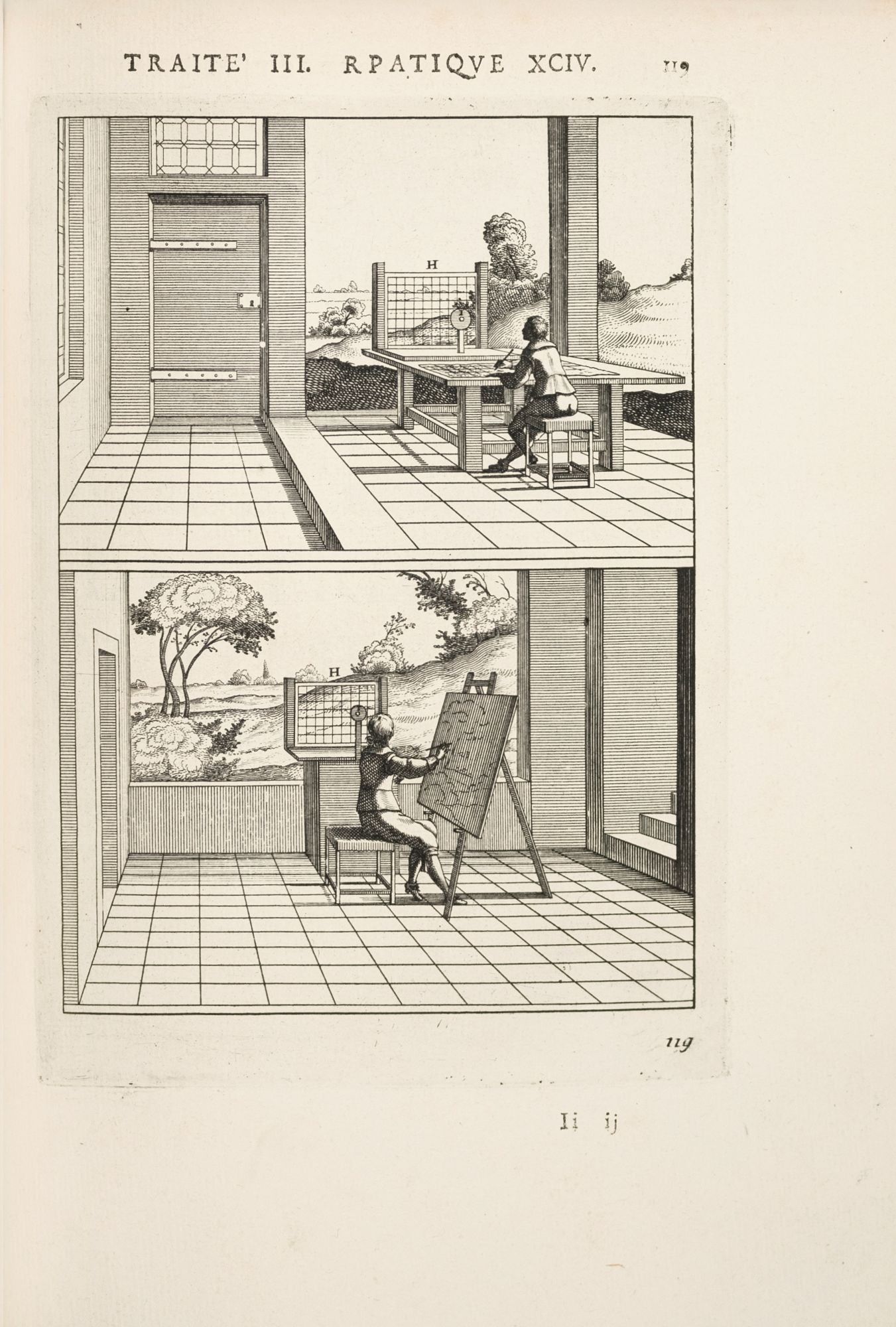
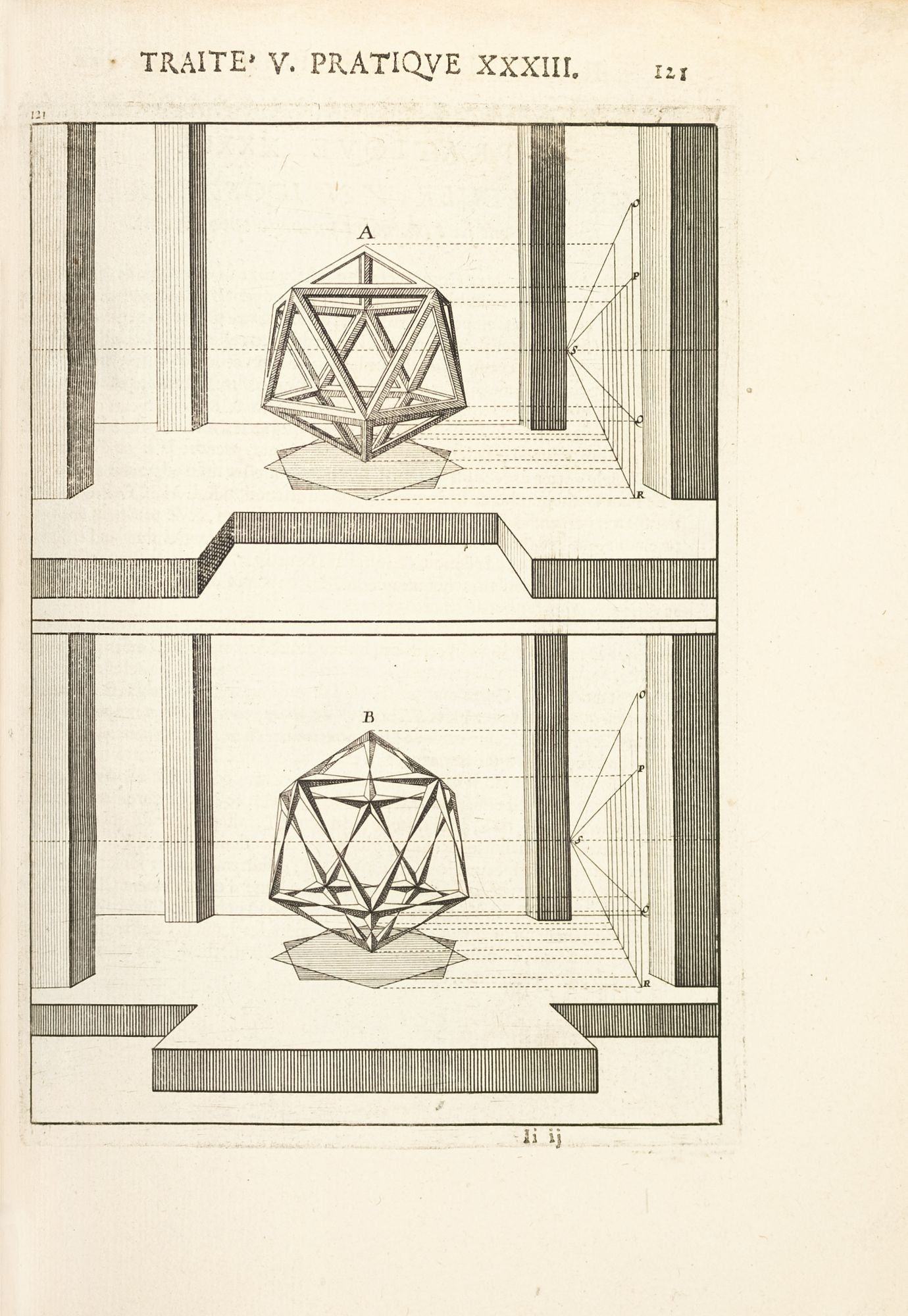
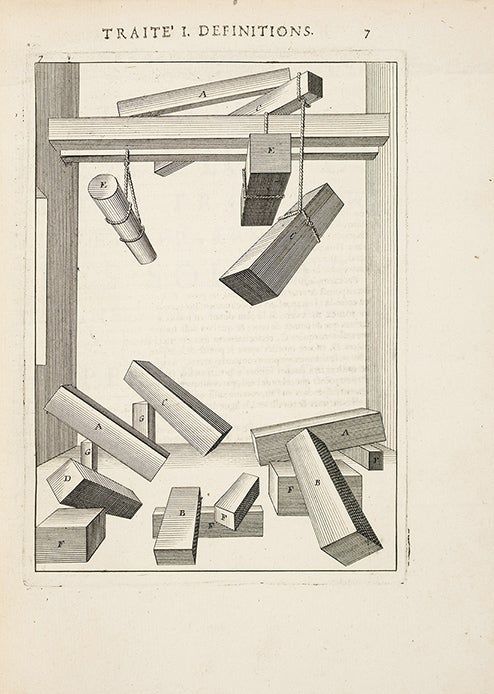
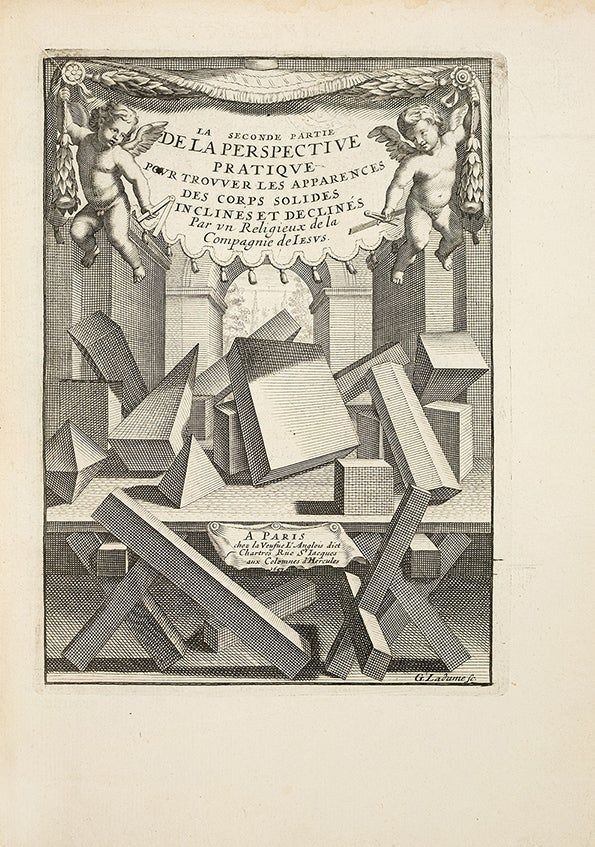
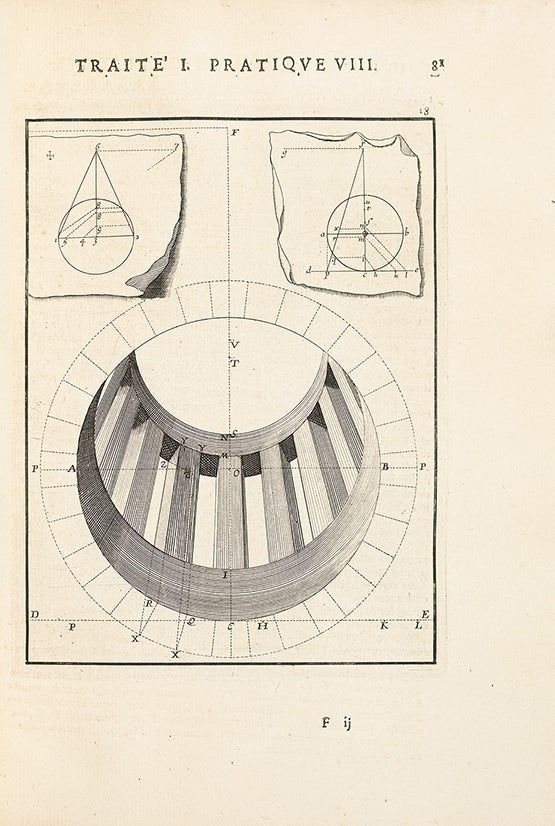
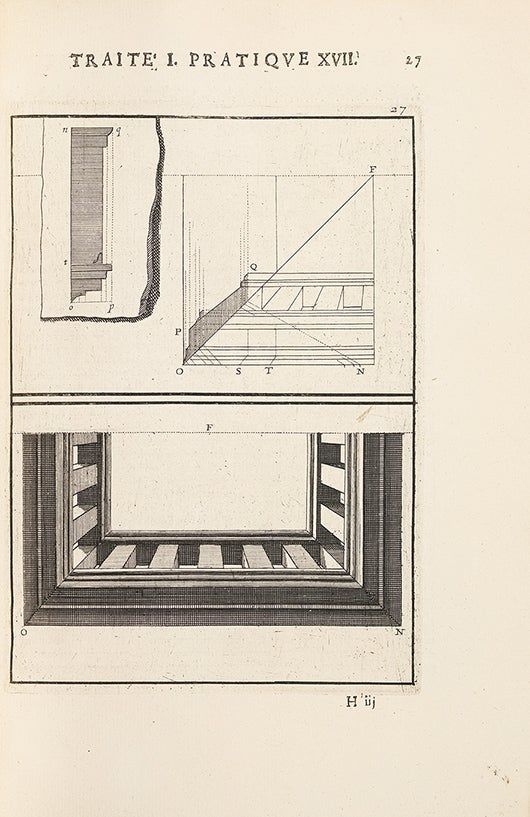
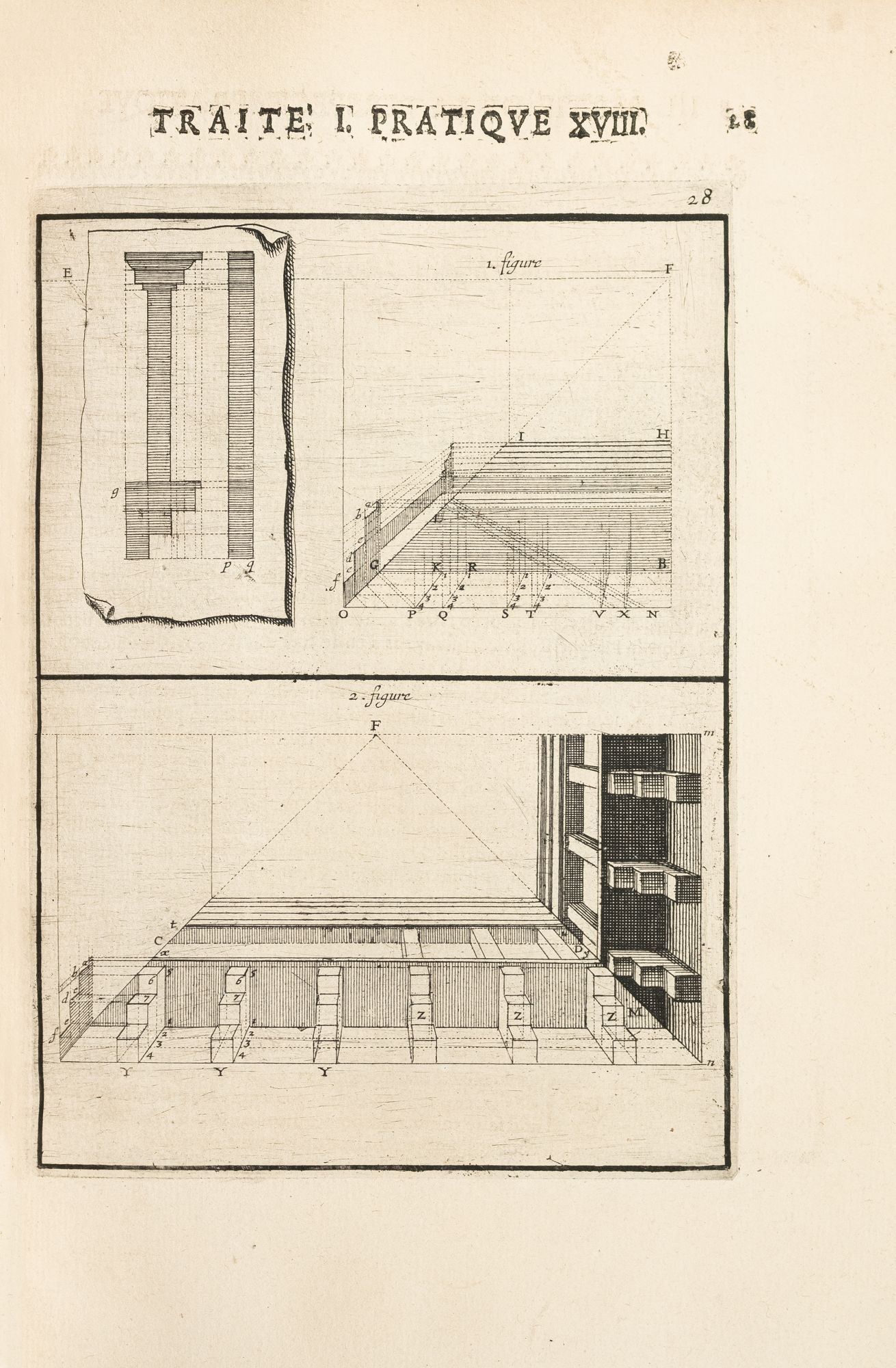
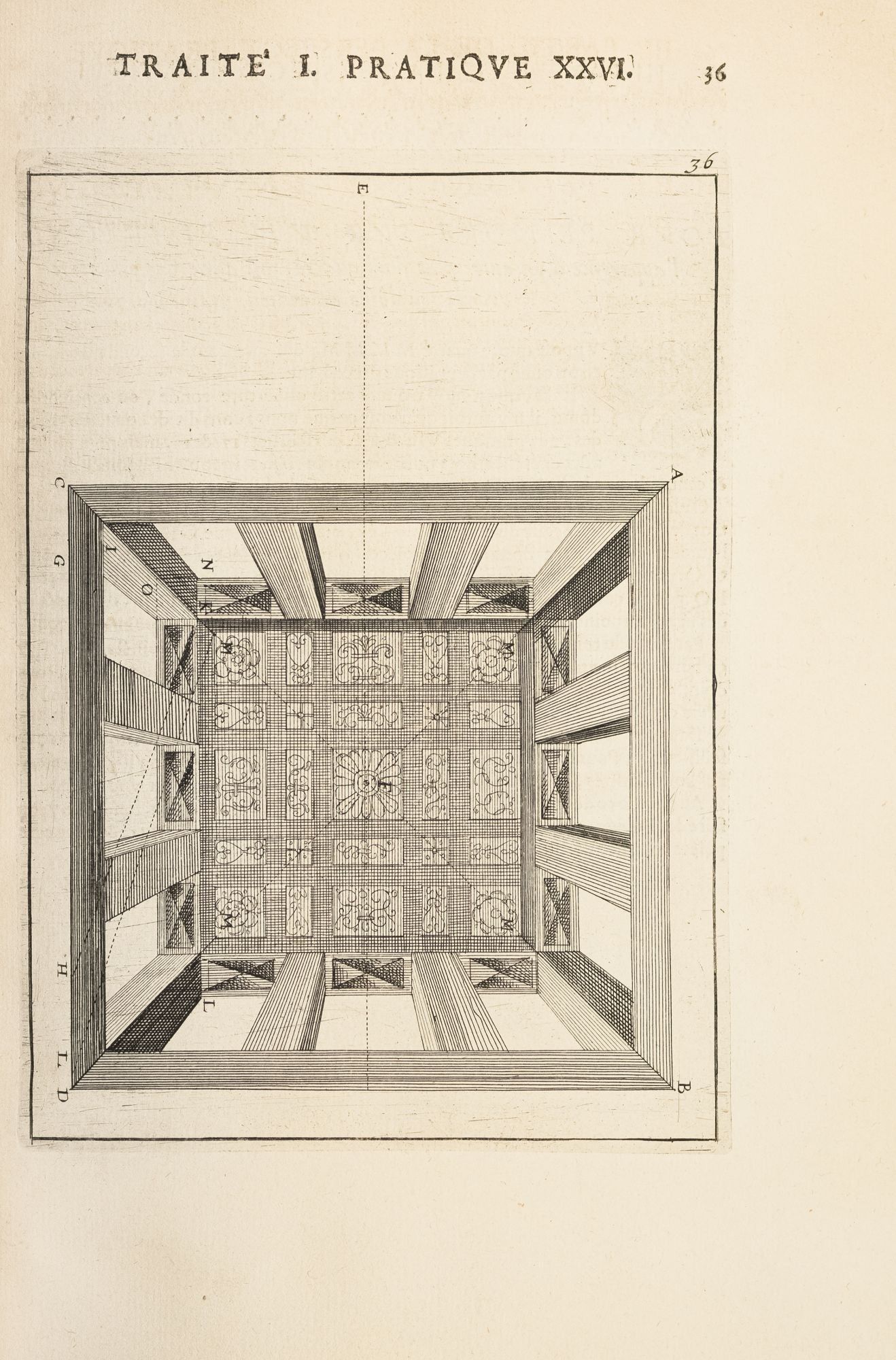
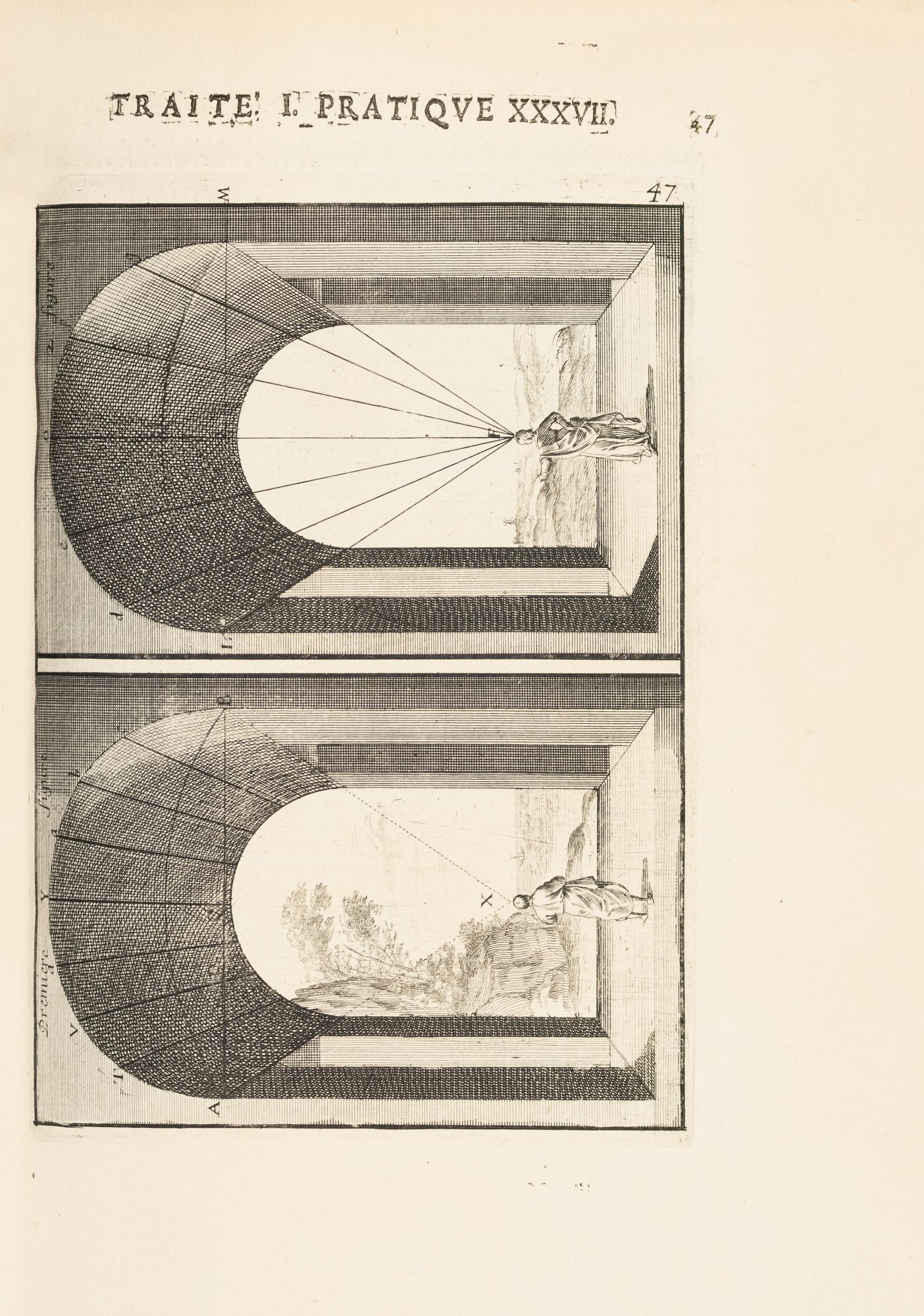
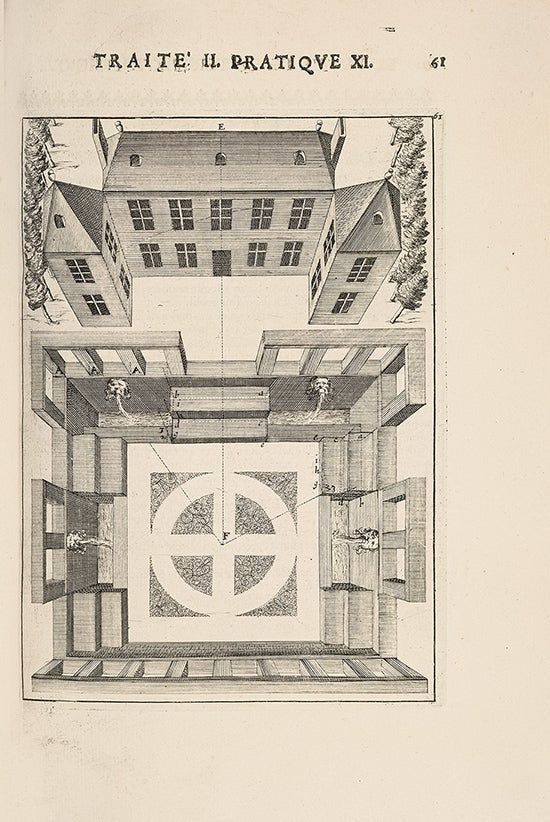
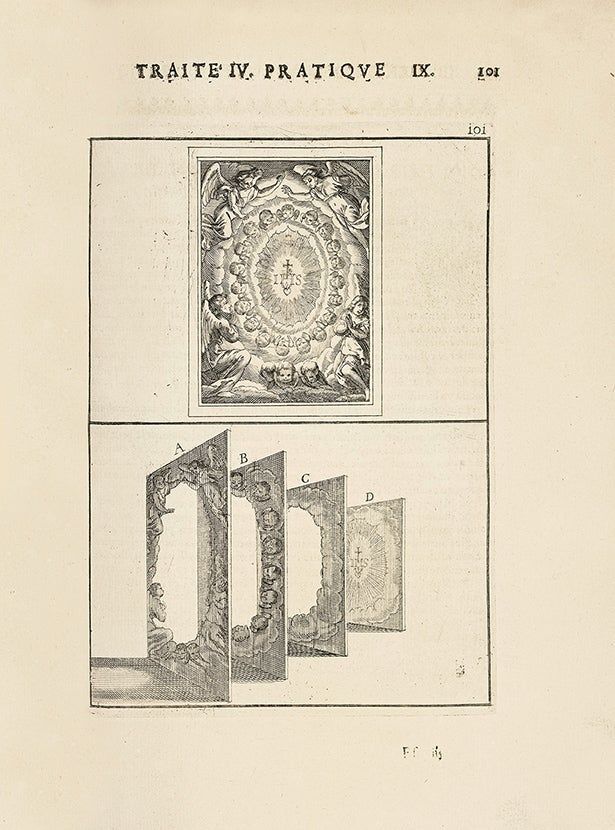
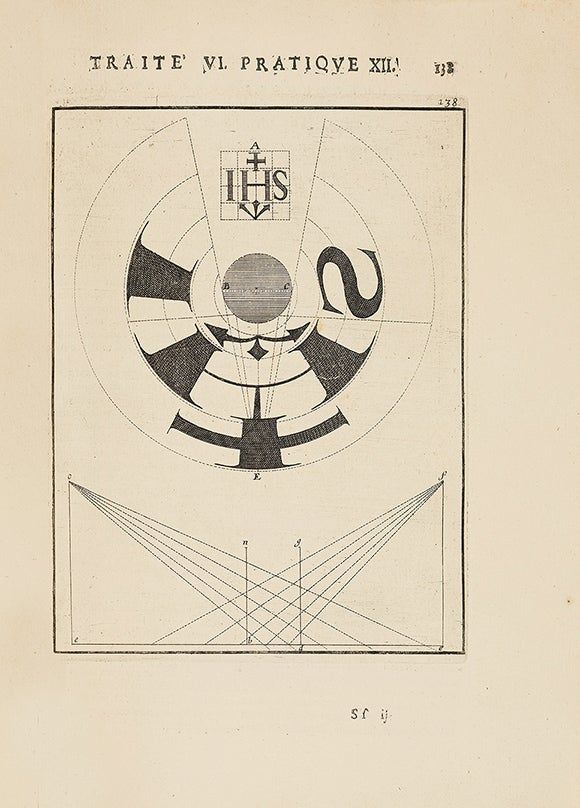
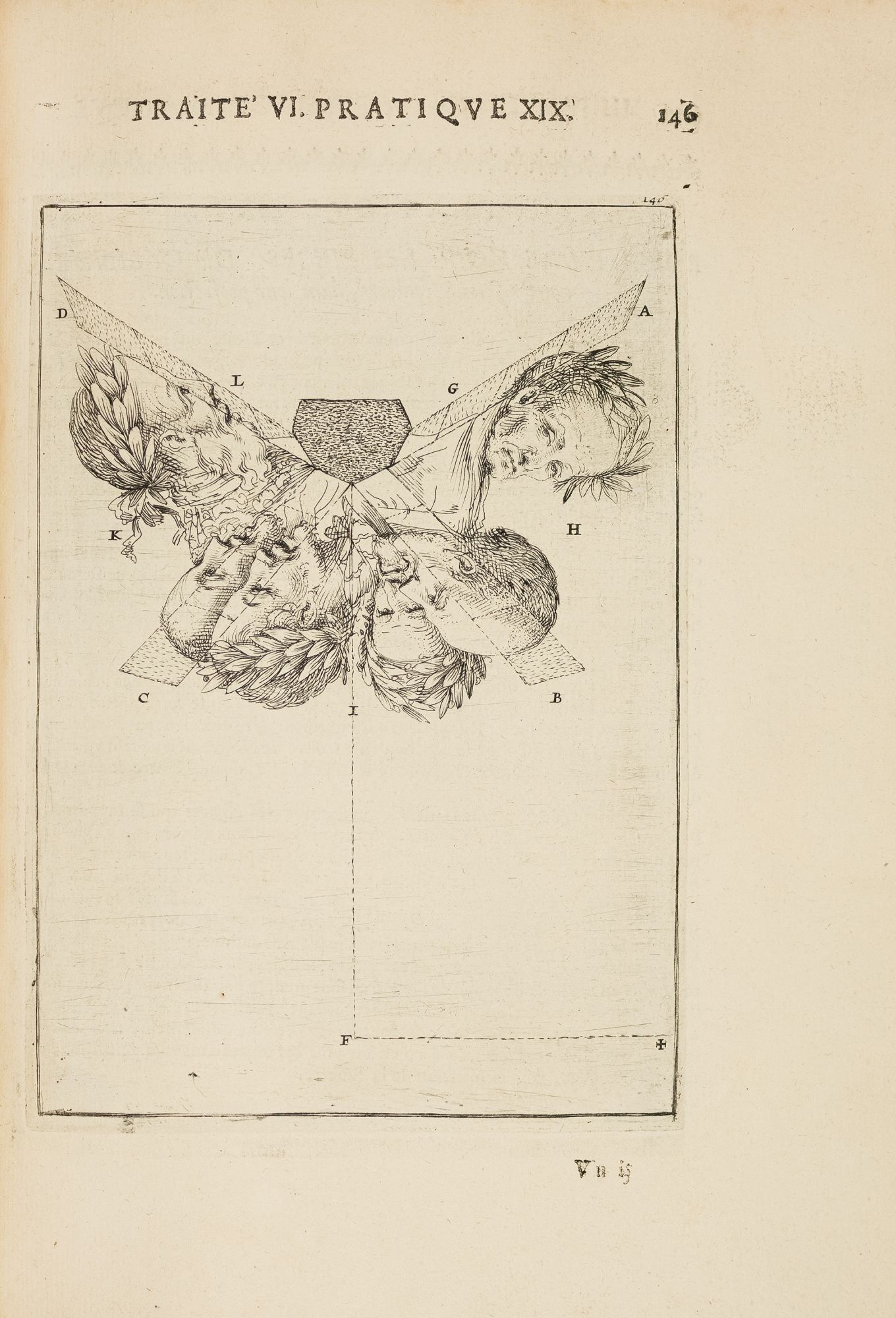
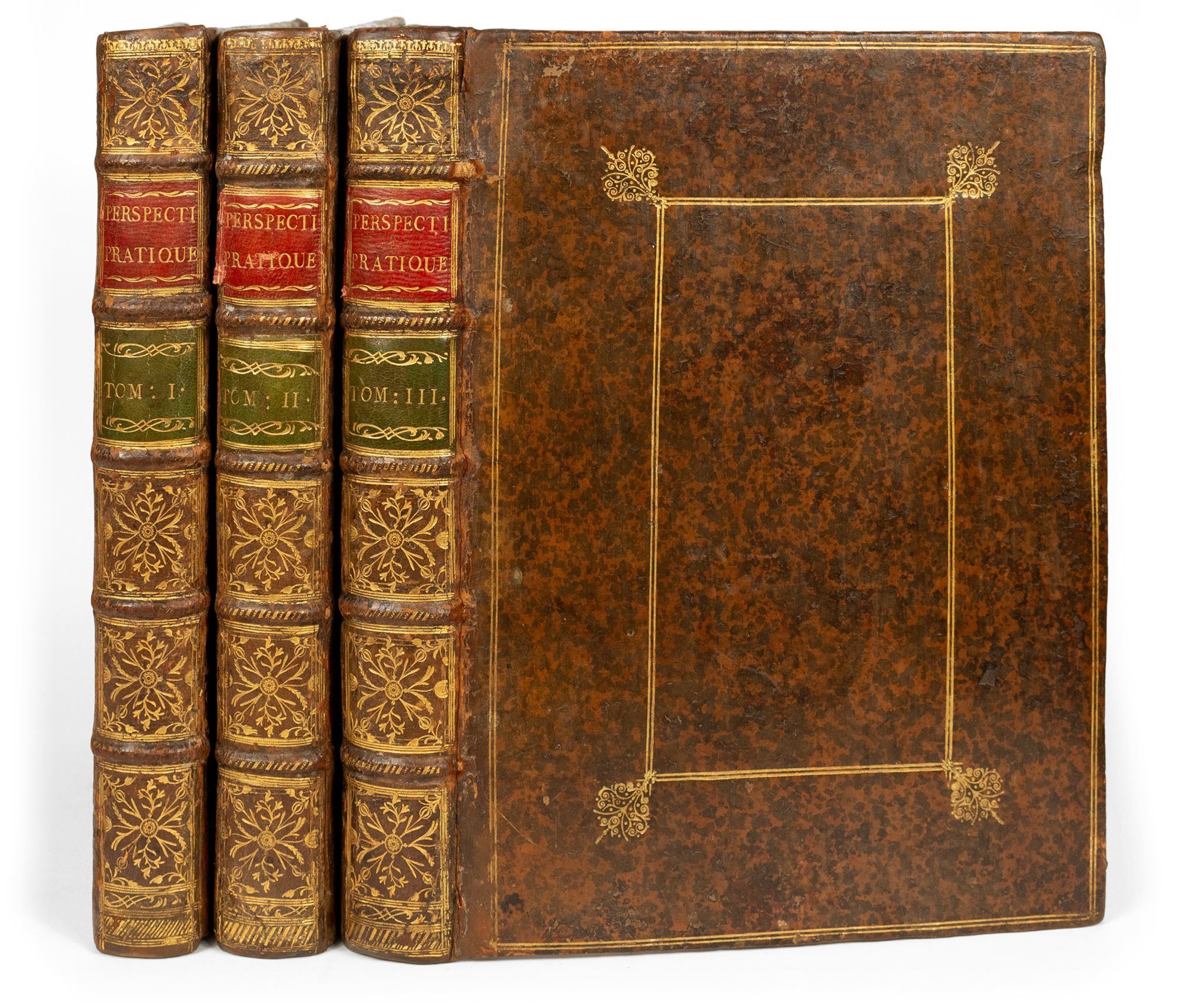
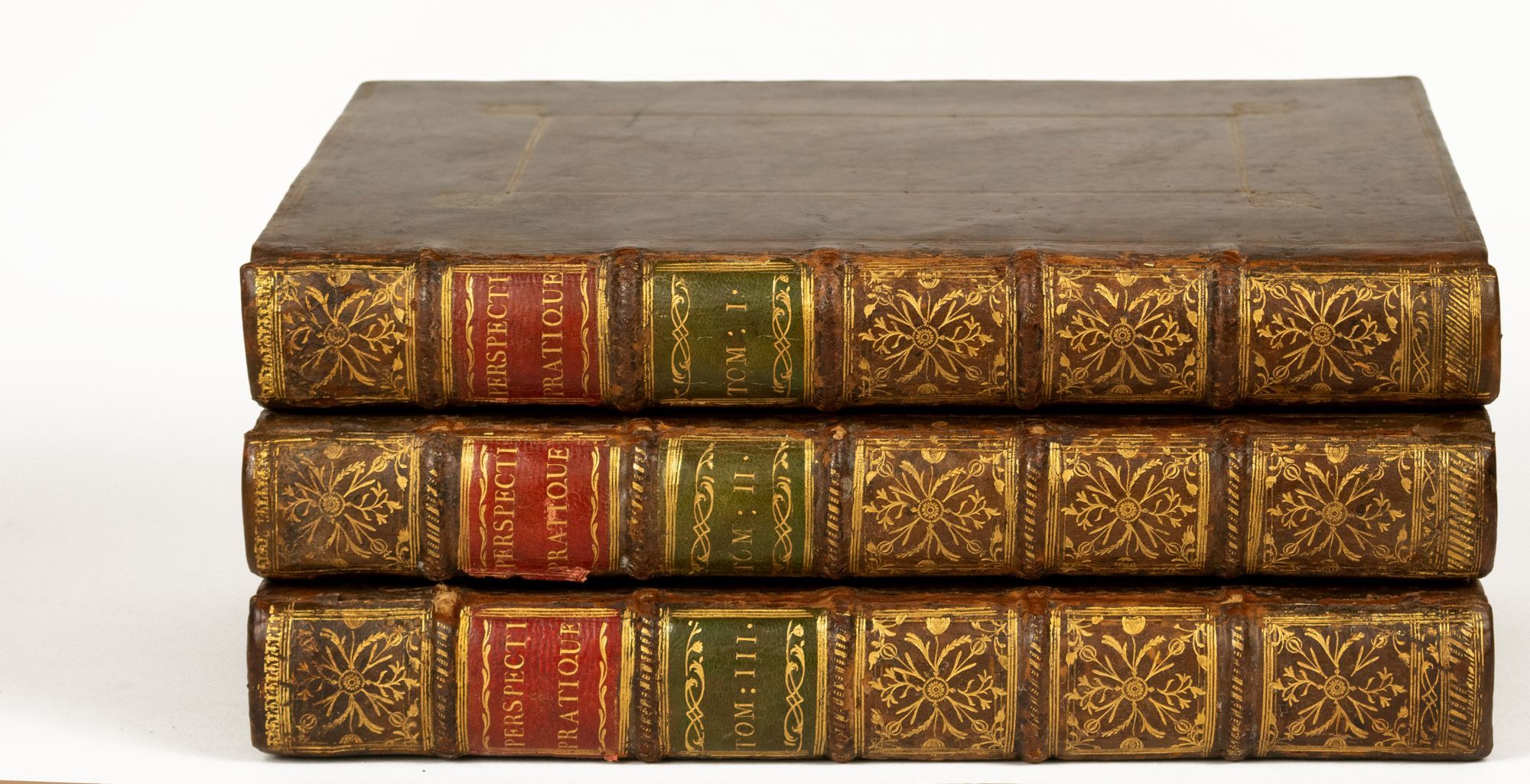
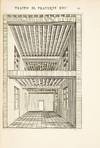
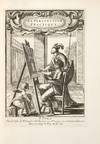
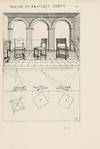
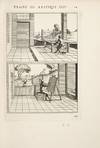
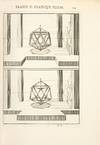
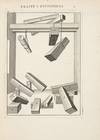
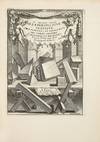
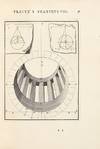
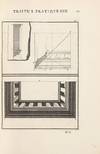
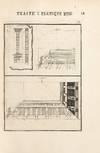
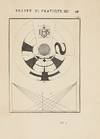
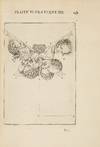
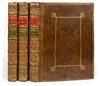
Paris: L'Anglois, 1647-1651. Quarto (27.8 × 21 cm). Eighteenth-century leather bindings, each with two colored spine labels and gilt ornaments and fillets to spines and boards; 2 blank leaves, [49] pp., 172 [recte 173] numbered leaves and [36] pp. interspersed between the seven parts, [11] pp., 4 blank leaves; 4 blank leaves, [23] pp., 123 numbered leaves and [8] pp. interspersed between the five parts, [13] pp., [Collation of the bound-in supplements see below], 41 blank leaves; 2 blank leaves, [39] pp., 156 [recte 166] numbered leaves and [44] pp. interspersed between the five parts, [14] pp., 8 blank leaves. The three volumes with a total of 462 full-page copperplate engravings (of which 3 are folded and double-paged, one of them a duplicate), 3 engraved title pp., and numerous engraved vignettes and initials. The Macclesfield copy, with the armorial bookplate to all three volumes. The pagination of the leaves and engravings skips back and forth several times (see Millard for a detailed list); with wide margins, noticeably larger than the one recorded by Millard; in the second volume, corrections were made by the printer or binder via pasting over: copper plate 12 and 4 leaves of the plate register; bindings with age-typical signs of use; joints barely noticeably, professionally restored; slightly toned in places; only a few leaves sporadically faintly stained; title pages with blind-stamped owner's stamps; else very good. This art-historically significant and extensive practical introduction to perspective not only marks the beginning of the so-called "perspective war" in France, but also influenced the development of Baroque illusionistic painting - a practice that would become formative for seventeenth- and eighteenth-century architecture, above all through Andrea Pozzo, who was also a member of the Jesuit order. Dubreuil's "work on perspective is probably the most influential ever published expressly for the use of a lay audience" (Millard). Available here is a compilation of different editions: The first volume in the second, expanded edition, the other two volumes and the appendices in the first edition (same composition as Millard).
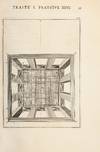
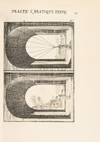
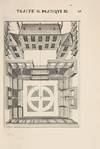
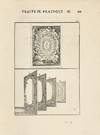
In recent times, Dubreuil's work, which was explicitly aimed at artists, sculptors, architects and all other artisans, has not only become the focus of research into the French "war of perspective". The art historian Andrew Horn has worked out, among other things, that "the essential principles and techniques upon which Pozzo constructed many, if not most of his widely varying projects can be found in Dubreuil's work" (Andrew Horn, Ritual, Scenography and Illusion: Andrea Pozzo and the Religious Theatre of the Seventeenth, Edinburgh 2016, p. 75). The creation of the illusion for three-dimensional architecture rising into the sky, of domes and lantern towers, of celestial choirs and assemblies of saints from a strong under-view on flat surfaces are foreshadowed in Dubreuil's practical instructions on the use of perspective. The Jesuit architect is intensively concerned with changing the perception of space through different locations, viewing angles, and the effects of light and shadow. In addition, he explores architectural structures and openings overhead, including rectangular, round, and irregular shapes viewed from both centered and off-center perspectives. Furthermore, Dubreuil deals with the perception of domes, with the projection of images onto vaults, as well as with anamorphic images. Andrew Horn also refers to Jesuit theatre practice, which in the Baroque period was an essential part of the Counter-Reformation's missionary and educational work. What characterized Jesuit theatre was not merely the use of music, ballet, and pyrotechnic effects to simulate explosions, fire-breathing dragons, lightning, and thunder. By the mid-seventeenth century, a specifically Jesuit art of stage design had developed, aimed at creating illusions of vast spatial depth. Accordingly, "La perspective pratique" contains an extensive section on stage scenography. In it, Dubreuil discusses various methods for creating the illusion of depth, which would later have a formative influence on Pozzo. (Cf. ibid., pp. 44f., 73-77).
But Pozzo also developed his strategies of illusionist ceiling painting, as Andrew Horn points out, on the basis of publications by authors who positioned themselves against Dubreuil in the so-called "Perspective War". After all, this debate, which lasted many decades and was primarily conducted through printed treatises, was the driving force behind the production of an almost unmanageable number of publications. It is not without reason that this period is also regarded as the golden age of treatises on perspective. The immediate cause of the debate was Dubreuil's "Perspective pratique". In it, he also dealt with Gérard Desargues' projective geometry in order to make it practically usable. Desargues responded with two small texts in which he accused Dubreuil (who identified himself on the title pages only as the Jesuit from Paris) of "incredible errors" and "enormous mistakes". In response, Dubreuil published "Diverses methodes universelles, et nouvelles", also incorporated here, in which he accused Desargues of plagiarism. However, in the ensuing back and forth of accusations and insults, the fundamental question of how geometric theory and artistic practice related to each other was negotiated. With the founding of the Paris Academy of Arts, this also became a question of which party would prevail in the dispute within the institution. (Cf. Martin Kemp. The Science of Art. Optical Themes in Western Art from Brunelleschi to Seurat. New Haven/London 1989, pp. 119-131).
An avowed partisan of Desargues was the graphic artist Abraham Bosse, who was appointed to the newly founded Paris Academy to teach perspective. He paid particular attention to the illusionistic projection of perspective onto ceilings and vaults. His opponent at the academy was Charles Le Brun, who, citing Leonardo's writings, questioned the prioritization of geometric theory over painterly perception and practice. The dispute came to such a head that Bosse was expelled from the Academy and forbidden to spread "slander" about the Academy on pain of imprisonment. This was followed by numerous other treatises by Bosse, in which he set out his teachings influenced by Desargues. In contrast to Desargues and Bosse, Dubreil was of the opinion that although the rules of perspective were a useful aid, they were subordinate to practical considerations and experience. Put in simplified and pointed terms, the question was whether the artist was executing the complex rules of geometry or whether they were being used as an instrument alongside his perception and practice (ibid).
De Backer and Sommervogel quote two letters by the London mathematician Augustus De Morgan, who describes Dubreuil's influence on artists and architects as late as the mid-nineteenth century: "The work (of Breuil) is better known than that of Pozzo, both in England and in France. It is in French (1642, etc.), and has been translated into both German and English. (...) Of all the works on perspective which have been in the hands of practical draughtsmen, this is the most widely known. (...) This Jesuit's perspective has had more influence on common methods than any other." In the second letter, he again compares the history of Pozzo's and Dubreil's impact in practical application: "Pozzo is a greater writer, but Du Breuil made a book of routine, which was very accessible to draughtsmen who knew nothing about geometry."
Bound with:
I). Melchior Tavernier. Advis charitables sur les diverses oeuvres et feuilles volantes du Dr. Girard Desargues. Paris: Tavernier and L'Anglois, 1642. [4], 14, [1] pp.
II). [Jean Dubreuil]. Diverses methodes universelles, et nouvelles. (...) por faire des perspectives (...) Response aux deux affiches du Sieur Desargues contre la (...) Perspective pratique. Paris: Tavernier and L'Anglois, 1642. [36] pp. with 10 full-page copper engravings.
III). Extraict d'une lettre de Mr R. touchant les erreurs prétendues dans le livre de la Perspective practique. N.p.: n.p. [1642]. [4] pp.
Provenance: Library of the Earls of Macclesfield, Shirburn Castle. / George Lane Parker (1742-1791), younger son of the second Earl of Macclesfield (1697-1764). On the question of whether the engraved exlibris on the endpapers were already pasted in by Parker or were only made in the nineteenth century when they were incorporated into the library of Shirburn Castle, see: >https://blogs.princeton.edu/rarebooks/2012/12/militar-collection/