- Condition: Very good.
- Location: [Various locations, mainly Tokyo and New York
- Date: 1967
- Seller SKU: 4169
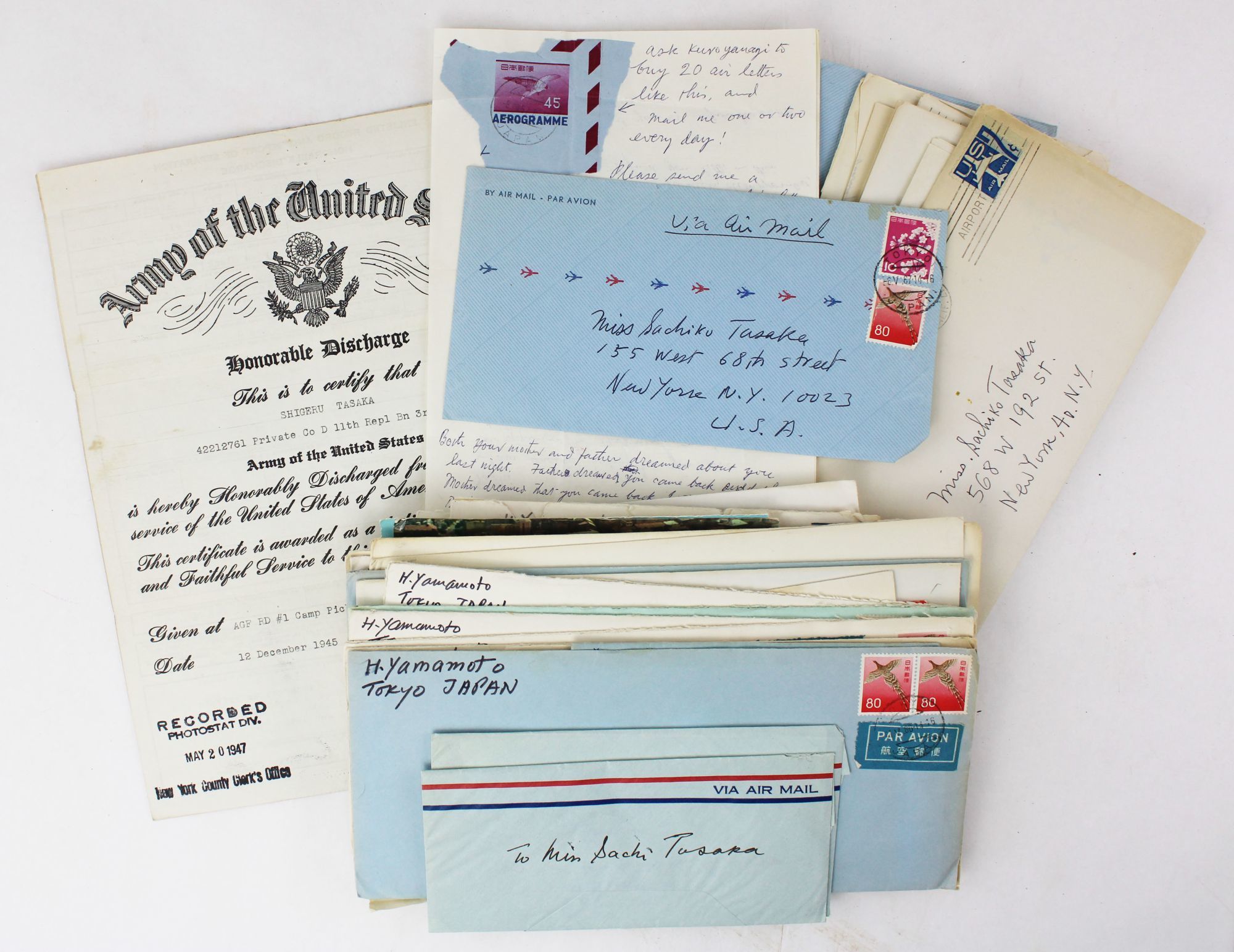
[Various locations, mainly Tokyo and New York, 1967. Very good.. Twenty-three manuscript letters, signed, totaling fifty-nine pages, plus three postcards, thirteen greeting cards, eighteen photographs, and a small collection of related papers. Occasional wear and fold separations to letters. Otherwise general use wear. An informative archive of correspondence, photographs, and more belonging to a young Japanese-American woman named Sachiko Tasaka. Sachiko was born in Brooklyn in 1921, but still had deep roots in Japan. Most of the letters here were written to Sachiko by Hideo Yamamoto, who appears to have been a scientist or businessman who worked for some period for Asahi Glass, one of the world's largest glass companies. The letters from Hideo to Sachiko were written from various locations, mostly in the United States, while he was traveling for business. The earliest letters were sent to Sachiko in Japan, but the great majority of them were sent to her in New York. Hideo was married to another woman who lived in Japan, and mentions his family and children to Sachiko in a few cases.
Hideo's tone to Sachiko is often controlling. He constantly complains that Sachiko is not writing back to him enough, at one point noting that "Nobody can understand why you don't write even a short note, and everybody is uneasy about you." He also attempts to direct her travel and movements, determine her wardrobe, and often insults her (in more than one letter, he refers to Sachiko as an animal, i.e., "I think you are animal wiser than dog. I hope you are a human being, a sensible human being.... What kind of animal you are: you have no human thoughtfulness"). An example of his controlling nature appears in his November 2, 1957 letter: "Cut short your trip! Ask Kuroyanagi to cable me your arrival flight immediately. Take PAA or NWA in case JAL unavailable.... Skip visit to Hawaii. I don't want you to have your own memories about Hawaii when we take trip together." In another letter, he comments that "You don't have to listen to anyone except me." And in two instances, Hideo expresses that he is more interested in what Sachiko is thinking than what she is doing.
Hideo also writes about his business activities, visits with mutual acquaintances, his sightseeing, world events, and more. In one early letter, Hideo mentions a Japanese travel guide that Sachiko was supposed to be writing. Throughout the course of his correspondence Hideo comments on Sputnik, criticizes American involvement in the Vietnam War, harps on the importance of education, and more. Hideo writes mostly in English, but occasionally writes portions of his letters in Japanese. In one case, Hideo sends Sachiko an original poem. In one letter in 1967, Hideo finally addresses the state of his marriage, which seems to be colored by his relationship with Sachiko: "I have not yet had any chance to talk to my wife. Serious problem. I know I am avoiding such chance consciously or unconsciously...and my wife, too, is avoiding such a chance."
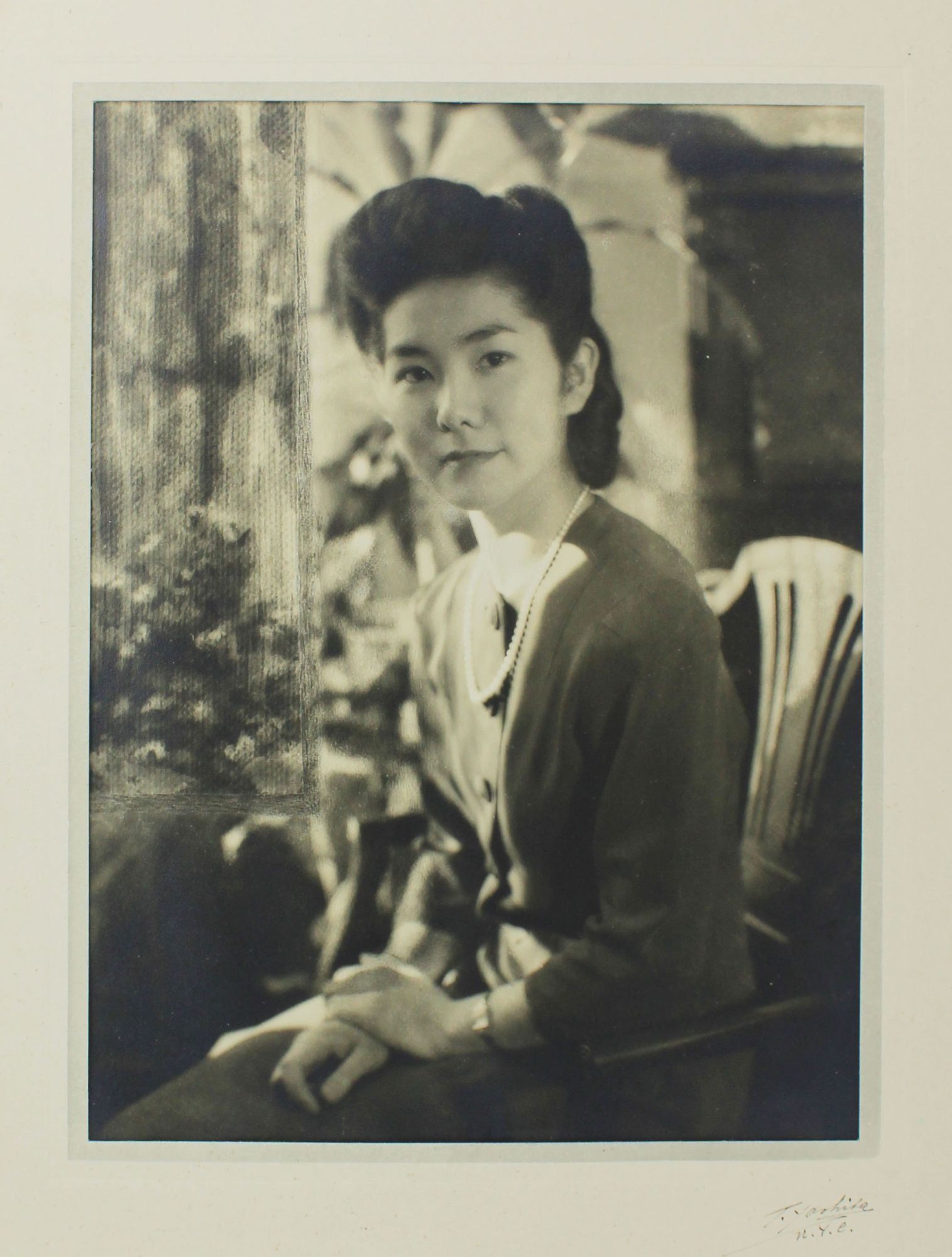
The collection also contains three postcards written to Sachiko, including one from Hideo and two from other correspondents; one of the latter is addressed to Sachiko at Hideo's address on Central Park South, and the other was sent to Sachiko presumably at her work address at the internationally-renowned advertising firm, Doyle Dane Bernbach (a few of the letters are also addressed to Sachiko at DDB). The greeting cards often contain long inscriptions to Sachiko that qualify at least as notes, if not short letters in their own right. Hideo reports further on his activities, work, and more. In one card, he recounts his visit in 1939 to the Princeton home of Professor Albert Einstein, who told him, "You are young but you should study harder because life is short." At least two of the cards are sexual in nature, and speak to the notion that the two were carrying on an affair. The photographs consist of two large studio portraits (one by a Japanese-American photographer in New York, T. Yashita), as well as a portrait of Hideo, and about fifteen vernacular shots mostly comprised of portraits of both Sachiko and Hideo.
The remainder of the archive contains a small amount of material relating to the military careers of Sachiko Tasaka's siblings Shigeru and Toshio, as well as insurance paperwork (in which Hideo names Sachiko the beneficiary each time he takes out travel insurance), a few copies of retained letters sent by Sachiko, a typed itinerary for a trip Sachiko took through Europe in 1971, and more. Throughout the archive, Sachiko is referred to as "Miss," indicating that she never married. Online ancestry documents do not dispute this. From the language of Hideo's letters to her, it is at least easy to understand why she didn't marry HIM.