Skip to content
Have questions? Peter Harrington is online now!
Virtual Book Fair Exclusive

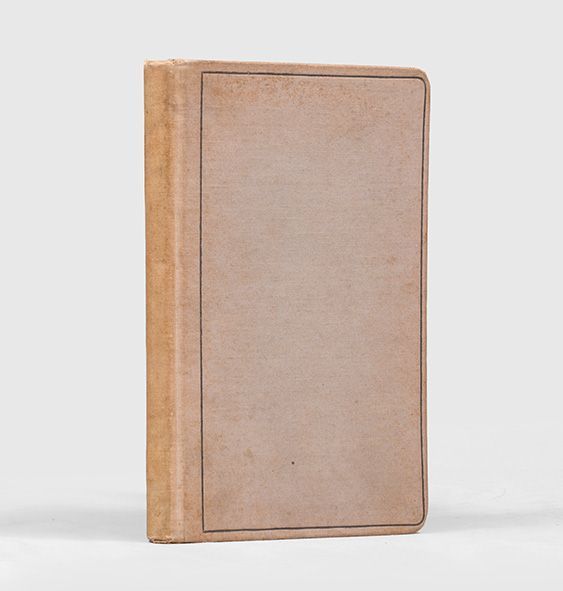
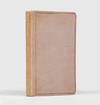
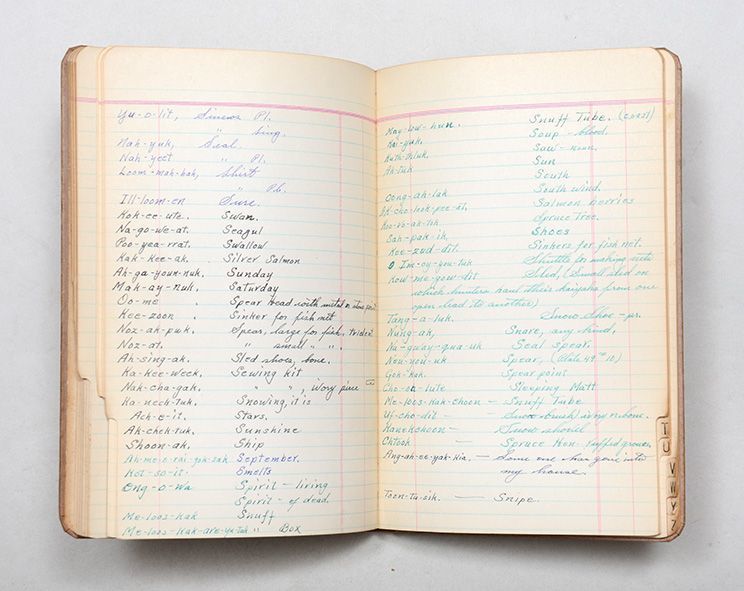
Central Alaskan Yup'ik-English manuscript dictionary.

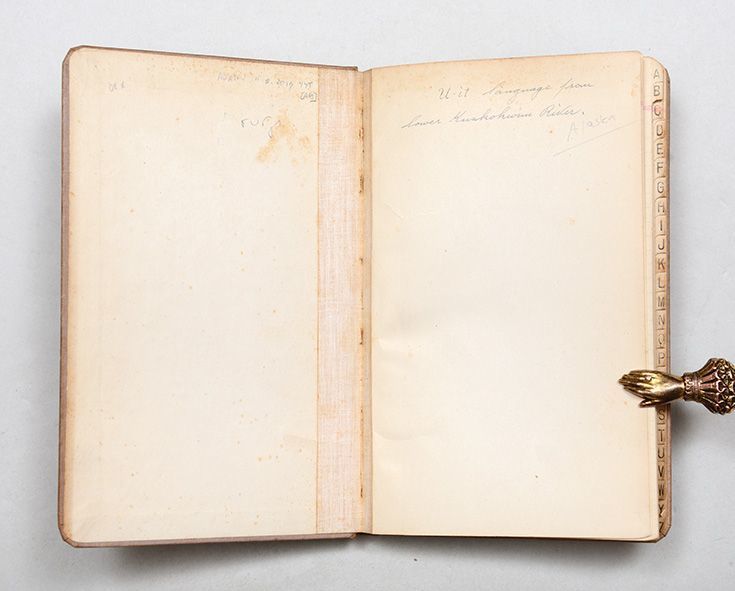
[Title on the front free endpaper:] "U-it language from lower Kuskokwim River, Alaska".

YUPIK LANGUAGE

£2,250
  • Binding: Hardcover
  • Location: Alaska:
  • Date: early 1900s
  • Seller SKU: 138009
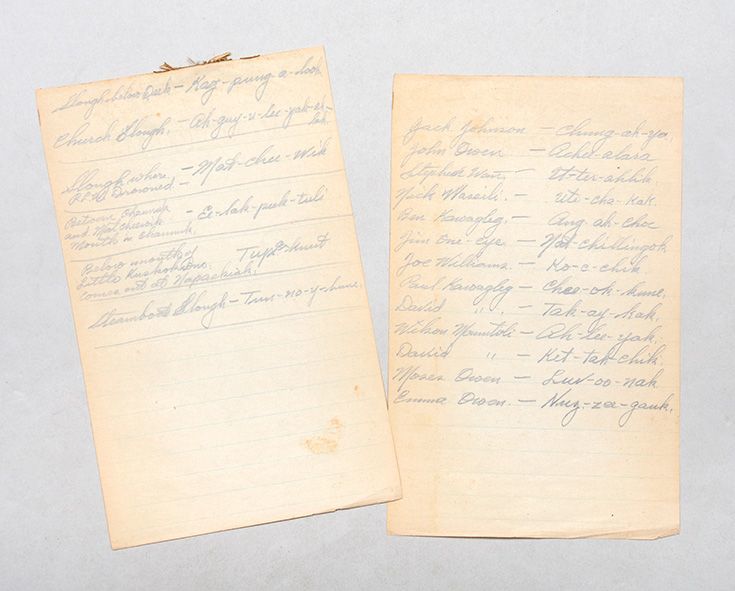
Alaska: , early 1900s. Alaskan lexicography An extensive manuscript dictionary of Central Alaskan Yup'ik, one of the languages in the Yupik family spoken along the coast of southwestern Alaska and its major river systems, including the Kuskokwim. It proves a valuable source of a language that has been under threat since the Alaska Purchase. The entries are mainly weekdays, numerals, animals, family members, and tools. Some have their practical use explained, like "Kah-nuk-um-yuk", a "respirator (used as a plug in the mouth while taking a bath to prevent the inhaling of smoke)". Simple phrases are also included, such as "Umchi-kee-kee" ("Hurry up"), "Ketozit-yucht-toon" ("what is your native name"), "Oh-mee-nak-wa" ("Oh my!"), "Nut-tmon-iyaka-dot-cheet" ("what are you going to do?"). Two sheets are loosely inserted, comprising 13 names and 6 placenames with their Central Alaskan Yup'ik equivalents. Listed is Jim One-Eye as "Nat-Cillingok" and Church Slough, a branch of the Kuskokwim River, is "Ah-guy-u-lu-yak-al-lak". There is little to indicate a date, however, under the word "Kah-ko-tuk", the compiler refers to the Eighteenth Annual Report of the Bureau of American Ethnology to the Secretary of the Smithsonian Institution, published in 1899. Additionally, the loose sheets are watermarked "Eastern Writing", a brand issued by the American Colortype Company of Chicago, in business during the first decades of the 20th century. This dictionary was likely compiled by a Moravian missionary "recognizing the importance of communicating with the people in their own Yup'ik language" (Henkelman, p. 75). It might also be by the American ethnologist Edward William Nelson (1855-1934), who published the paper "The Eskimo About Bering Strait" in the abovementioned Eighteenth Annual Report. Nelson's seminal work remains the richest source of information on the 19th-century Yupik. The first written record of Central Alaskan Yup'ik was made during Captain Cook's third expedition (1776-80). Following the explorers missionaries recorded the indigenous languages, though mainly for disseminating religious literature. The Moravian Protestants were particularly avid translators, creating orthographies using the Roman alphabet. Phonemic orthographies were not developed until the mid-twentieth century. Central Alaskan Yup'ik is a polysynthetic language, using suffixation as the primary means for word formation. It is part of the Eskaleut language family, spoken across the North American continent and northeastern Asia. Eskaleut is divided into two branches, Aleut and Eskimoan, with the latter subdivided into Yupik and Inuit. Yupik is then comprised of four distinct languages - Central Alaskan Yup'ik, Alutiiq, Siberian Yupik, and Sirenikski (now extinct). Indigenous Alaskan languages have been under threat since the Alaska Purchase in 1867 from American assimilation policies. Commercial developments from the 1890s brought large influxes of people and destructive effects of epidemics. In the same period, church missions opened schools for indigenous Alaskans, opposing native languages in education. Today the languages are "suffering from an accelerated decline in vitality under ever-increasing pressure from English, especially since the advent of bilingual education in 1970 and the introduction of television to rural Alaska in the 1980s" (Miyaoka, p. 5). Octavo (218 x 135 mm). Contemporary greyish-brown cloth, 24 ff. lined paper with manuscript annotations, largely recto only, alphabetized tab index; 2 ff. ruled sheets with manuscript annotations loosely inserted. Spine sunned, a little rubbed, minor toning. A very good copy. Dirmid R. F. Collis (ed.), Arctic Languages: An Awakening, 1990; James Henkelman, "The Development of the Alaska Moravian Church 1885-1985", Transactions of the Moravian Historical Society, vol. 24, 1986, pp. 71-82; Osahito Miyaoka, A Grammar of Central Alaskan Yu'pik, 2012.

Offered by Peter Harrington

Peter Harrington
Specializing in Children's Books, Fine Bindings And Sets, First Editions Of English, American Literature, Landmarks In Science, Philosophy And The History Of Ideas, Modern art and photobooks, Natural History And Colour-Plate Books, Original Artwork and Travel, Voyages And Atlases.
Peter Harrington is one of the most respected and dynamic names in the world of rare books, with permanent galleries in London and New York.

From its beginnings in London in 1969, the firm has built an international reputation for sourcing and selling the finest first editions, signed and inscribed books, rare manuscripts, fine bindings, and library sets. Over more than fifty years, Peter Harrington has handled thousands of significant works, from incunabula, early illuminated manuscripts, and Shakespeare folios to landmark works of science, literature, political thought, travel, philosophy, and the arts.

As a member of the Antiquarian Booksellers' Association, Peter Harrington offers an unconditional guarantee on the authenticity and completeness of each item it sells,
Contact the Seller
Pom Harrington
100 Fulham Road
Chelsea
London, London SW3 6HS
Phone/Text: +44 (0)20 7591 0220
We offer free delivery on all UK orders of rare books, maps and prints placed through this website. Delivery to USA and the rest of the world is similarly free for orders over £200. Please visit our website for full details regarding our shipping and returns policies.
tracking-