Skip to content
Have questions? Liber Antiquus is online now!
Virtual Book Fair Exclusive

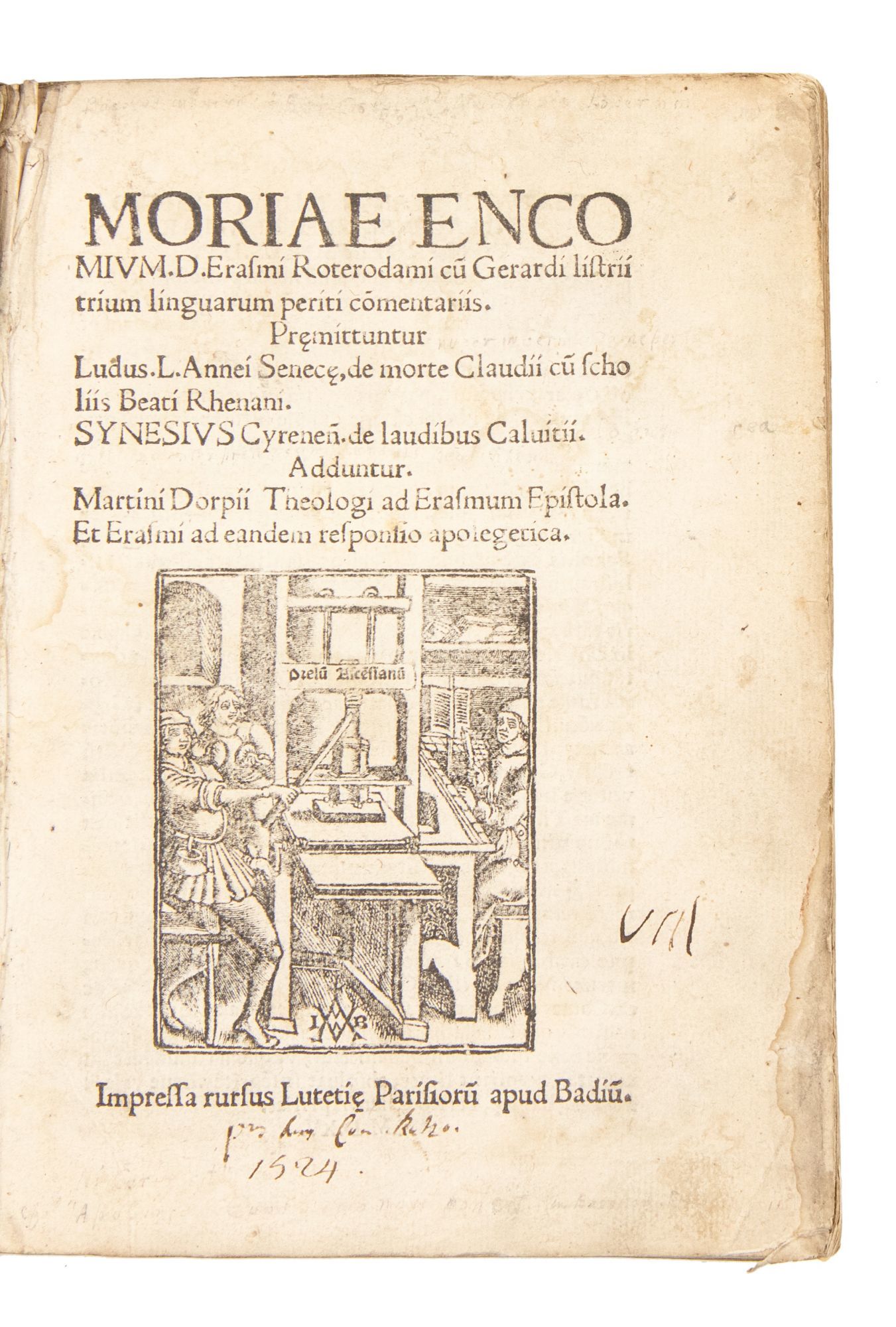
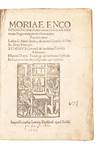
Moriae encomium D. Erasmi Roterodami cu[m] Gerardi Listrii trium linguarum periti commentariis. Praemittuntur Ludus L. Annei Senec[ae], de morte Claudii, cu[m] scholiis Beati Rhenani. Synesius Cyrenen[sis] de Laudibus caluitii. Adduntur Martini Dorpii theologi ad Erasmum epistola et Erasmi ad eandem responsio apologetica

Erasmus, Desiderius (ca. 1466-1536)

$12,500
Offered by Liber Antiquus
  • Condition: Fine
  • Edition: THE 1524 BADIUS ASCENSIUS EDITION. Written in 1509 as a visitor'
  • Binding: Hardcover
  • Publisher: Jodocus Badius Ascensius
  • Location: Paris
  • Date: 1524
  • Seller SKU: 2455
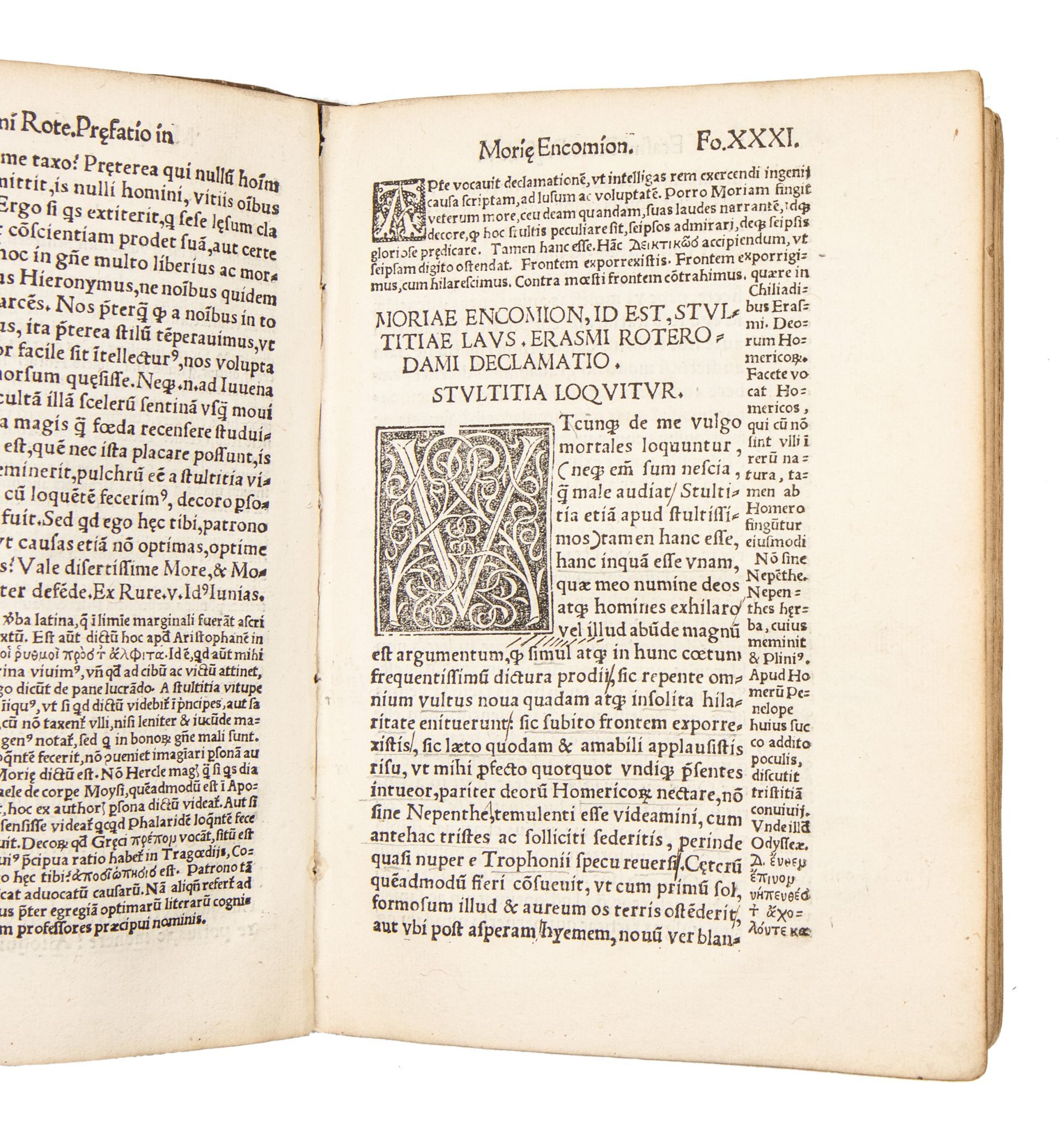
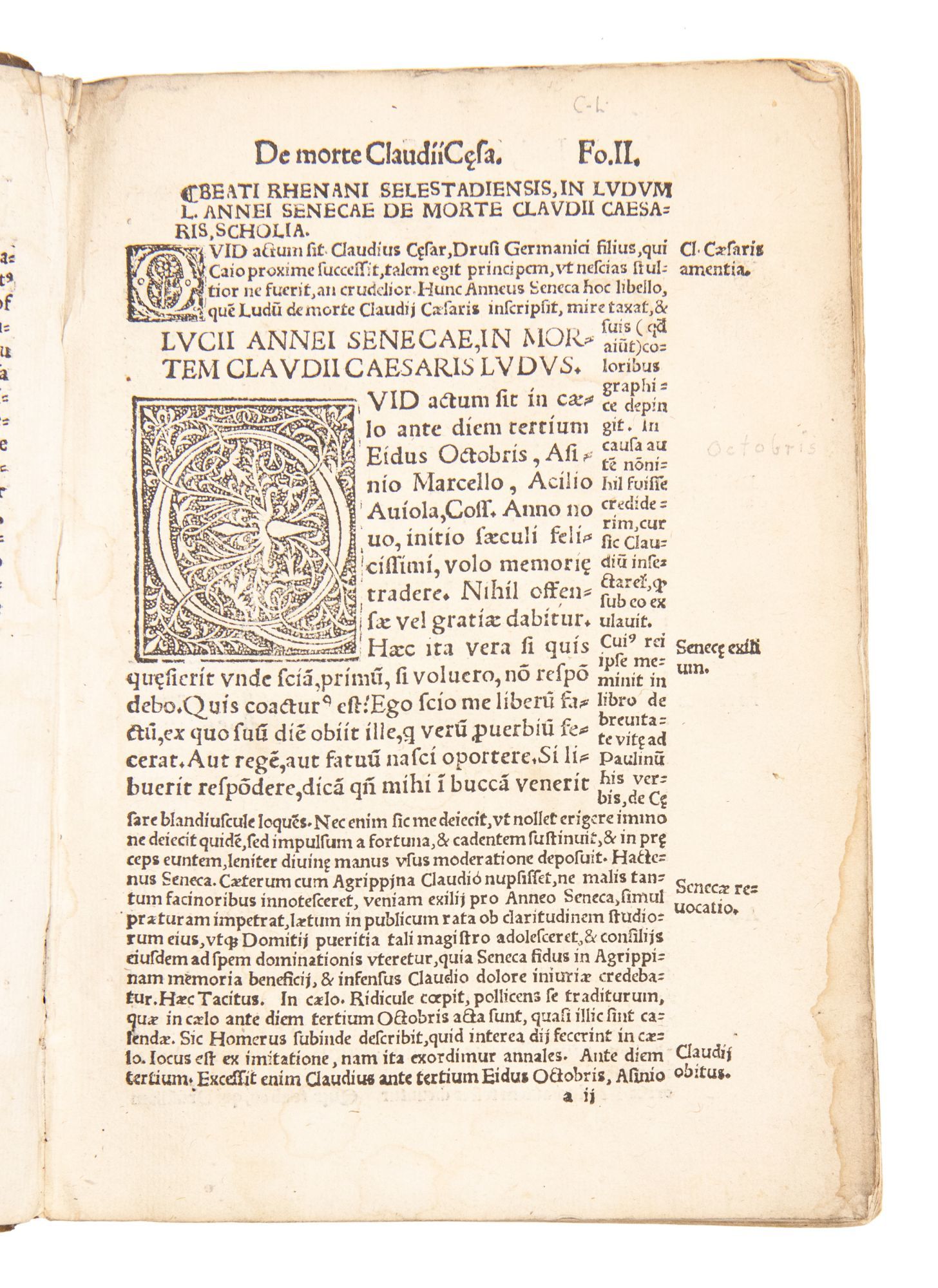
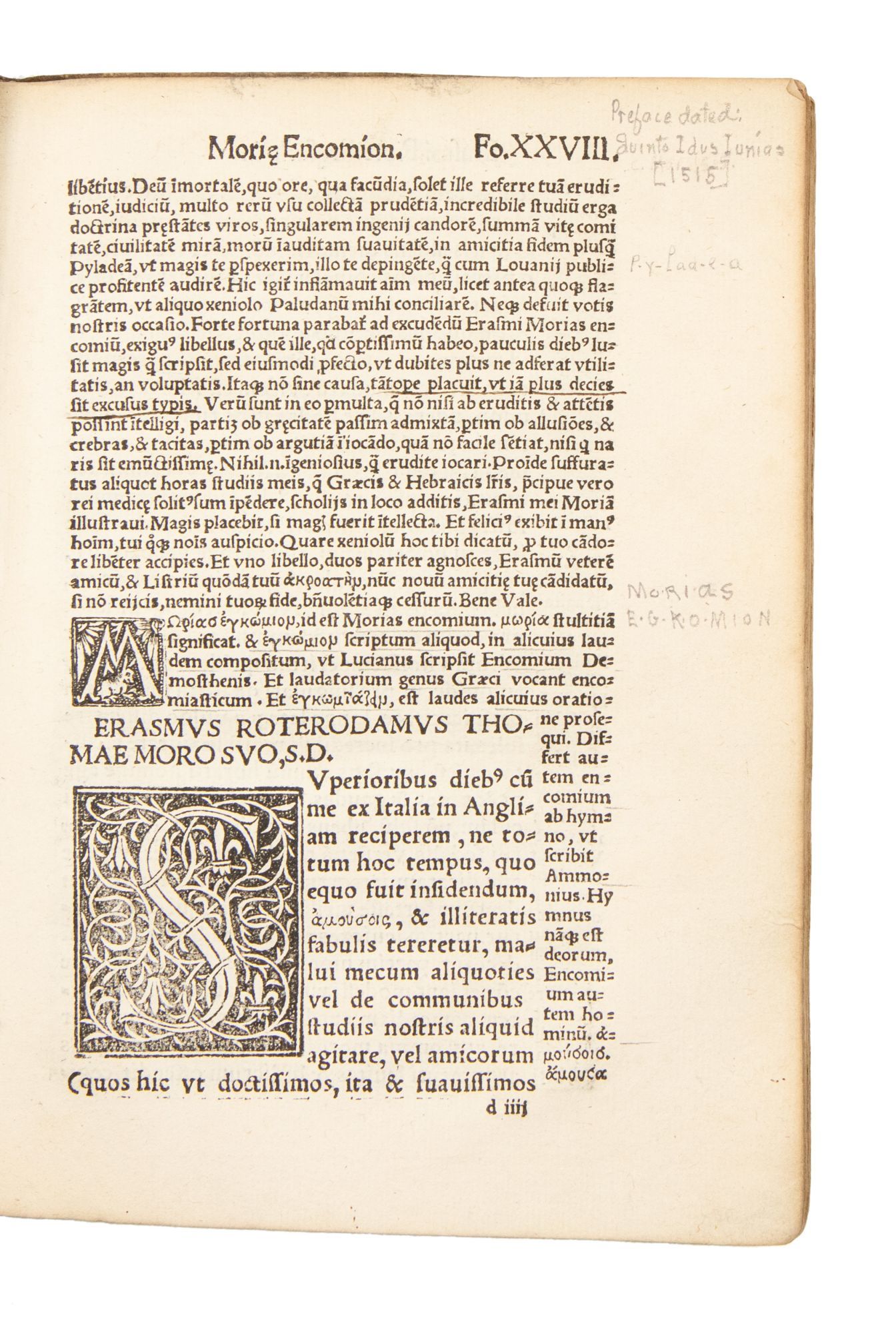
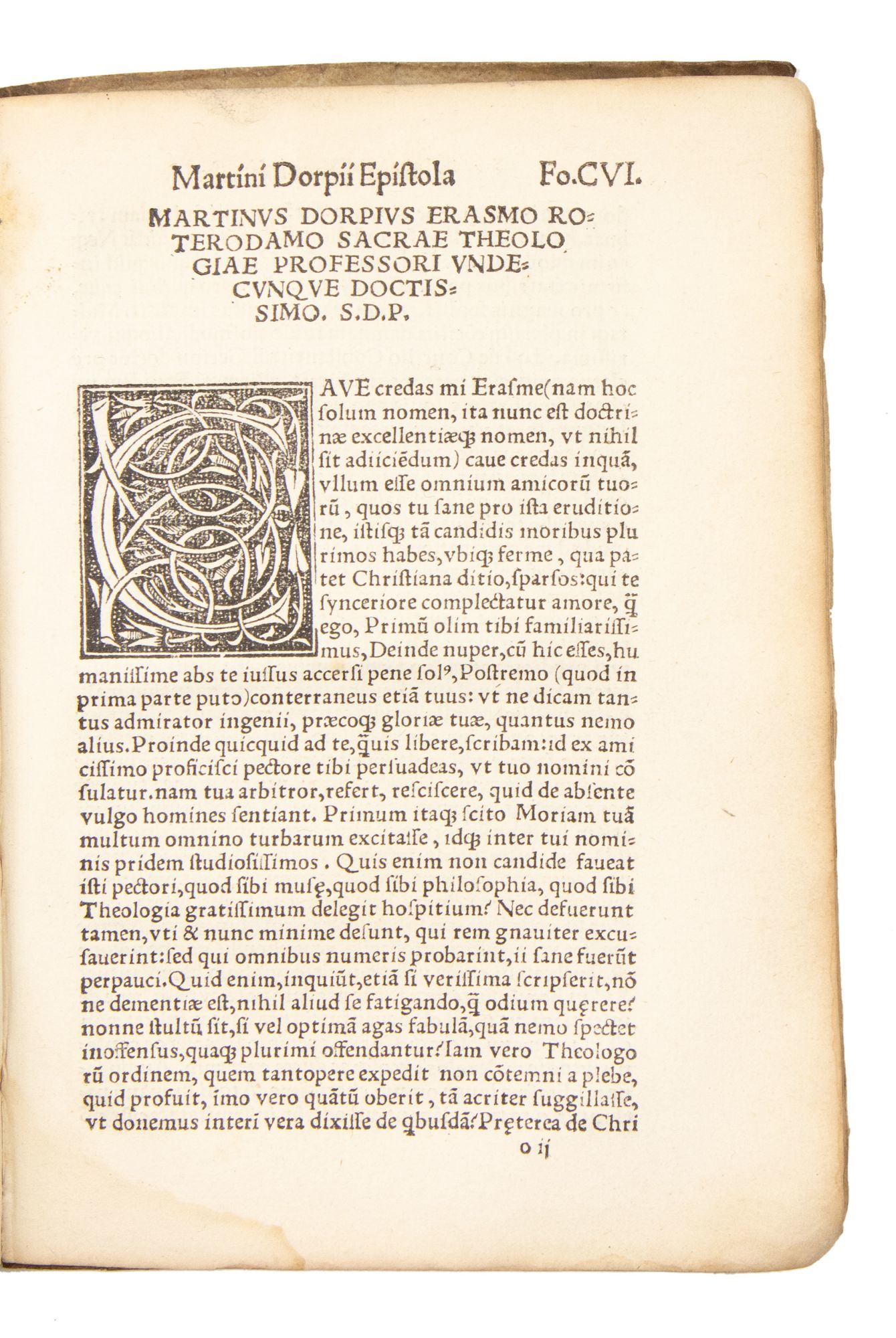
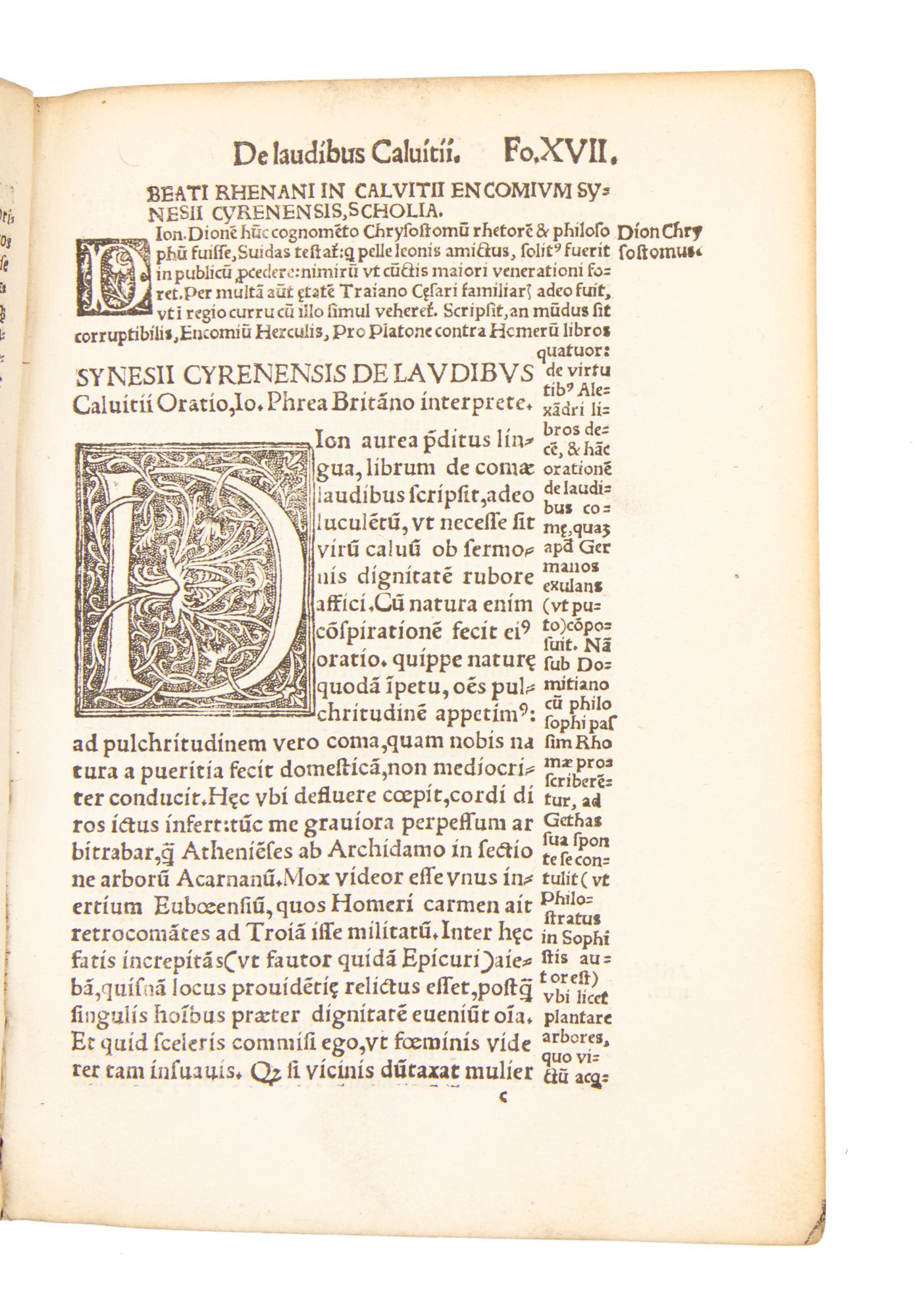
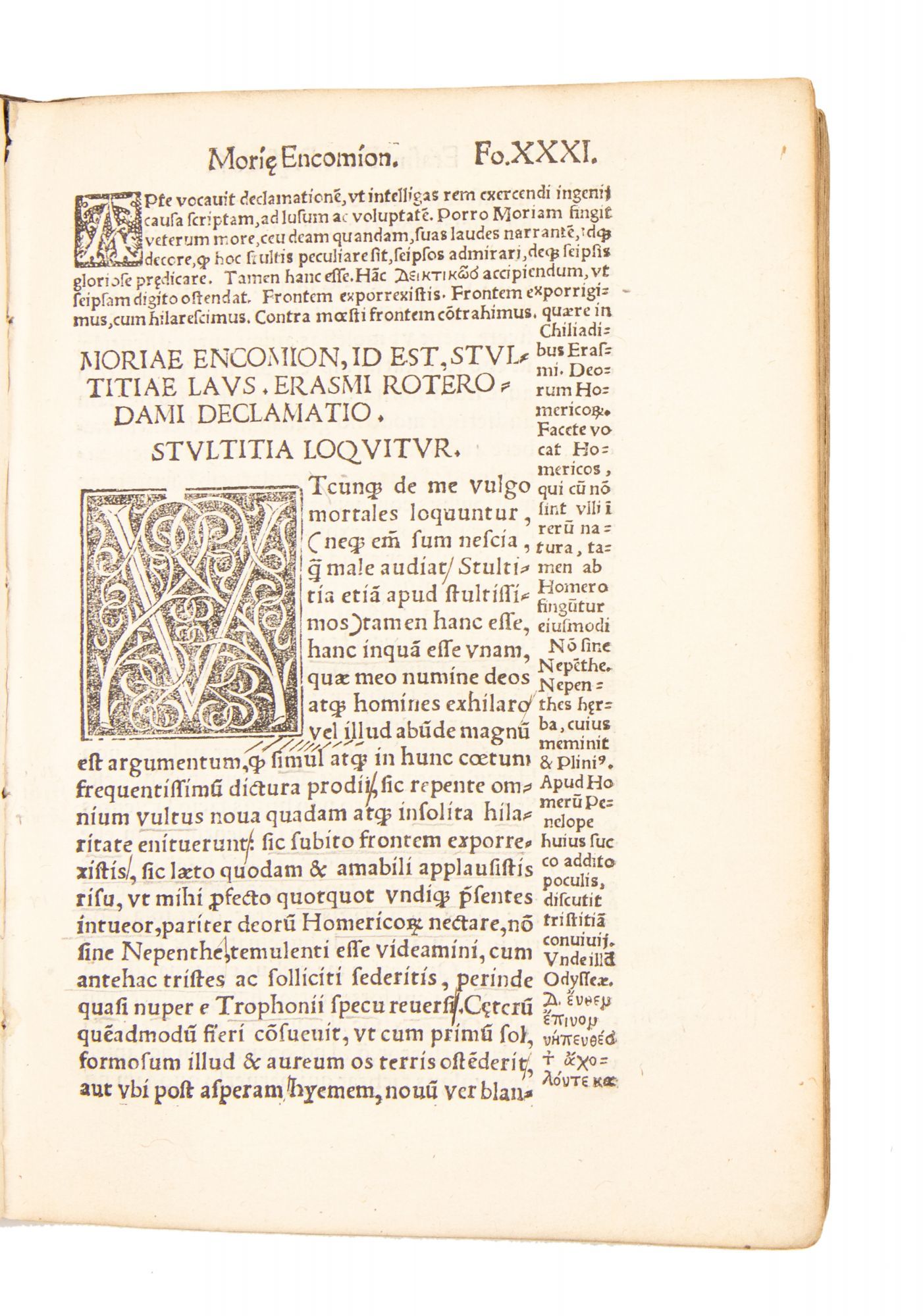
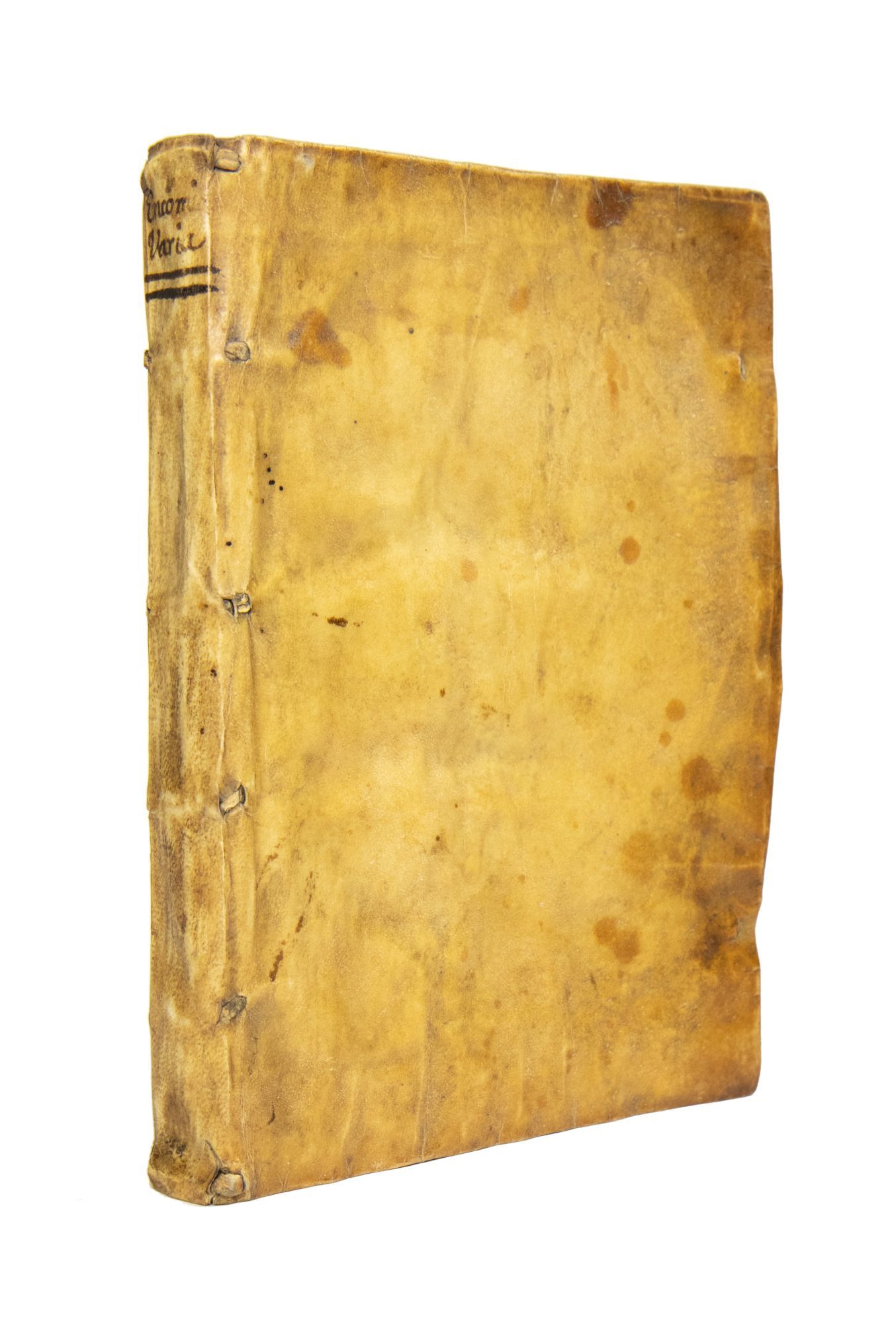
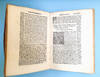
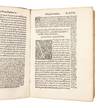
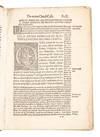
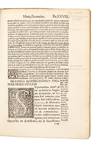
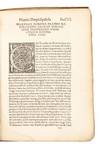
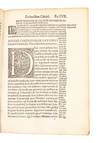
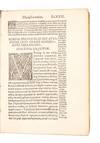
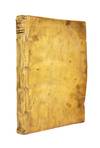
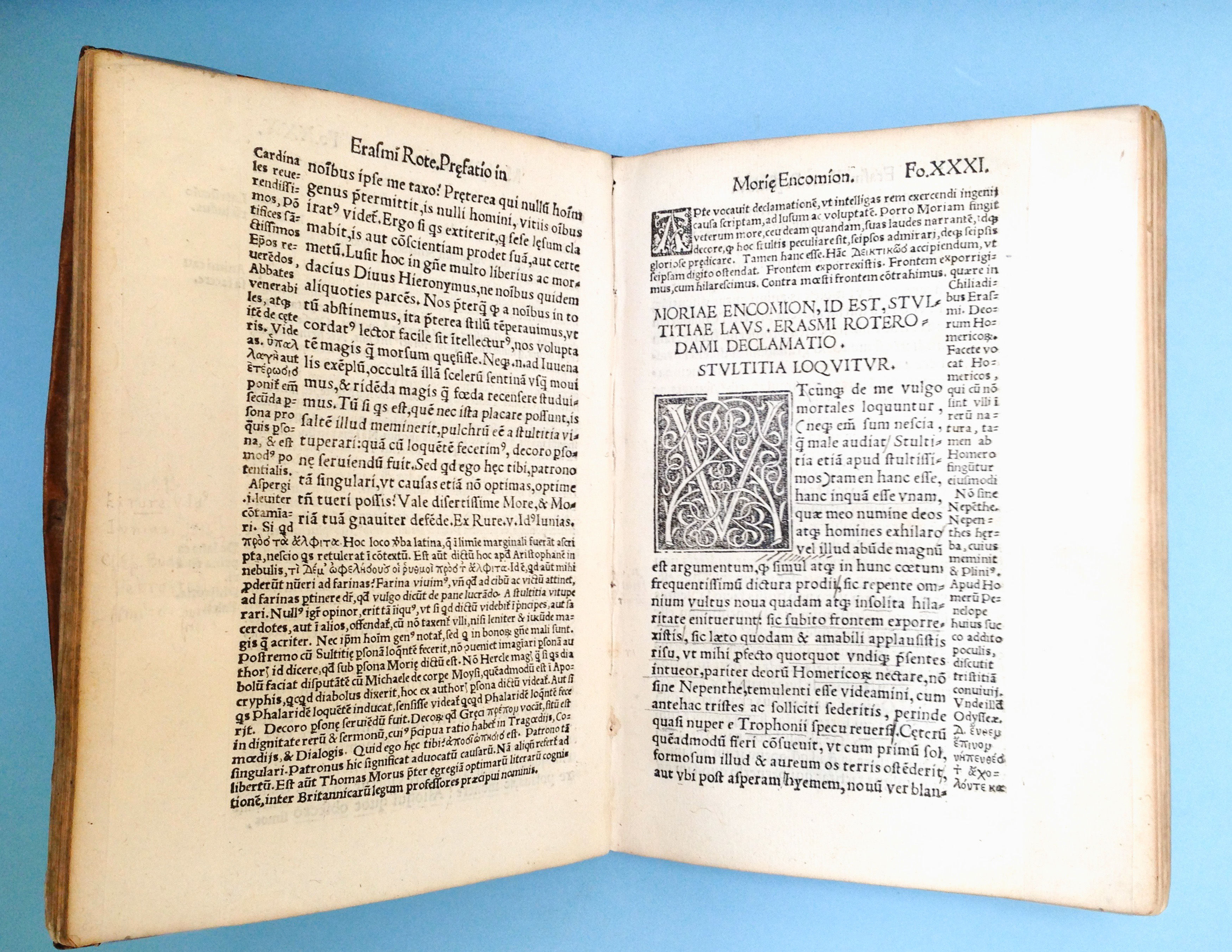
Paris: Jodocus Badius Ascensius, 1524. THE 1524 BADIUS ASCENSIUS EDITION. Written in 1509 as a visitor's gift to Thomas More, whose name -Morus- was so aptly similar to the Greek "moros," folly, the "Moriae Encomium" was first printed by Gilles de Gourmont at Paris, probably in 1511. Hardcover. Fine. Bound in contemporary limp vellum, lightly soiled. The contents are in very good condition with a few pencil annotations and light soiling to the title page. With Badius' device of his print shop, the “Praelum Ascensianum” showing printers working a press, on the title page. With large, attractive crible initials, and smaller, charming historiated initials. Passages in Greek. A fine, unsophisticated copy of this rare edition. From the personal library of Bob and Emily De Graaf. The rare 1524 Parisian “Praise of Folly”, printed by Erasmus’ friend, the scholar-printer Badius Ascensius, who printed the first authorized edition in 1512. This edition contains all of the supplementary texts found in the Froben edition of 1519 (see the note “additional Moria texts” below), including the dedicatory letter to Thomas More and the letter to Martin Dorp in which Erasmus explains his motives for writing the “Moria”:

“My aim in the ‘Folly’ was exactly the same as in my other works. Only the presentation was different. In the ‘Enchiridion’ I simply outlined the pattern of a Christian life. In my little book, the ‘Education of a Christian Prince’, I offered plain advice on how to instruct a prince. In my ‘Panegyric’ I did the same under the veil of eulogy as I had done elsewhere explicitly. And in the ‘Folly’ I expressed the same ideas as in the ‘Enchiridion’, but in the form of a joke.”

“The ‘Praise of Folly’ is Erasmus’ most famous and controversial work… In Erasmus’ lifetime, the ‘Moria’ was condemned in 1527 by the theologians of Paris for its attacks on faith and morality and again in 1533 by the Franciscans, who found it full of heresies. The officials of the Sorbonne put it on the list of condemned books in 1542 and 1543, a list that was the basis of the Tridentine Index of 1564…

“The ‘Moria’ may start as a learned joke to amuse a fellow humanist [Thomas More] but it moves into sharp criticism of contemporary mores, and ends with a plea for a return to the Christianity of the Gospels… Erasmus writes in a Lucianic spirit of irreverent burlesque of the gods of classical mythology and light-hearted amusement at the irrationality of mankind. Folly argues that she is all that is natural, youthful, fecund, and happy, and that life would be intolerable if it were not ruled by civilized conventions, which necessitate a degree of humbug and illusion. By contrast, the Stoic ideal, rational man is a ‘kind of marble statue of a man, devoid of sense and any sort of human feeling.’ She [then] shifts her viewpoint and lists the people who enjoy her benefits insofar as they try to preserve their illusions or are happy in their ignorance, self-deception, or self-love. She even adds superstitious piety to alchemy, gambling, and the nobility’s obsession with hunting and extravagant building…

“[Next] Erasmus starts to deliver a sharp and often bitter attack on all the victims of blind folly, those who are deaf to the voice of true religion and lacking the gentler Christian virtues, among whom are sycophants, self-seekers, money-makers, pedants, scholastics, lawyers, theologians, superstitious worshippers of images and relics, courtiers and kings, worldly monks, and irreligious pontiffs. This section culminates in a savage thrust at Pope Julius II, the bellicose pope. The keen wit and ingenuity of the satire can be highly entertaining, but there is no note of gaiety now. As Erasmus surveys the gulf between the Church and the ‘true philosophy of Christ’ he moves into the final section, where the alternative offered to barren scholasticism is the vision of reality taken from Plato, and folly in the sense used by Saint Paul, that of receptivity to the Christian message by the ‘fool in Christ.’ All irony is dropped, until the final short epilogue when Folly light-heartedly cuts short her ‘hotch-potch of words’; this is a direct and simply worded account of Erasmus’ personal belief, moving into an exposition of the Neoplatonist concept that the soul’s ascent to beatitude ends in ecstasy, a form of folly which is its supreme fulfillment.”(Betty Radice, Collected Works of Erasmus, Vol. 27, pp. 78 ff.)

Additional Moria Texts:

In addition to Erasmus' main text, this edition includes two ancient examples of the mock-encomium, Seneca's "Ludus de Morte Claudii Caesaris" and Synesius of Cyrene's "De Laudibus Calvitii" ("In Praise of Baldness"), translated from the Greek by the Englishman John Phreas (d. 1465). In his introductory letter to Thomas More, Erasmus cites both the "Ludus" and the "Praise of Baldness" in a pre-emptive defense against those who will object to his literary frivolity, "levitas et ludicrum argumenti" (pp. 102-104 in this edition). The text of the "Moria" is accompanied by the commentary of Gerard Listrius, with assistance from Erasmus.

Offered by Liber Antiquus

Liber Antiquus
Specializing in Architecture And Art, Astronomy, English Literature, Incunabula, Jesuit, Natural History, Reformation, Science and Voyages And Travel.
Welcome. For the past 24 years, I have been selling printed books from the dawn of printing to the Early Modern Period. I also sell manuscripts from the Middle Ages to the Enlightenment.

I am extremely proud to offer these books to both institutional and private clients worldwide. I take great pride in my work and I sincerely appreciate my clients' patronage. It is a dream job, a great honor, and a tremendous pleasure.

If you should find yourself in the Washington DC area, please call me to schedule an appointment. I can be contacted directly at 202-907-7429 or by email at [email protected]

I look forward to hearing from you.

Sincerely,

Paul M. Dowling
Liber Antiquus, Early Books & Manuscripts
Contact the Seller
Paul Dowling
7306 Brennon Lane
Chevy Chase, Maryland 20815
Phone/Text: (202) 907-7429
Items are shipped by FEDEX 2nd Day or Overnight, based on your preference. Institutions are billed net 30 or by individual arrangement, based on your budget and fiscal year restrictions. Please do not hesitate to ask for accommodations. All books may be returned, arriving in the condition in which they were sent, within 7 business days if found wanting.
tracking-