- Condition: Fine
- Edition: FIRST EDITION
- Binding: Hardcover
- Publisher: Gabriel Giolito de' Ferrari e fratelli
- Location: Venice
- Date: 1554
- Seller SKU: 3858
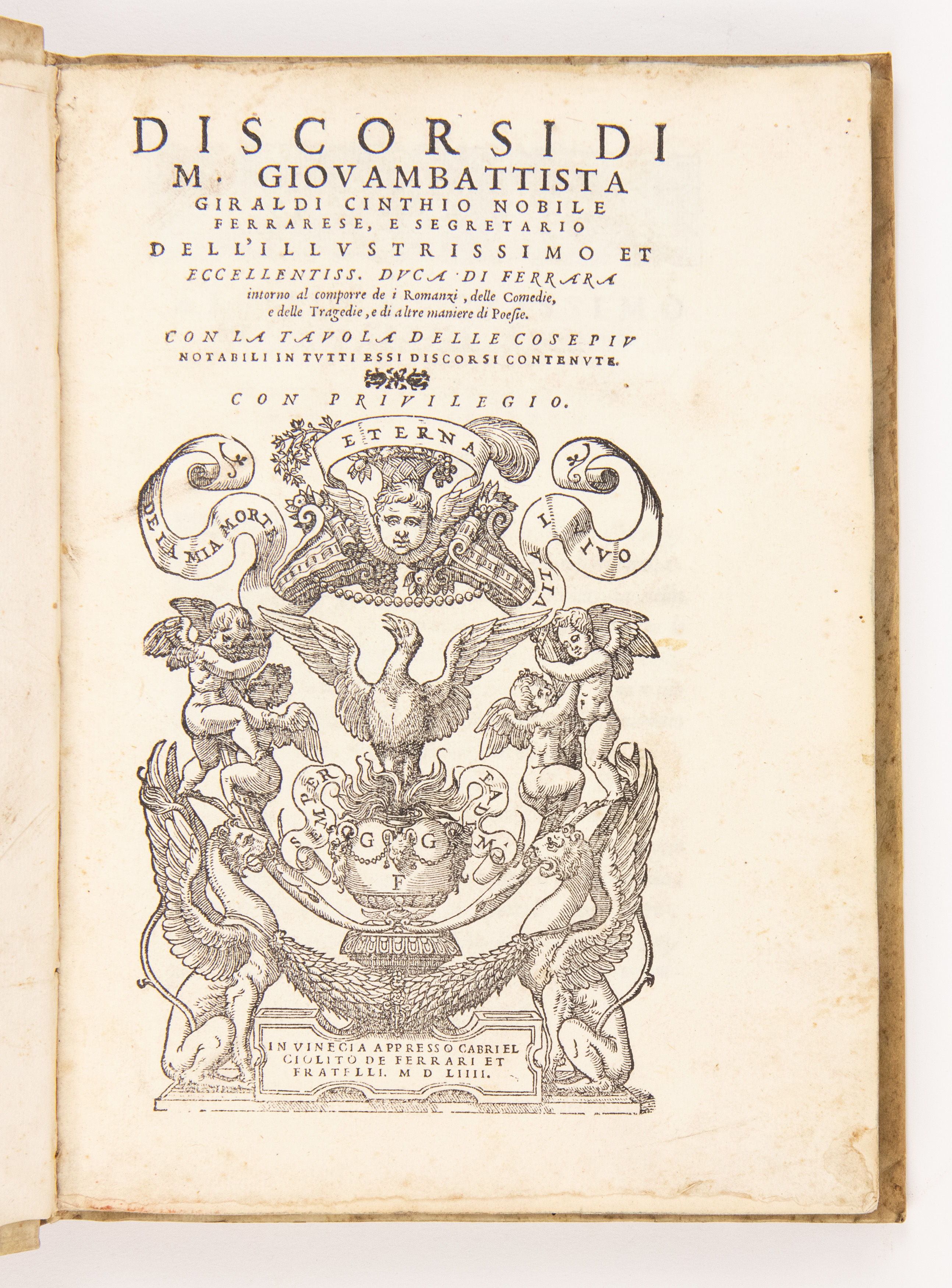
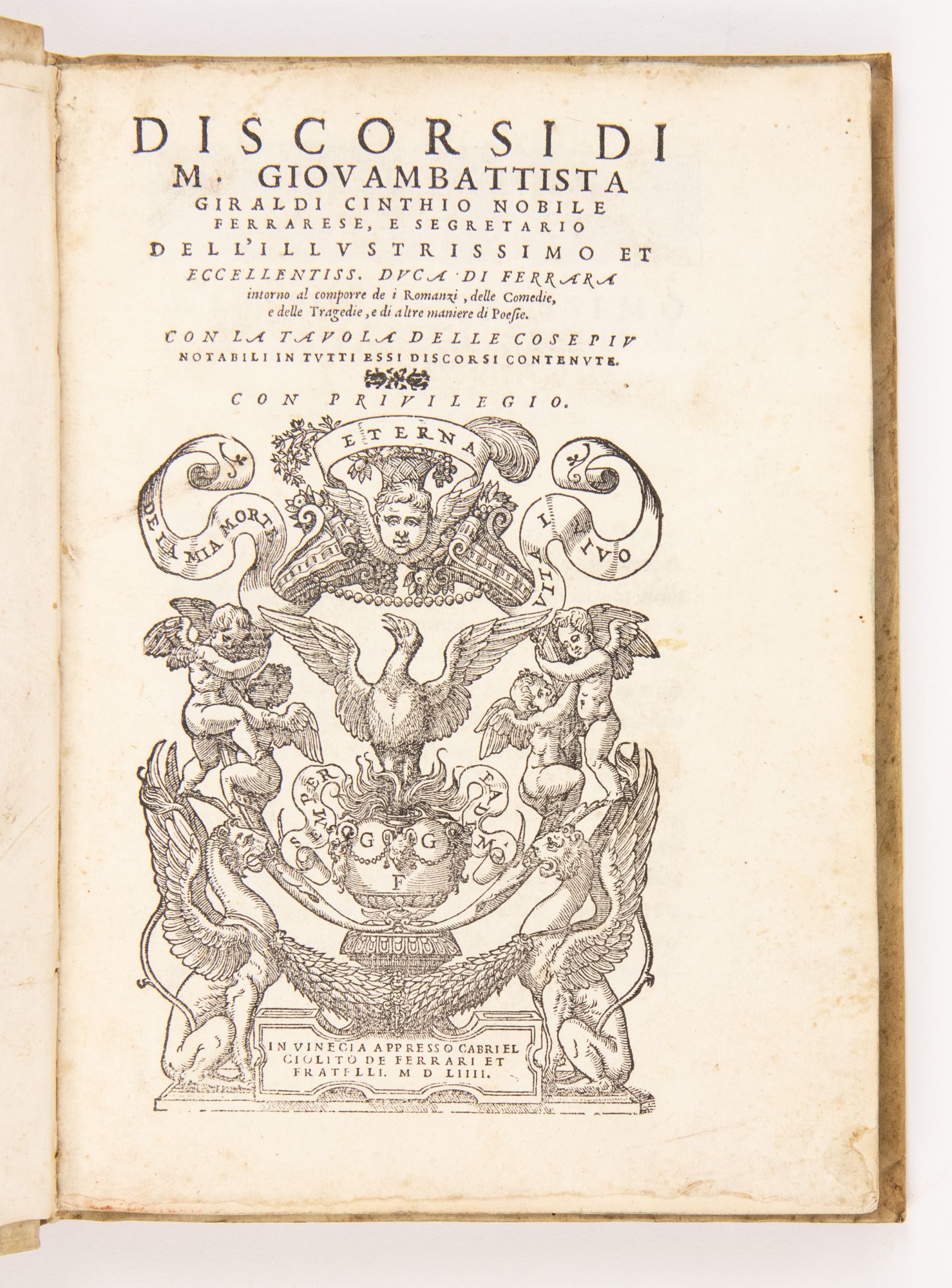
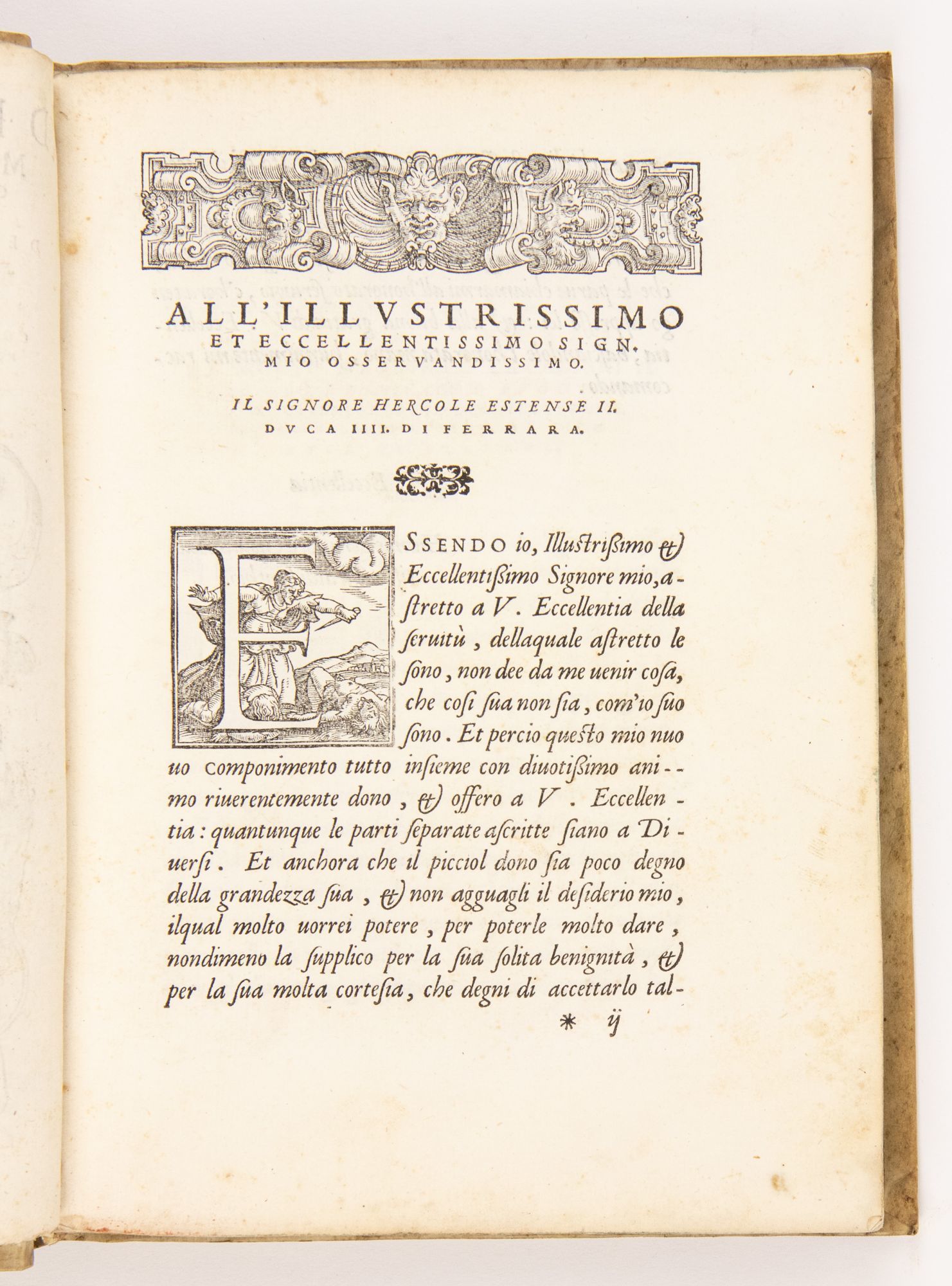
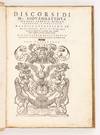
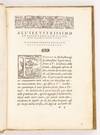
Venice: Gabriel Giolito de' Ferrari e fratelli, 1554. FIRST EDITION. Hardcover. Fine. Contemporary limp vellum, colored edges, some light marginal foxing, v. light stain on p. 80. A very nice copy with the 18th-c. engraved bookplate of Felice Durando Count of Villa (1729-1791), famous for his erudition and his famous library. With the printer's device on the title page and at the end of the volume. FIRST EDITION of Giraldi's most important contribution to literary criticism and his most lasting influence on dramatic theory and practice. Almost all the main issues in Renaissance dramatic criticism are examined somewhere in his various works and prefaces.
Giraldi rejected the Greek arrangement of plays into prologue, episodes, and choral odes and returned to the five acts of the Roman theatre. He reasoned that a good play should first present the argument, direct the argument toward its end, present obstacles to its resolution, offer a means of removing the obstacles, and end with a resolution, all arranged in five acts. In contrast to only three or four speaking parts in some Greek plays, he increased the number of actors used in a play to as many as twenty. Following Seneca, he emphasized the function of the messenger, whose arrivals and reports cause the audience to experience 'all the horror and compassion which are the pith of the plot'. Consequently, he used soliloquies freely.
In drama he preferred verse, rhymed or unrhymed, to prose and favored the separation of stylistic levels between comedy and tragedy. He believed that the proper function of tragedy was both to teach and to delight as well as to induce wonder, pity, and horror. Although he used historical plots in several of his tragedies, he was willing to expand the traditional themes of Italian tragedy to non-historical and fictitious plots; the seven plays taken from his own novelle all fall into this category. While he never used the term tragicomedy, his concept of ‘tragedia mista’ (mixed tragedy - tragedy with a happy ending) combines the goal of arousing emotions of horror and pity with the more pleasant satisfaction of seeing good characters rewarded at the end of the play for their virtue. For example, the Orbecche, his most influential work, was a Senecan horror tragedy dealing with Sulmone, king of Persia, and his daughter, Orbecche. It presented both Orbecche's murder of her father and her subsequent suicide directly on the stage, a practice imitated in scores of gory scenes in the theatres of Renaissance Italy, France, and England.
Giraldi's treatise reflected his belief that the classical epic was not the only proper form for narrative poetry, and in it he defended Ariosto's Orlando Furioso against its detractors. In such matters, he stands on the side of progressive critics in the early literary quarrels that came to be known as the "Battle of the Books" between the ancients and the moderns. Thus, while he admits the necessity of poetic unity, he denies that it is only of the kind Aristotle observed in Homer. In effect, he defines the poem of Ariosto as evolving from a different source (the romanzi) than its classical antecedents, although he believed that all forms of the epic, both ancient and modern, belonged to the same genre.
The grounds of Giraldi's defence are twofold. In the first place Giraldi maintains that the romance is a poetic form of which Aristotle did not known, and therefore do not apply; and in the second place, Tuscan literature, differing as it does from the literature of Greece in language, in spirit, and in religious feeling, need not and indeed ought not to follow the rules of Greek literature, but rather the laws of its own development and its own traditions (cf. P. Osborn, G.B. Giraldi Cinthio's dramatic theory and stage practice: a creative interaction, in: ''Scenery, Set, and Staging in the Italian Renaissance: Studies in the Practice of Theatre'', Lewiston, NY, 1996, pp. 39-58).
“The first sketch of a theory of acting was not to originate from the professional comic actors but in the academy, where in the mid-sixteenth century debate was developing on Aristotle’s Poetics and attempts to fix the rules of composition for literary works were multiplying. In 1554 there appeared the Discorsi... by Giambattista Giraldi Cintio, an eminent intellectual and the author of various tragedies, who held a prominent position in Ercole II d’Este’s court at Ferrara” (C. Vicentini, Theory of Acting III. The Early Italian Tratises and the Theoretical Acting Model, in: “Acting Archives Essays, AAR Supplement 3, April 2011, p.1)
Giovanni Battista Giraldi, surnamed Cinzio, was born at Ferrara and educated at the university of his native city. He became professor of natural philosophy in 1525 and, twelve years later, succeeded Celio Calcagnini in the chair of rhetoric. He also acted as private secretary to Ercole II and Alfonso II d'Este. Apart from his tragedies, he is mainly remembered for his prose work Hecatomithi, a collection of tales in the manner of Boccaccio and Bandello, which, directly or indirectly furnished the plot for several of Shakespeare's plays (cf. R. Bruscagli, B.G. Giraldi: comico, satirico, tragico, in: ''Il teatro italiano del Rinascimento'', Milano, 1980, pp. 261-283).